
Chef Juliette
Apricots (Abricots)
Apricots peeled clean and poached just to tenderness, their golden halves held in clear syrup for tarts and cold sweets: a small lesson in texture, restraint, and knowing when fruit is ready.
A cooking platform built around craft, culture, and the stories behind what we eat.
Created by Chef Juliette
Based on No. 2584, Poires à la Parisienne, from Le Guide Culinaire (1907) by Auguste Escoffier
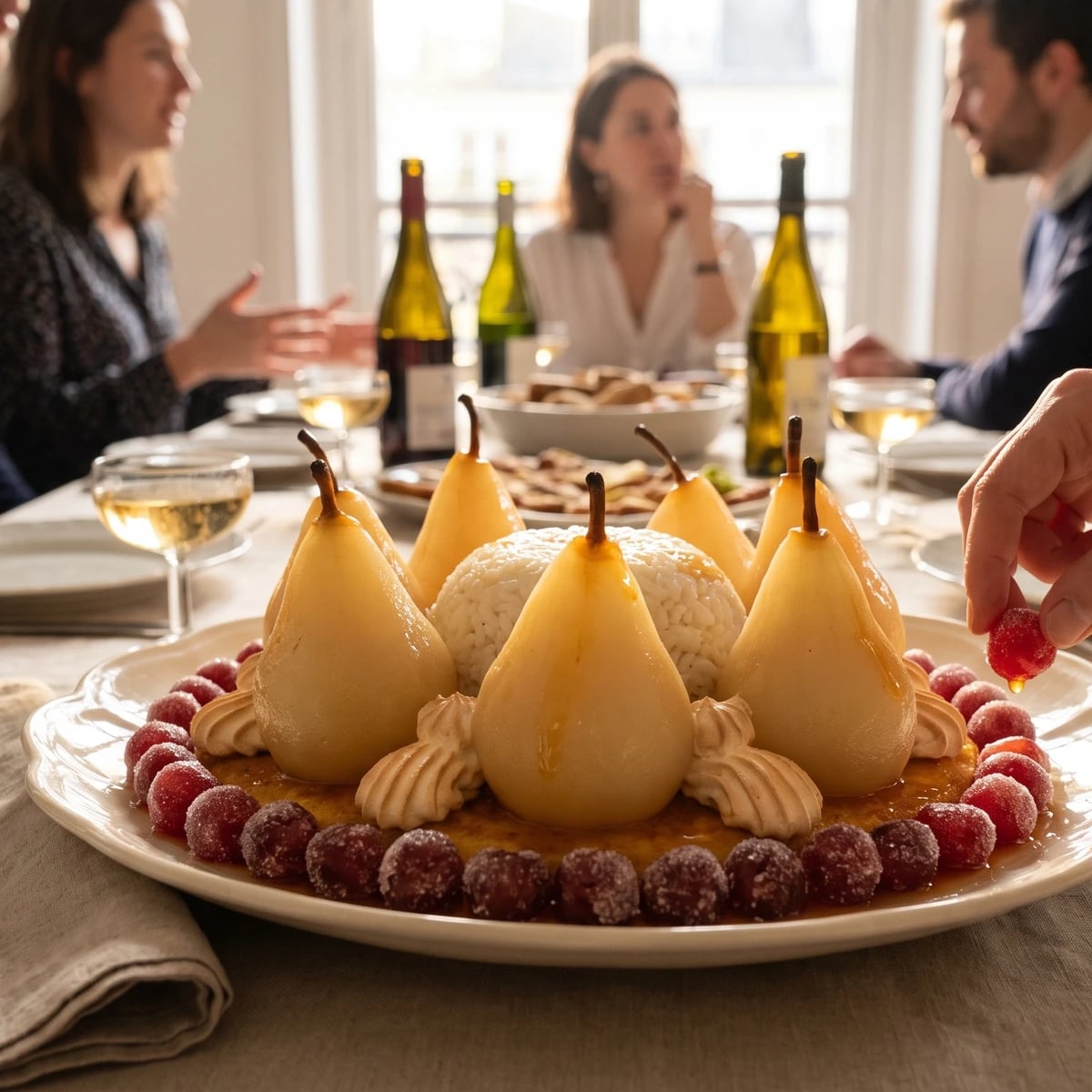
Poires à la Parisienne teaches disciplined assembly: kirsch-soaked Génoise, vanilla rice, upright syrup-poached pears, and ridged meringue, finished with apricot gloss and a ruby border of preserved cherries.
Poires à la Parisienne (pears in the Paris style) teaches the discipline of a composed entremets: each element must remain distinct, yet the fork should meet cake, rice, pear, meringue, and glaze as one dessert. The one true thing is simple. Soak the Génoise when it is almost cold. Hot cake drinks syrup past tenderness and into mush.
The original assumed a pastry room where Pâte à Génoise Fine and Ordinary Meringue waited as finished preparations, a flawn-ring set the size, preserved cherries stood on the shelf, and a mild oven could be trusted by touch. Your home equivalent is a 9-inch round, a small bowl for the rice dome, a piping bag with a star tip, and a low modern oven. Here, the architecture is scaled to six, the separate referenced preparations remain intact, and half-sugared cherries become their honest pantry equivalent, cherries preserved in light syrup. The brigade's bulk is scaffolding and can go. The almost-cold soak, upright pears, piped meringue, and apricot gloss are the dish, so they stay.
Done properly, pale pears rise around an ivory dome, meringue ridges take a quiet gold, and the apricot glaze catches the light above a ruby cherry border. One cook, one stove, one evening. Before you touch a pan, leave enough cooling time for the Génoise to reach that almost-cold moment, because that is where Poires à la Parisienne is won.
Poires à la Parisienne belongs to the Parisian repertory of composed entremets, where pastry kitchens arranged familiar preparations into architectural desserts for formal dining rooms and bourgeois celebration tables. The name does not point to a pear variety or an orchard around Paris; à la Parisienne describes the polished composition of Génoise, rice, poached fruit, meringue, glaze, and preserved cherries. It traveled into home kitchens through those components, all ordinary enough alone, being prepared in smaller batches and assembled on one serving dish.
Quantity
1 prepared 9-inch (23 cm) round Pâte à Génoise Fine (No. 2376), about 1 inch (2.5 cm) thick
cooled until almost cold
Quantity
6 (about 1 3/4 pounds / 800 g total)
peeled with stems intact
Quantity
4 cups (960 ml / 960 g)
Quantity
2 cups (480 ml / 400 g)
Quantity
1/3 cup (80 ml / 65 g)
Quantity
1 1/2 cups (360 ml / 370 g)
Quantity
1/2 bean
split lengthwise and scraped
Quantity
1/4 cup (60 ml / 50 g)
Quantity
1 tablespoon (15 ml / 14 g)
divided between the rice and its mold
Quantity
1/8 teaspoon (0.6 ml / 0.7 g)
Quantity
1/3 cup (80 ml / 80 g)
Quantity
1/3 cup (80 ml / 67 g)
Quantity
1/4 cup (60 ml / 57 g)
Quantity
1 1/2 cups (360 ml / 180 g) prepared Ordinary Meringue (No. 2382)
Quantity
1/3 cup (80 ml / 105 g)
strained
Quantity
2 tablespoons (30 ml / 30 g)
Quantity
18 (about 4 ounces / 115 g)
drained and patted dry
| Ingredient | Quantity |
|---|---|
| Pâte à Génoise Finecooled until almost cold | 1 prepared 9-inch (23 cm) round Pâte à Génoise Fine (No. 2376), about 1 inch (2.5 cm) thick |
| small firm-ripe pears, preferably Forelle or small Boscpeeled with stems intact | 6 (about 1 3/4 pounds / 800 g total) |
| water for poaching | 4 cups (960 ml / 960 g) |
| granulated sugar for poaching | 2 cups (480 ml / 400 g) |
| short-grain white rice | 1/3 cup (80 ml / 65 g) |
| whole milk | 1 1/2 cups (360 ml / 370 g) |
| vanilla beansplit lengthwise and scraped | 1/2 bean |
| granulated sugar for the rice | 1/4 cup (60 ml / 50 g) |
| unsalted butterdivided between the rice and its mold | 1 tablespoon (15 ml / 14 g) |
| fine salt | 1/8 teaspoon (0.6 ml / 0.7 g) |
| water for the kirsch syrup | 1/3 cup (80 ml / 80 g) |
| granulated sugar for the kirsch syrup | 1/3 cup (80 ml / 67 g) |
| kirsch | 1/4 cup (60 ml / 57 g) |
| Ordinary Meringue | 1 1/2 cups (360 ml / 180 g) prepared Ordinary Meringue (No. 2382) |
| smooth apricot preservesstrained | 1/3 cup (80 ml / 105 g) |
| reserved pear-poaching syrup | 2 tablespoons (30 ml / 30 g) |
| half-sugared cherries, or cherries preserved in light syrupdrained and patted dry | 18 (about 4 ounces / 115 g) |
Combine the poaching water and sugar in a wide saucepan, warming them just until the sugar dissolves. Lower in the peeled pears and cover them with a cartouche (parchment lid), turning them occasionally if the syrup does not fully cover them. Hold the syrup at the barest tremble for 15 to 25 minutes, until a thin skewer enters the thickest part with slight resistance. Remove each pear as it becomes tender, because small pears rarely finish together. If one begins to split, lift it out immediately and cool it in a little syrup; once dry, turn the split toward the rice dome and let the dome support it. Reserve 2 tablespoons of syrup, then leave the pears in the remaining syrup for 15 minutes before draining them thoroughly.
Reserve 2 tablespoons of the milk. Put the remaining milk, rice, vanilla seeds and pod, rice sugar, and salt in a small heavy saucepan. Bring them slowly to a simmer, then cook over very low heat for 25 to 35 minutes, stirring often, until the grains are completely tender and the mixture is thick enough for a spoon drawn across the pan to leave a clear trail. Remove the vanilla pod and stir in 2 teaspoons of butter. If the milk catches, do not scrape the pan floor. Ça se rattrape: transfer the clean upper portion to another pan, add the reserved milk, and finish it gently.
Butter a 4-inch (10 cm) hemispherical bowl with the remaining butter. Pack in the warm vanilla rice, pressing firmly enough to remove air pockets without crushing the grains. Smooth the surface, cover, and chill for about 30 minutes, until the rice holds its shape but has not hardened.
Bring the kirsch-syrup water and sugar to a boil, stirring only until the sugar dissolves. Boil for 1 minute, then remove the pan from the heat. Let the syrup cool until barely warm before stirring in the kirsch, which keeps its clean cherry perfume instead of sending it up the chimney.
Set the almost-cold Pâte à Génoise Fine (No. 2376) on a flat ovenproof platter or removable tart-tin base. Brush the kirsch syrup over it in three or four passes, pausing a minute between each so the liquid travels through the crumb instead of collecting on top. Saturate it evenly, including the rim, but never pour the syrup on at once. Hot Génoise drinks syrup to mush. If the surface begins to pool or sag, stop, touch the puddle with the edge of a folded paper towel, and chill the base uncovered for 10 minutes before continuing more cautiously.
Heat the oven to 300°F (150°C). Unmold the vanilla rice in the center of the soaked Génoise. If it clings, wrap the bowl briefly in a warm towel, invert it again, and lift straight upward. Pat the pears very dry, trim the thinnest possible slice from each base, and stand them in a ring around the dome with their stems upright. Nestle each pear lightly against the rice so the arrangement is stable without being crowded.
Fit a piping bag with a 1/2-inch (12 mm) open-star tip and fill it with the Ordinary Meringue (No. 2382). Pipe one continuous ridged thread around the bases of the pears, following the circle closely, then pipe a fine rosette on top of the rice dome. Keep the pear surfaces visible. If the meringue softens and loses its ridges, chill the filled bag for 5 minutes and repipe the affected section; beating it again only knocks out more air.
Bake for 12 to 18 minutes, rotating the platter once, until the meringue ridges are dry to the touch and colored a quiet biscuit-gold. Use the mild oven the dish asks for, never the broiler. If the tips darken before the rosette sets, lower the temperature to 275°F (135°C) and lay a loose sheet of parchment over the dessert.
While the dessert bakes, warm the strained apricot preserves with the reserved pear-poaching syrup until they form a smooth, rather stiff apricot syrup. If it slides from the brush like water, boil it for another 30 seconds; if it sets in the pan, loosen it with a teaspoon of syrup. Let the baked dessert stand for 5 minutes, then brush the pears generously until they gleam. Arrange the half-sugared cherries in a close border around the outer edge of the Génoise. Serve warm or at room temperature, while the meringue remains crisp at its ridges. À table!
1 serving (about 350g)
Culinary guides, cultural storytelling, and the editorial depth that makes cooking meaningful.
Discover Culinary Explorer
Chef Juliette
Apricots peeled clean and poached just to tenderness, their golden halves held in clear syrup for tarts and cold sweets: a small lesson in texture, restraint, and knowing when fruit is ready.

Chef Juliette
Abricots à la Bourdaloue teaches the discipline of colour: an ivory flawn crust, macaroon-rich frangipane, and vanilla-poached fruit, finished with one fierce flash of buttered gratin.

Chef Juliette
Firm-poached apricots, sweet entremets rice, and a fine panure à l’anglaise meet the fryer for one golden minute, then arrive crisp with warm Kirsch apricot sauce alongside.

Chef Juliette
Apricots à la Condé sets tender poached fruit on a border of distinct vanilla rice grains, then coats the whole with glossy kirsch-scented apricot syrup and bright candied fruit.