
Chef Juliette
Flan aux Carottes
A pale short-paste shell holds silken, lightly sweet carrot purée beneath neat glazed half-discs, their butter syrup catching the light: a classical tart poised between vegetable course and sweet.
A cooking platform built around craft, culture, and the stories behind what we eat.

Created by Chef Juliette
Based on No. 2550, Apricots à la Colbert, from Le Guide Culinaire (1907) by Auguste Escoffier
Firm-poached apricots, sweet entremets rice, and a fine panure à l’anglaise meet the fryer for one golden minute, then arrive crisp with warm Kirsch apricot sauce alongside.
Abricots à la Colbert (poached apricots rebuilt around sweet entremets rice, crumbed and fried) teaches one uncompromising lesson: firm fruit is structure. The apricot must leave its syrup a shade firmer than you would serve it alone, because the rice, coating, and hot fat will ask more of it. Let it soften fully and the parcel slumps before the crust can set.
The classical entry doesn't lean on a saucier, a stock never off the fire, or a salamander. Its brigade assumption is the pastry equivalent: Rice Preparation for Entremets (No. 2404) cold in quantity, Anglaise (for Egg-and-bread-crumbing) (No. 174) ready by the bowl, and frying fat held hot for service. The home equivalent is four reconstructed fruits, a small heavy saucepan, and a thermometer, with the two cited preparations made from their own entries. One cook, one stove, one evening.
The bulk can go. The firm poach, thorough drying, cold rice, panure à l’anglaise, and last-minute fry must stay, because they are the dish. Before you touch a pan, remember the one true thing: stop poaching while the apricot still resists the spoon.
Abricots à la Colbert belongs to the Parisian classical repertoire of sweet entremets, not to a regional farmhouse table. The Colbert title reflects the canon's habit of naming highly composed dishes for figures of state and court, but it does not indicate one shared Colbert sauce or garnish across every preparation. Though often filed beside fritters, this is not a batter-coated fruit: the apricot is rebuilt around sweet rice, sealed in a fine crumb crust, and accompanied by Kirsch-flavoured apricot sauce.
Quantity
5 large (about 1 lb / 450 g)
halved along their natural seams, pitted, and kept in matching pairs
Quantity
2 cups (480 ml / 480 g)
Quantity
1 cup (240 ml / 200 g)
Quantity
½ cup (120 ml / 130 g) Rice Preparation for Entremets (No. 2404)
prepared according to its own entry and chilled until firm
Quantity
½ cup (120 ml / 60 g)
Quantity
½ cup (120 ml / 120 g) Anglaise (for Egg-and-bread-crumbing) (No. 174)
prepared according to its own entry
Quantity
1½ cups (360 ml / 150 g)
Quantity
½ cup (120 ml / 160 g)
Quantity
2 tablespoons (30 ml / 28 g)
Quantity
4¼ cups (1 L / 920 g)
Quantity
4 slender pieces, about 2 inches (5 cm) each
| Ingredient | Quantity |
|---|---|
| firm-ripe apricotshalved along their natural seams, pitted, and kept in matching pairs | 5 large (about 1 lb / 450 g) |
| cold water | 2 cups (480 ml / 480 g) |
| granulated sugar | 1 cup (240 ml / 200 g) |
| Rice Preparation for Entremetsprepared according to its own entry and chilled until firm | ½ cup (120 ml / 130 g) Rice Preparation for Entremets (No. 2404) |
| all-purpose flour | ½ cup (120 ml / 60 g) |
| Anglaise for coatingprepared according to its own entry | ½ cup (120 ml / 120 g) Anglaise (for Egg-and-bread-crumbing) (No. 174) |
| very fine dry white breadcrumbs | 1½ cups (360 ml / 150 g) |
| smooth apricot preserves | ½ cup (120 ml / 160 g) |
| Kirsch | 2 tablespoons (30 ml / 28 g) |
| neutral high-heat frying oil | 4¼ cups (1 L / 920 g) |
| candied angelica | 4 slender pieces, about 2 inches (5 cm) each |
Bring the water and sugar to a boil in a wide saucepan, stirring only until the sugar dissolves. Lower the syrup to a bare tremble and slide in the apricot halves, skin-side down, without crowding them. Poach for 1 to 3 minutes, turning once, until the flesh yields slightly at the surface but still resists near the stone cavity. Lift each half out as it reaches that point and reserve the syrup. If a pair softens faster than the others, set it aside for the sauce; the four firmer pairs are the ones that belong in the fryer.
Reserve one matched pair of poached halves for the sauce. Lay the remaining eight halves cut-side down on a lint-free towel for 10 minutes, move them to a dry patch, and blot the skins and cavities carefully. Set them uncovered on a rack in the refrigerator for 20 minutes. Wet fruit sheds its flour and coating, while properly dried fruit takes a close, even crust.
Mash the reserved apricot pair through a fine sieve into a small saucepan. Add the apricot preserves and ½ cup (120 ml) of the reserved poaching syrup, then simmer gently for 4 to 6 minutes, whisking, until the sauce is smooth, glossy, and coats a spoon lightly. Pass it through the sieve once more if needed. Take it off the heat and stir in the Kirsch. If it tightens too far, loosen it with another spoonful of syrup; if it runs like juice, return it to the pan for another minute. Keep it warm, never boiling.
Divide the cold Rice Preparation for Entremets (No. 2404) among the cavities of the eight firm apricot halves, using about 1 tablespoon per half. Press each matching pair together so the rice fills the stone cavities and restores the fruit's whole oval shape. Smooth away rice that bulges beyond the seam, then chill the reconstructed apricots for 20 minutes. If a pair slides apart, the fruit is damp or the rice is too warm. Ça se rattrape: blot the seam, press it together again, and chill until the rice holds firmly.
Arrange the flour, Anglaise (for Egg-and-bread-crumbing) (No. 174), and very fine breadcrumbs in three shallow dishes. Roll each reconstructed apricot in a whisper-thin coat of flour, dip it completely in the Anglaise, let the excess fall away, then cover it closely with breadcrumbs. Press gently around the seam without flattening the fruit. Set the crumbed apricots on a dry rack and chill for 20 minutes so the panure à l’anglaise settles into a firm shell.
Heat the oil in a deep, heavy saucepan to 355°F (180°C), leaving at least 3 inches (7.5 cm) of empty space above it. Lower in one or two apricots at a time and fry for 60 to 90 seconds, turning gently, until the crumbs are evenly deep gold. Keep the oil above 347°F (175°C); cool fat soaks the coating and gives the fruit time to collapse. If a seam begins to open, lift the apricot out immediately, drain it, and cool it for 5 minutes. Patch the breach with cold rice, flour, Anglaise (for Egg-and-bread-crumbing) (No. 174), and crumbs, then chill for 15 minutes before frying it again. Drain every finished apricot on a wire rack, not flat on paper, so the underside stays crisp.
Insert one slender piece of candied angelica into the top of each apricot to imitate its stem. Arrange the fruits on a folded white napkin set over a platter, preserving the classical presentation only after the rack has done the real draining. Pour the warm Kirsch-flavoured apricot sauce into a small sauce boat and serve it separately. Bring the apricots to the table at once, while the crumb is crisp and the fruit within is warm. À table!
1 serving (about 255g)
Culinary guides, cultural storytelling, and the editorial depth that makes cooking meaningful.
Discover Culinary ExplorerChef Juliette
A pale short-paste shell holds silken, lightly sweet carrot purée beneath neat glazed half-discs, their butter syrup catching the light: a classical tart poised between vegetable course and sweet.
Chef Juliette
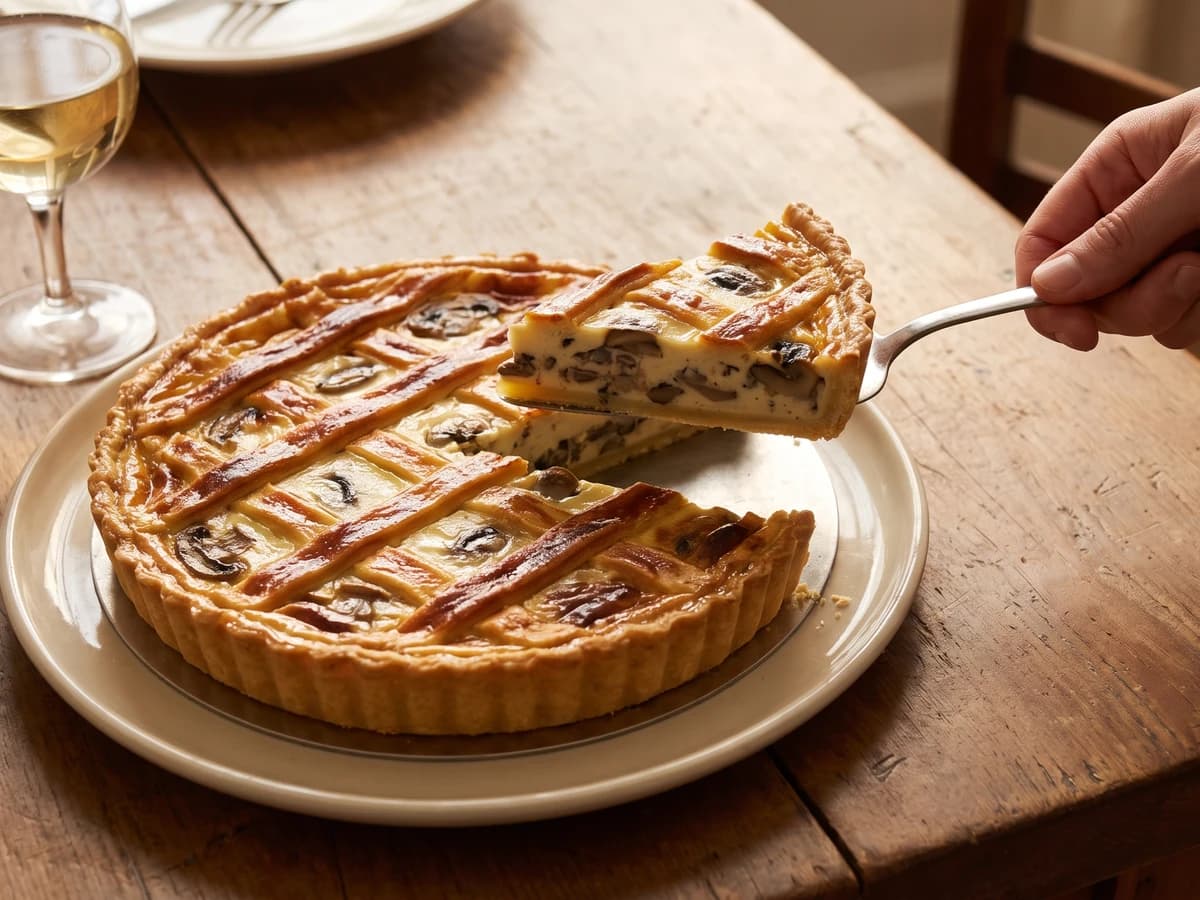
A hot mushroom flan under a butter-gold lattice, with cream reduced close around barely opened caps and a crisp short-paste base protected by one discipline: cool the filling completely.

Chef Juliette
Four little mushroom flans, latticed and gilded, baked hard and fast until butter-gold: a classical garnish scaled to the meat it accompanies and served before its crispness has time to fade.
Chef Juliette
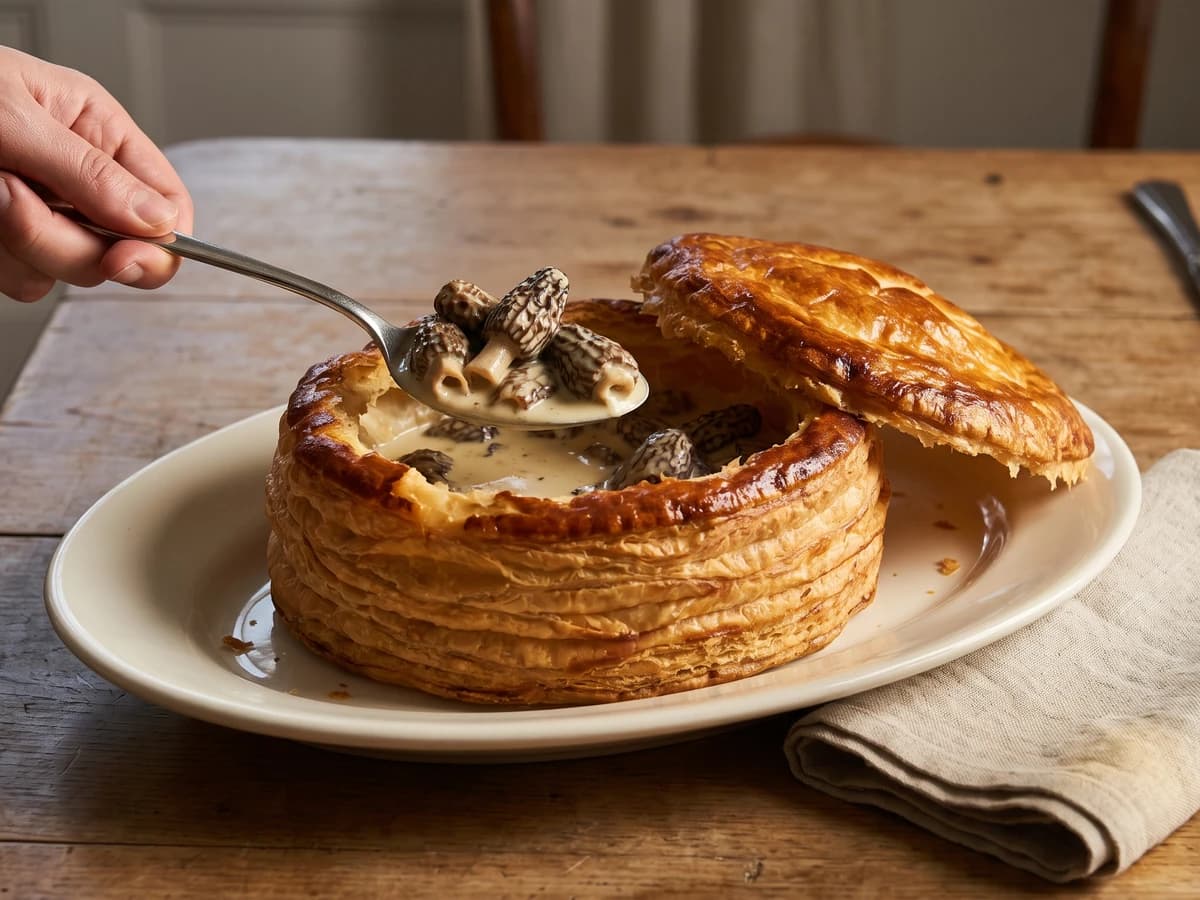
Morels surrender their liquor, then take it back as a glossy cream-and-butter sauce inside burnished puff pastry. The lesson is simple and absolute: reduce with patience, then heat gently and never boil.