
Chef Juliette
Flan aux Carottes
A pale short-paste shell holds silken, lightly sweet carrot purée beneath neat glazed half-discs, their butter syrup catching the light: a classical tart poised between vegetable course and sweet.
A cooking platform built around craft, culture, and the stories behind what we eat.

Created by Chef Juliette
Based on No. 2077, Tartelettes Grillées aux Champignons, from Le Guide Culinaire (1907) by Auguste Escoffier
Four little mushroom flans, latticed and gilded, baked hard and fast until butter-gold: a classical garnish scaled to the meat it accompanies and served before its crispness has time to fade.
Tartelettes Grillées aux Champignons (latticed mushroom tartlets) teach one uncompromising principle: small pastry garnishes must go directly from oven to table. Their pleasure is the contrast between crisp, egg-gilded lattice and tender mushrooms held in cream. A warming drawer destroys that contrast within minutes.
The original recipe assumed a pastry bench already holding Flan Grillé aux Champignons (No. 2076), rows of moulds chosen to match the tournedos or noisettes, a fierce oven, and a brigade able to synchronize garnish and meat. At home, one batch becomes four tartlets in 9 cm moulds, baked together on a preheated sheet. The dedicated garnish station is scaffolding and can go. The original paste, cooled mushroom filling, criss-cross lattice, gilding, very hot bake, and immediate service are the dish itself, so they stay unchanged. One cook, one stove, one evening.
The one step that matters most comes before assembly: the pastry and mushroom filling from Flan Grillé aux Champignons (No. 2076) must be thoroughly cold. Warm filling softens the shells and pulls the lattice downward before the oven can set it.
Tartelettes grillées aux champignons belong to the Parisian grand-kitchen tradition of garnitures composées, small composed garnishes shaped to echo the meat beside them. They are the individual form of Flan Grillé aux Champignons (No. 2076), not a regional mushroom tart or a separate first course, but a hot pastry accompaniment for tournedos and noisettes. Moving the flan into small moulds made portioning exact, yet made holding impossible, because covered or warmed tartlets quickly lose the crisp shell that defines them.
Quantity
1 home-scale batch Flan Grillé aux Champignons (No. 2076)
prepared as directed but divided among four tartlet moulds before baking
| Ingredient | Quantity |
|---|---|
| Flan Grillé aux Champignonsprepared as directed but divided among four tartlet moulds before baking | 1 home-scale batch Flan Grillé aux Champignons (No. 2076) |
Set four 9 cm / 3½ inch loose-bottomed tartlet moulds on a tray. Heat the oven to 220°C / 425°F conventional, or 200°C / 400°F fan, with a heavy baking sheet on the lower-middle rack. Give the oven at least 25 minutes to become fully hot, and arrange the cooking of the tournedos or noisettes so they will be ready when the tartlets emerge. These cannot wait for the meat.
Bring the Flan Grillé aux Champignons (No. 2076) to the assembly point specified in its own recipe, before the single large flan is moulded. Divide every prepared element evenly among the four tartlet moulds, then follow that preparation's buttering, lining, cooled-mushroom filling, edge-moistening, criss-cross lattice, and gilding sequence exactly as written. The formula remains whole; only the size and number of moulds change.
Work with one mould at a time, keeping the remaining pastry and filling cold. Fill each shell evenly without mounding the mushrooms above the rim, then lay the lattice lightly across the top and trim it cleanly rather than stretching it into place. If the pastry turns soft or the lattice begins to sink, stop and chill the entire tray for 10 minutes. Ça se rattrape. Cold pastry will recover its shape, while more handling only makes it greasy and tough.
Chill the assembled tartlets for 15 minutes, then set their tray directly onto the preheated baking sheet. Bake for 16 to 20 minutes, until the pastry is butter-gold, the lattice intersections are deeply bronzed, and the cream-bound mushrooms glisten through the openings. If the lattice colours before the bases are crisp, shield the tops loosely with foil and move the tray one rack lower for 3 to 5 minutes. Do not lower the oven heat and prolong the bake, because the filling will loosen before the pastry dries.
Let the tartlets stand only 2 minutes, just long enough for the shells to release without breaking. Lift them from their moulds with a small metal spatula and set one beside each tournedos or noisette, never underneath the meat or its sauce. Serve at once. No covered dish, no warming oven, no leisurely wait at the pass. À table!
1 serving (about 185g)
Culinary guides, cultural storytelling, and the editorial depth that makes cooking meaningful.
Discover Culinary ExplorerChef Juliette
A pale short-paste shell holds silken, lightly sweet carrot purée beneath neat glazed half-discs, their butter syrup catching the light: a classical tart poised between vegetable course and sweet.
Chef Juliette
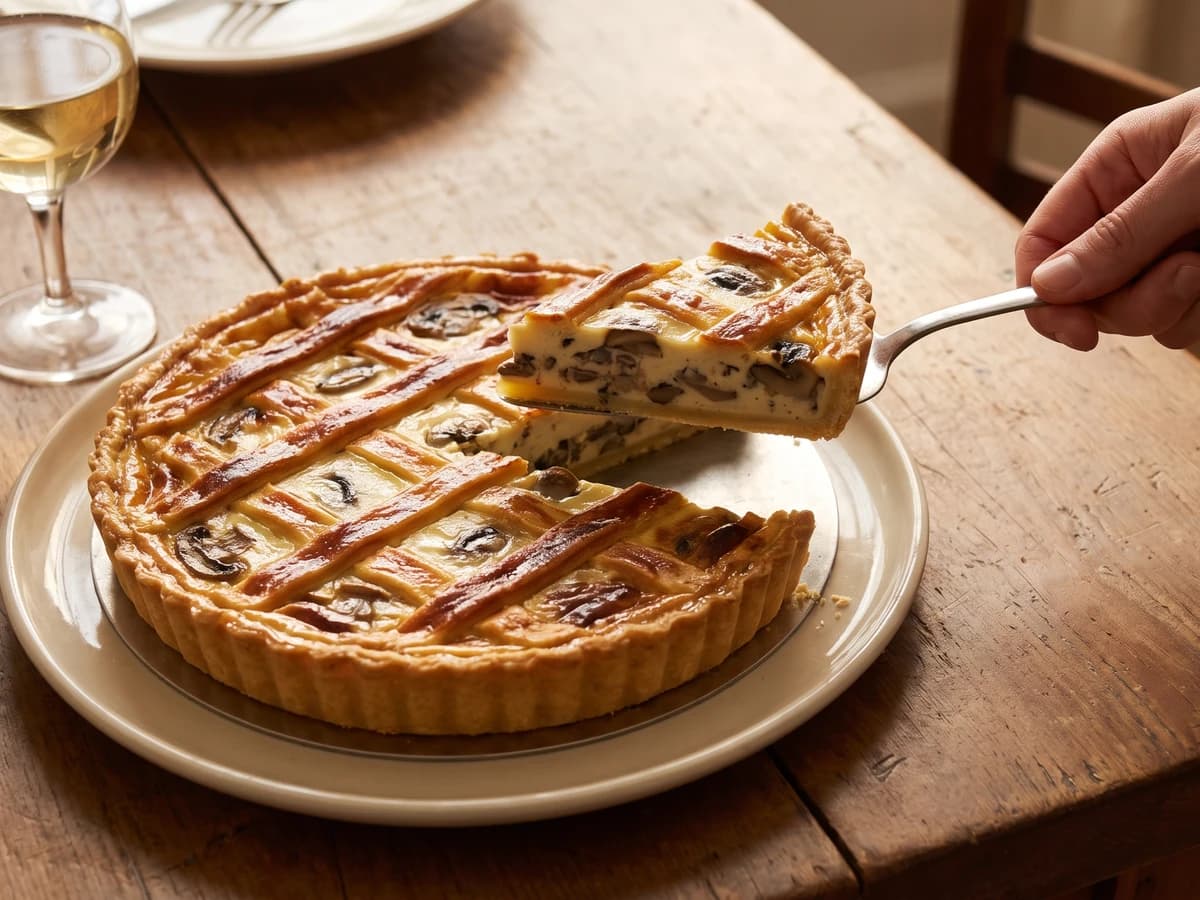
A hot mushroom flan under a butter-gold lattice, with cream reduced close around barely opened caps and a crisp short-paste base protected by one discipline: cool the filling completely.
Chef Juliette
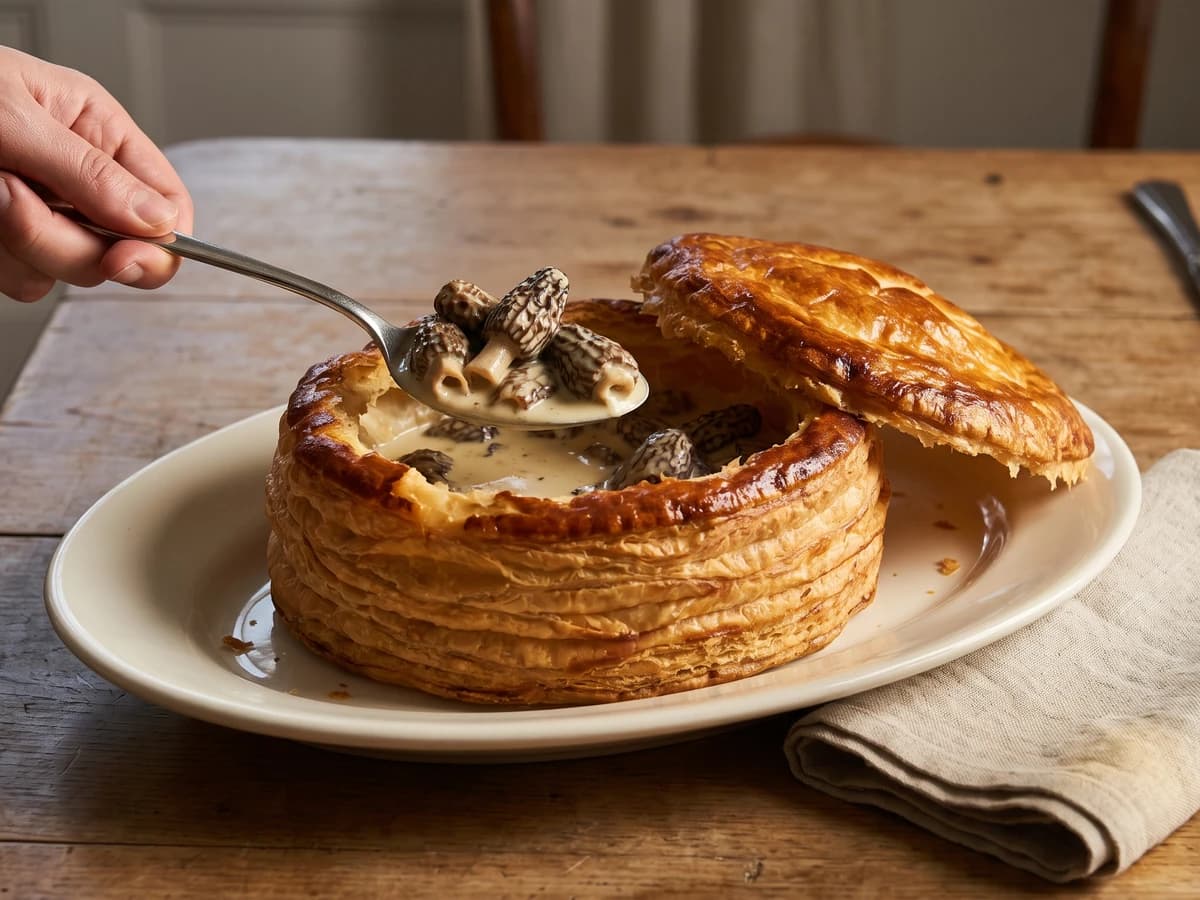
Morels surrender their liquor, then take it back as a glossy cream-and-butter sauce inside burnished puff pastry. The lesson is simple and absolute: reduce with patience, then heat gently and never boil.

Chef Juliette
Pommes de terre mousseline turns baked potato, butter, yolks, and whisked cream into a pale-crusted tart with an airy domed filling, piped in ridges and glazed gold just before serving.