
Chef Juliette
Flan aux Carottes
A pale short-paste shell holds silken, lightly sweet carrot purée beneath neat glazed half-discs, their butter syrup catching the light: a classical tart poised between vegetable course and sweet.
A cooking platform built around craft, culture, and the stories behind what we eat.

Created by Chef Juliette
Based on No. 2235, Pommes de Terre Mousseline, from Le Guide Culinaire (1907) by Auguste Escoffier
Pommes de terre mousseline turns baked potato, butter, yolks, and whisked cream into a pale-crusted tart with an airy domed filling, piped in ridges and glazed gold just before serving.
Pommes de terre mousseline (a light potato tart) teaches one precise lesson: air must be folded into richness, not beaten out of it. The potatoes bring body, butter and yolks bring satin, but the whisked cream is what lifts the dome. Before you touch a pan, know this: the potato base must be warm enough to accept the butter and yolks, then cooled until merely warm before the cream goes in.
The original entry assumes a pastry hand could set a pale flan crust beside a cook working the potatoes over the fire, then pass the finished tart beneath a salamander. Your honest equivalents are one 8-inch tart tin, one oven used in stages, and the fierce overhead heat of a household broiler. I have scaled the dish to exactly 1 pound of baked potato pulp for four people, keeping the original proportions intact: 4 ounces of butter, two yolks, and one-sixth of an imperial pint of whisked cream. The separate hands and hot stations were brigade scaffolding, so they can go. The pale shell, dry baked potato, whisked cream, piping, and rapid glaze are the dish, so they stay.
The finished mousseline should stand proud inside its barely colored crust, ivory beneath and delicately golden along the piped ridges, with a crumb that yields softly rather than slumping. Let the potato base cool to merely warm, fold until the last white streak disappears, then stop. That fold is the step that matters most.
This particular pommes de terre mousseline belongs to the codified French service table rather than to one province: its flan shell, domed filling, grooved piping, and rapid glaze join the work of pastry and vegetable cookery. Mousseline names the method, a rich preparation made lighter with whisked cream, and in this form it traveled from grand dining rooms to bourgeois dinner tables as a composed accompaniment or savory course. It should not be confused with the loose mashed potatoes often given the same name; in this preparation, the crust and piped dome are essential.
Quantity
1¼ cups (300 ml / 150 g)
Quantity
5 tablespoons plus 1 teaspoon (80 ml / 75 g)
cubed
Quantity
¼ teaspoon (1.25 ml / 1.5 g)
Quantity
3 tablespoons (45 ml / 45 g)
used as needed
Quantity
3 large, enough to yield 2 cups (475 ml / 454 g) baked pulp
Quantity
8 tablespoons (120 ml / 113 g)
cubed
Quantity
2
Quantity
6 tablespoons plus 1 teaspoon (95 ml / 95 g), equivalent to one-sixth imperial pint
whisked to soft peaks
Quantity
¾ teaspoon (3.75 ml / 4.5 g), plus more to taste
Quantity
¼ teaspoon (1.25 ml / 0.5 g)
Quantity
1 tablespoon (15 ml / 14 g)
melted
| Ingredient | Quantity |
|---|---|
| all-purpose flour | 1¼ cups (300 ml / 150 g) |
| cold unsalted buttercubed | 5 tablespoons plus 1 teaspoon (80 ml / 75 g) |
| fine salt for the crust | ¼ teaspoon (1.25 ml / 1.5 g) |
| ice waterused as needed | 3 tablespoons (45 ml / 45 g) |
| floury baking potatoes | 3 large, enough to yield 2 cups (475 ml / 454 g) baked pulp |
| unsalted butter for the potato fillingcubed | 8 tablespoons (120 ml / 113 g) |
| large egg yolks | 2 |
| cold heavy creamwhisked to soft peaks | 6 tablespoons plus 1 teaspoon (95 ml / 95 g), equivalent to one-sixth imperial pint |
| fine salt for the potato filling | ¾ teaspoon (3.75 ml / 4.5 g), plus more to taste |
| ground white pepper | ¼ teaspoon (1.25 ml / 0.5 g) |
| unsalted butter for glazingmelted | 1 tablespoon (15 ml / 14 g) |
Mix the flour and salt, then cut or rub in the cold butter until the mixture resembles coarse crumbs with a few small flakes remaining. Add the ice water a spoonful at a time, stopping as soon as the dough holds together when pressed. Flatten it into a disc, wrap, and chill for 30 minutes. If it crumbles when pressed, add another teaspoon of the measured water; if it feels greasy, chill it before working further. Ça se rattrape.
Heat the oven to 425°F (220°C). Scrub and dry the potatoes, prick each a few times, and place them directly on the oven rack. Bake for 30 minutes while the pastry chills. Baking rather than boiling keeps the pulp dry, and dry starch is what lets the butter enrich the filling without making it loose.
Roll the chilled dough between two sheets of parchment into an 11-inch (28 cm) round. Line an 8-inch (20 cm) fluted tart tin, pressing the dough into the corner without stretching it. Trim the rim, prick the base lightly, and chill the lined tin for 10 minutes. Line it with parchment and fill it completely with baking weights so the sides remain upright.
Once the potatoes have baked for 30 minutes, lower the oven to 350°F (180°C) and place the weighted shell beside them. Bake the shell for 18 minutes, remove the parchment and weights, then bake for 5 to 7 minutes more. The pastry must be dry and set but still ivory, not deeply golden. If the rim begins coloring, cover it loosely with foil. Test the potatoes when the shell comes out and continue baking them until a skewer passes through without resistance, about 55 to 70 minutes in total.
Split the potatoes as soon as they are tender and scoop out the pulp while it is hot. Pass it through a potato ricer or fine sieve into a saucepan, then measure exactly 2 cups (475 ml / 454 g). Save any excess for another meal. Never use a food processor here; its blades rupture the starch until the potato turns elastic and gluey.
Set the saucepan over low heat and season the potato with the salt and white pepper. Beat in the 8 tablespoons of butter a few pieces at a time, allowing each addition to disappear before adding more. When the mixture is smooth and glossy, beat in the yolks one at a time and work it over the gentle heat for 2 to 3 minutes, until it thickens slightly and reaches 160°F (71°C). If butter gathers at the edge, return the pan to the lowest heat and beat firmly until it is absorbed. If the yolk begins catching on the bottom, move the clean mixture to a fresh bowl immediately without scraping the caught layer.
Transfer the potato base to a wide bowl and stir it occasionally until it is merely warm, about 100 to 110°F (38 to 43°C). Hold back 1 tablespoon of the measured cream, then whisk the remainder to soft peaks whose tips curl over. If the cream becomes grainy, whisk in the reserved liquid cream a teaspoon at a time until smooth; if no rescue is needed, whisk the reserved spoonful separately and combine it with the rest. Fold one-third of the cream into the potato to loosen it, then fold in the remainder with broad, gentle turns. Stop as soon as no white streaks remain. The whisked cream is the lift, so stirring hard now would undo the dish.
Set aside about one-quarter of the mousseline for piping. Spoon the rest into the pale shell and shape it into a smooth dome rising above the rim. Fit a piping bag with a ½-inch (12 mm) grooved or open-star tip, fill it with the reserved mixture, and pipe even ribs or overlapping shells from the base toward the crown. The piping is not decoration pasted onto the dish; it creates the ridges that catch the final glaze.
Heat the broiler to high and place an oven rack 6 to 8 inches (15 to 20 cm) below it. Brush or trickle the melted butter lightly over the piped surface, then broil the tart for 1 to 3 minutes, rotating it once, until the highest ridges turn delicate gold. Watch without leaving the oven. If one patch colors too quickly, shield that spot with a small piece of foil and rotate the tart. A long bake would deflate the cream and harden the filling; fierce, brief overhead heat is the home equivalent of the salamander.
Let the tart stand for 5 minutes so the filling settles without losing its lightness. Remove the tin, slide the pommes de terre mousseline onto a warm serving plate, and cut generous wedges with a thin, sharp knife. Serve at once, while the piped crown still gleams with butter. À table!
1 serving (about 225g)
Culinary guides, cultural storytelling, and the editorial depth that makes cooking meaningful.
Discover Culinary ExplorerChef Juliette
A pale short-paste shell holds silken, lightly sweet carrot purée beneath neat glazed half-discs, their butter syrup catching the light: a classical tart poised between vegetable course and sweet.
Chef Juliette
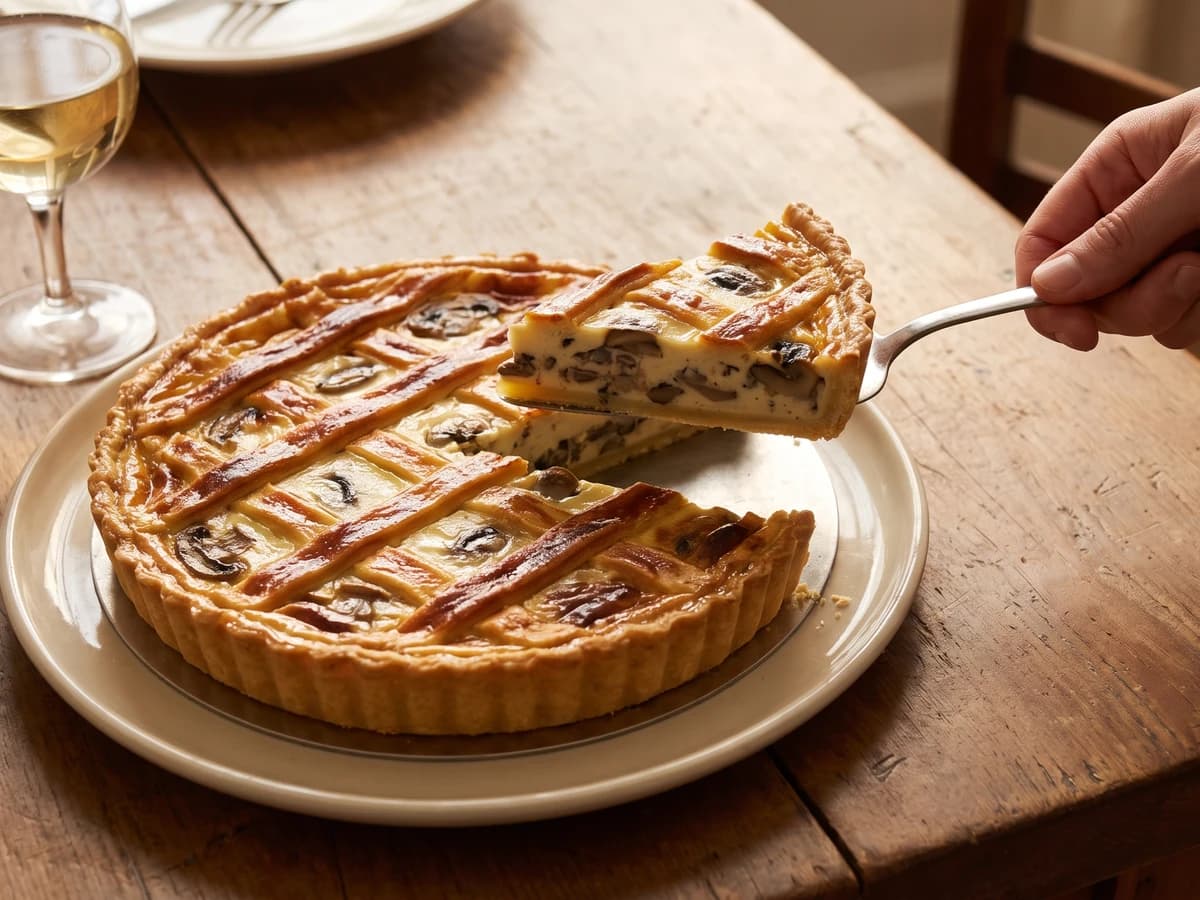
A hot mushroom flan under a butter-gold lattice, with cream reduced close around barely opened caps and a crisp short-paste base protected by one discipline: cool the filling completely.

Chef Juliette
Four little mushroom flans, latticed and gilded, baked hard and fast until butter-gold: a classical garnish scaled to the meat it accompanies and served before its crispness has time to fade.
Chef Juliette
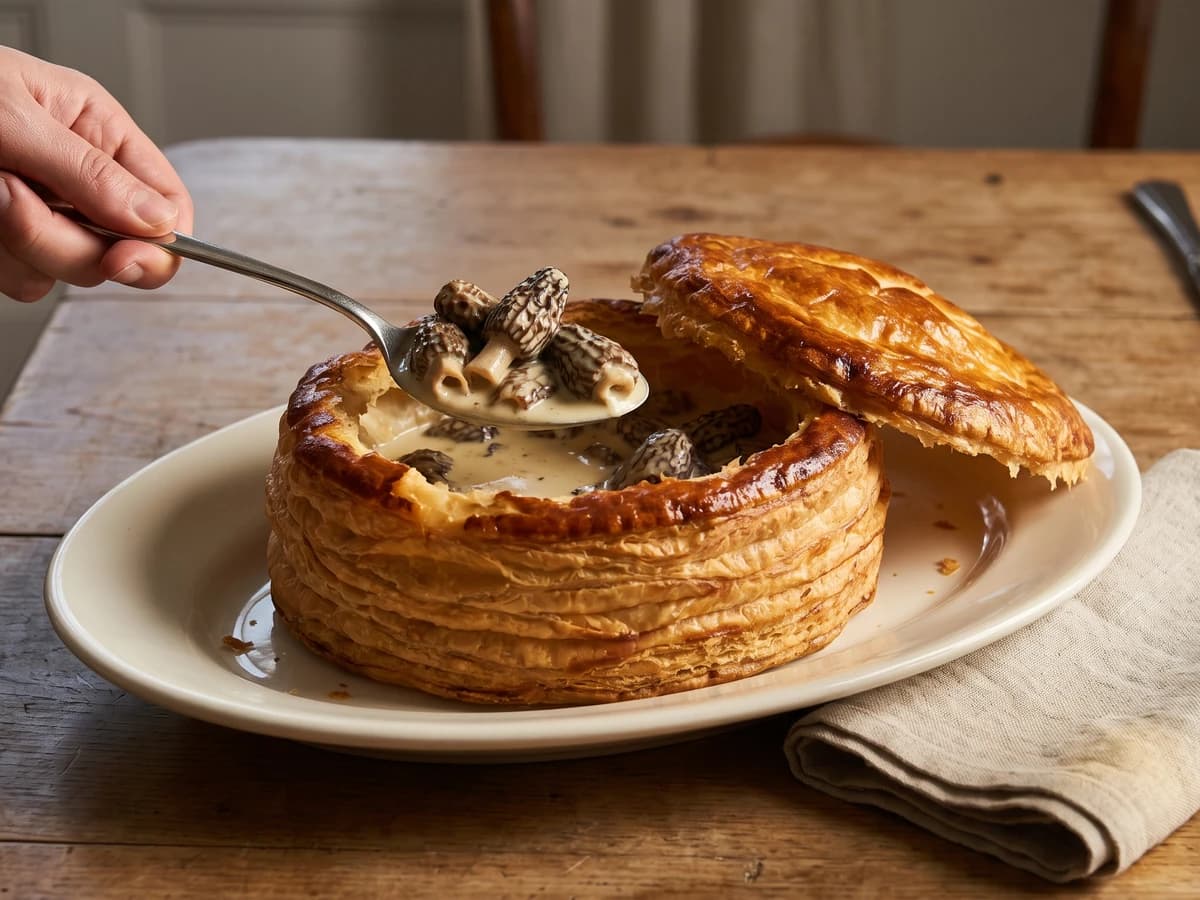
Morels surrender their liquor, then take it back as a glossy cream-and-butter sauce inside burnished puff pastry. The lesson is simple and absolute: reduce with patience, then heat gently and never boil.