Culinary Explorer
A cooking platform built around craft, culture, and the stories behind what we eat.
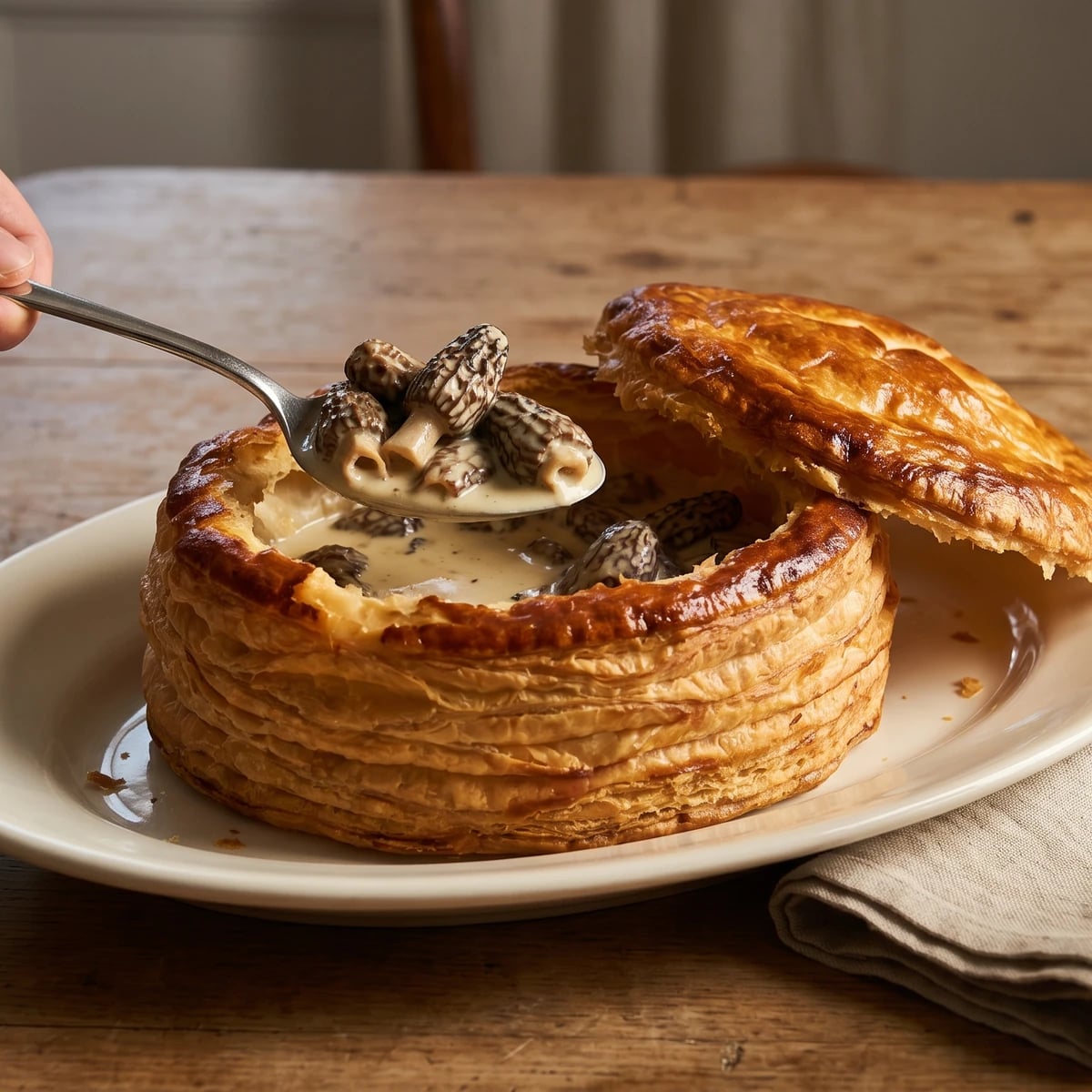
Tourte de Morilles
Created by Chef Juliette
Morels surrender their liquor, then take it back as a glossy cream-and-butter sauce inside burnished puff pastry. The lesson is simple and absolute: reduce with patience, then heat gently and never boil.
Tourte de morilles (morels in puff pastry) teaches the economy of mushroom cookery: the liquor is not runoff, it is the foundation. The morels give up their woodland intensity, the pan concentrates it, and cream and butter return it as a sauce that clings rather than floods. Lose that liquor and you lose the dish.
The classical entry assumes Morels (Morilles) (No. 2080) already cooked at one station, a Vol-au-Vent Crust (No. 2390) waiting from the pastry station, and a saucier, the sauce cook, free to watch one small reduction. At home, the honest equivalent is one prepared batch from a pound of fresh morels and one 8-inch shell for four. The source's vol-au-vent option is used because a finished shell receives the filling without a second bake, which could boil and split the sauce. The brigade handoff is scaffolding and can go. The reduction and gentle finishing heat are the dish and must stay. One cook, one stove, one evening.
Before the pan meets the heat, measure the reserved liquor so you know precisely what reducing it by one quarter means. Once the cream and butter enter, the sauce must become hot and glossy without boiling. That quiet finish decides everything.
Ingredients
cooked Morels (Morilles), drained well with all cooking liquor reserved
Quantity
1 batch Morels (Morilles) (No. 2080), prepared from about 8 loosely packed cups (1.9 L / 1 lb / 454 g) fresh morels
very thick heavy cream
Quantity
2 tablespoons (30 ml / about 30 g)
unsalted butter
Quantity
2 tablespoons (30 ml / 1 oz / 28 g)
cut into small pieces
| Ingredient | Quantity |
|---|---|
| cooked Morels (Morilles), drained well with all cooking liquor reserved | 1 batch Morels (Morilles) (No. 2080), prepared from about 8 loosely packed cups (1.9 L / 1 lb / 454 g) fresh morels |
| very thick heavy cream | 2 tablespoons (30 ml / about 30 g) |
| unsalted buttercut into small pieces | 2 tablespoons (30 ml / 1 oz / 28 g) |
Where cooking meets culture.
Culinary guides, cultural storytelling, and the editorial depth that makes cooking meaningful.
Discover Culinary Explorer