
Chef Juliette
Various Almond Preparations
Five almond preparations, one discipline: remove the skins cleanly, dry every kernel through, then cut, toast, or cloak it in pale caramel without letting its fragrant oils escape.
A cooking platform built around craft, culture, and the stories behind what we eat.
Created by Chef Juliette
Based on No. 2404, Rice Preparation for Entremets, from Le Guide Culinaire (1907) by Auguste Escoffier
Riz pour entremets keeps each grain whole: blanch it, bake it untouched in vanilla milk, then fold in yolks with a fork for the satin-bound base beneath the classical French pudding family.
Riz pour entremets (rice preparation for sweet puddings) teaches restraint. The one true thing to know before touching the pan is this: once the boiling mixture goes under its lid, leave it alone. Stirring releases starch and breaks the swelling grains, while a quiet covered bake leaves them tender, distinct, and ready to carry butter, vanilla, and yolk without becoming paste.
The original sets a pound of rice and sixteen yolks before a pastry brigade, with a large saucepan and a gentle oven managed as part of the kitchen's daily rhythm. That is brigade quantity, not flavor. Here the formula is quartered, with only practical gram rounding, for one cook, one stove, one evening. A tight-lidded 2-quart saucepan replaces the professional pan, and two broad citrus strips that lift out easily replace rind tied with cotton. Those details were scaffolding. The initial blanch, the untouched covered bake, and the final fork-folding are the dish, so all three stay.
Done properly, the grains remain whole beneath an ivory, buttery gloss, rich enough to become a molded pudding yet disciplined enough to hold its shape. Once the covered pan enters the oven, don't stir it; preserving those whole grains is the step that decides the preparation.
Riz pour entremets belongs to the pâtisserie and entremets repertory of Parisian brigade kitchens and bourgeois dining rooms, where milk-cooked rice became a standard base for molded sweets, fruit preparations, and creams. Its method refines household riz au lait (milk rice) by blanching and rinsing first, then finishing the grains covered in the oven so they remain distinct. It is not a finished pudding, despite the familiar ingredients; it is an appareil, a prepared base that receives the form and garnish of the entremets built from it.
Quantity
2/3 cup (4 oz / 113 g)
Quantity
6 cups (1.4 L / 1.4 kg), plus lukewarm water for rinsing
Quantity
1 cup plus 3 tablespoons (285 ml / 293 g)
Quantity
6 tablespoons (90 ml / 76 g)
Quantity
1 1/2 tablespoons (22 ml / 21 g)
Quantity
1 pinch
Quantity
1/4 bean or 2 wide strips
split the bean lengthwise, or cut the rind with as little white pith as possible
Quantity
4 (1/4 cup / 68 g)
Quantity
Up to 2 tablespoons (30 ml / 30 g)
only if needed to rescue dry rice
| Ingredient | Quantity |
|---|---|
| Carolina or Patna-style long-grain white rice | 2/3 cup (4 oz / 113 g) |
| cold water | 6 cups (1.4 L / 1.4 kg), plus lukewarm water for rinsing |
| whole milk | 1 cup plus 3 tablespoons (285 ml / 293 g) |
| granulated sugar | 6 tablespoons (90 ml / 76 g) |
| unsalted butter | 1 1/2 tablespoons (22 ml / 21 g) |
| fine salt | 1 pinch |
| vanilla bean or wide orange or lemon rind stripssplit the bean lengthwise, or cut the rind with as little white pith as possible | 1/4 bean or 2 wide strips |
| large egg yolks | 4 (1/4 cup / 68 g) |
| boiling water (optional)only if needed to rescue dry rice | Up to 2 tablespoons (30 ml / 30 g) |
Set a rack in the middle of the oven and heat it to 325°F (160°C). Have the egg yolks separated and waiting in a small heatproof bowl; once the rice leaves the oven, the yolks must be folded in while its heat can still thicken them.
Put the rice in a fine-mesh sieve and rinse it gently under cold water until the runoff changes from milky to lightly cloudy. Transfer it to the ovenproof saucepan, cover with the measured cold water, and bring to a full boil. The moment the whole surface boils, drain it. Do not let it simmer. Rinse the blanched rice once with lukewarm water, then leave it in the sieve for 2 minutes to drain thoroughly.
Wipe the saucepan clean and bring the milk just to a boil over medium heat. Lower the heat, return the drained rice, and add the sugar, salt, butter, and either the vanilla bean or citrus rind. Move a fork through the pan once to distribute everything without crushing the grains, then let the liquor return to its first gentle boil.
Cover the saucepan tightly and put it straight into the oven for 20 to 25 minutes. Do not stir it and do not lift the lid during the first 20 minutes. Then uncover and tilt the pan gently: the grains should be tender and swollen but whole, with no more than a shallow spoonful of creamy liquid beneath them. If they remain firm with plenty of liquid, re-cover and bake for 3 to 5 minutes. If the pan is dry while the centres remain chalky, trickle 1 tablespoon of boiling water around the edge, re-cover, and bake for 5 minutes. Ça se rattrape. If the grains are tender but very wet, leave the pan uncovered in the oven for 2 to 3 minutes without touching the rice.
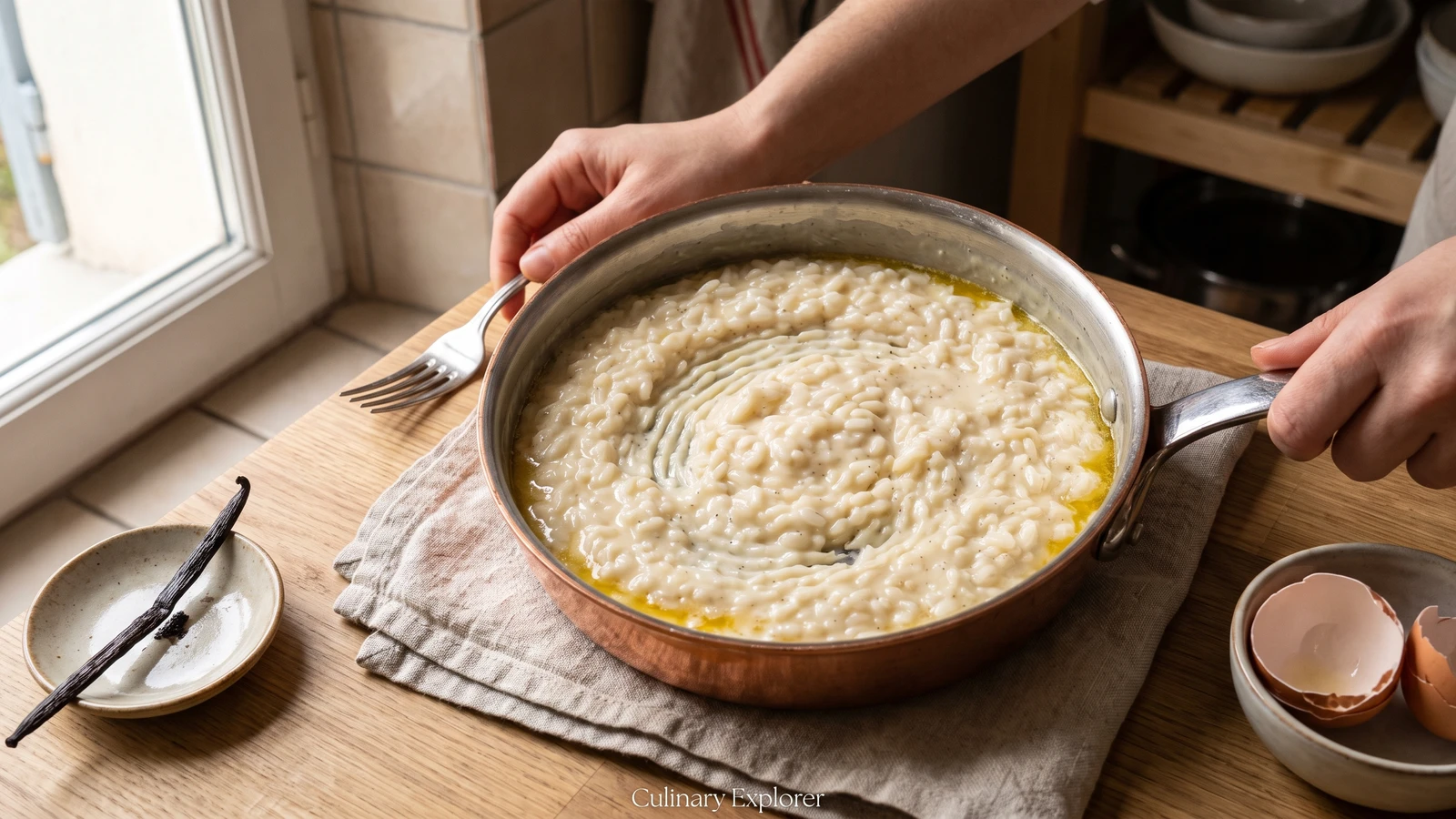
Remove the vanilla bean or citrus rind. Loosen the yolks with a fork, fold one forkful of hot rice into them, then pour this tempered mixture back into the pan. Lift and turn the rice gently with the fork, rotating the pan as you work, until the yolks disappear into a satin coating. Never beat or stir in circles; the fork is there to keep the grains separate. The mixture should remain at least 160°F (71°C) as the yolks thicken. If it has cooled below that, set it over the lowest heat and keep lifting gently until it reaches temperature, then remove it at once. If yellow threads begin to form, immediately transfer the rice to a cool shallow dish and continue folding gently. The falling temperature stops further curdling, provided you move at the first thread.
Use the riz pour entremets warm if the finished entremets calls for it at once. For later use, spread it no deeper than 1 1/2 inches (4 cm) in a shallow dish, let the fiercest heat subside for 15 minutes, then cover and refrigerate promptly. Chilling firms both butter and starch, so loosen the base with a fork before incorporating it into the final pudding. This is an appareil, a prepared base, not the finished dessert.
1 serving (about 110g)
Culinary guides, cultural storytelling, and the editorial depth that makes cooking meaningful.
Discover Culinary ExplorerChef Juliette
Five almond preparations, one discipline: remove the skins cleanly, dry every kernel through, then cut, toast, or cloak it in pale caramel without letting its fragrant oils escape.

Chef Juliette
A pastry pantry lesson in one tray: filberts warmed only until their red skins release, rubbed clean, cooled, and chopped into a fragrant mise-en-place for cakes, creams, pralines, and petits fours.

Chef Juliette
The smallest pâtisserie discipline decides whether a cake leaves its mould intact: clarified butter in every corner, followed by the lightest veil of dry flour or fécule.

Chef Juliette
Four whites, one spotless bowl, and a patient change of speed: whisk gently until loosened, then briskly to glossy stiffness, with powdered sugar waiting if the foam begins to granulate.