Culinary Explorer

A cooking platform built around craft, culture, and the stories behind what we eat.
Discover Culinary Explorer
Lérina Soufflé

Lérina Soufflé

Created by Chef Juliette

Based on No. 2530, Lérina Soufflé, from Le Guide Culinaire (1907) by Auguste Escoffier

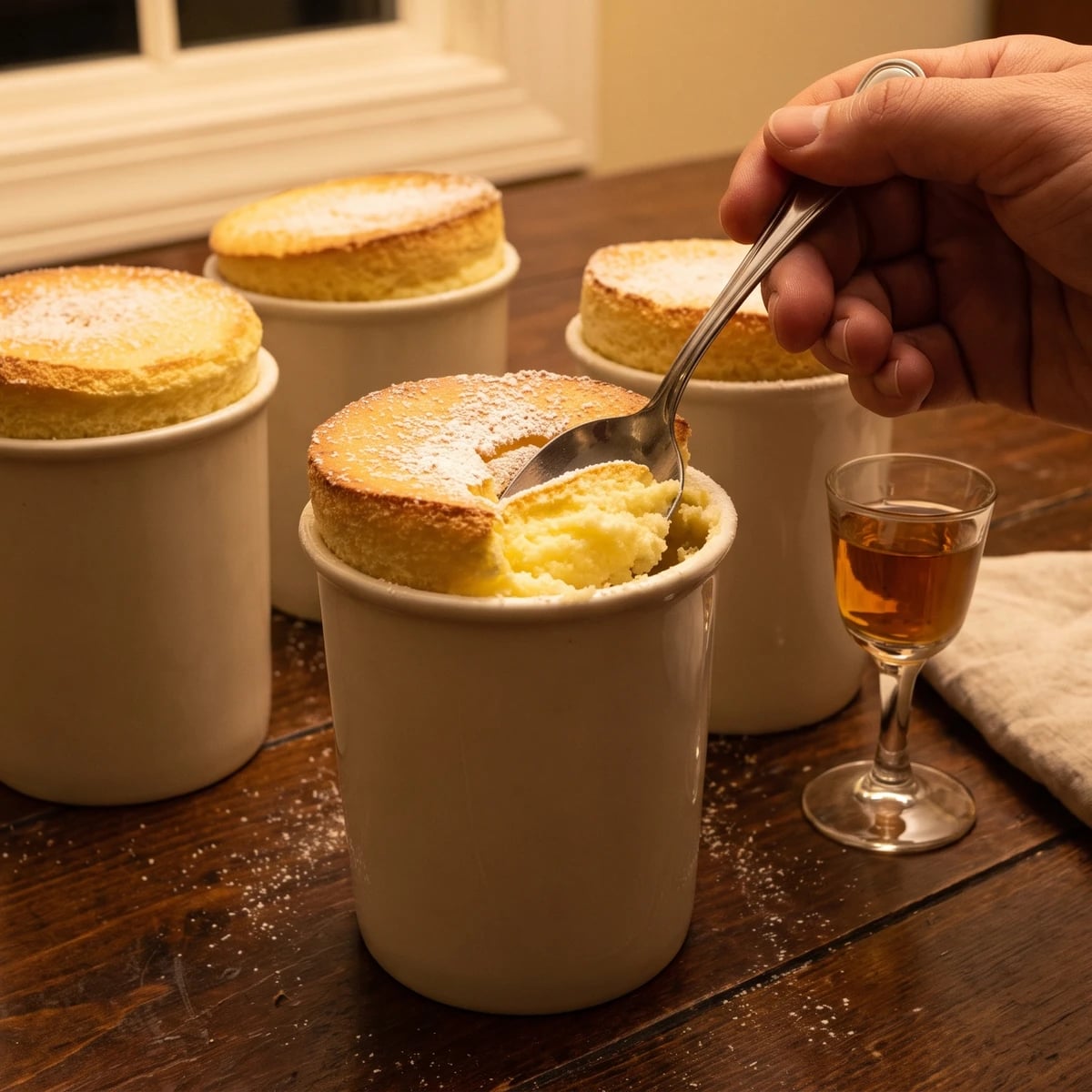
Soufflé à la Lérina rises butter-gold around a tender centre, carrying the island liqueur’s herb perfume in every spoonful. Add the Lérina off the heat, fold lightly, and let the oven do the rest.

Desserts
French
Dinner Party
Special Occasion
Celebration
25 min
Active Time
20 min cook45 min total
Yield4 servings

Soufflé à la Lérina (hot Lérina liqueur soufflé) teaches the essential truth of every sweet soufflé: the rise is prepared before the dish reaches the oven. A thick, smooth base holds the flavour, glossy egg whites carry the air, and a careful fold joins them. Know this before touching a pan: have your guests seated before you whisk the whites, because a soufflé waits for no toast.

The original entry gives only a sentence because it assumed a pâtissier with an ordinary sweet soufflé base in hand, prepared moulds, and an oven watched throughout service. Here that base is written out precisely and scaled to four ramekins. Bulk batches and station choreography are brigade scaffolding, so they go; the cooked panade, glossy whites, light folding, and immediate bake are the dish itself and must stay. One cook, one stove, one evening.

At its best, the soufflé rises in a butter-gold crown with a tender centre and the green, complex fragrance of the island liqueur still clear beneath the eggs and sugar. Keep the Lérina away from direct heat, stirring it into the warm base only after the saucepan leaves the stove. That off-heat addition is the step that matters most, because boiling the liqueur drives away precisely the herbs you came to taste.

Soufflé à la Lérina takes its place from Île Saint-Honorat in the Lérins archipelago off Cannes, where the monks of the Abbaye de Lérins distill their herbal liqueur from a guarded botanical formula. French pastry kitchens have long used aromatic liqueurs to perfume an ordinary sweet soufflé base, and classical descriptions place Lérina beside Chartreuse in character, though its island origin gives this version its name. This is a Côte d’Azur dish, not a lavender-scented Provençal fantasy: its regional identity rests in the monastic liqueur and its distinct herbal fragrance.

The technique, the tradition, and the story behind every dish.

Discover Culinary Explorer

Ingredients

unsalted butter

Quantity

1 tablespoon (15 ml / 14 g)

very soft, for coating the ramekins

granulated sugar

Quantity

2 tablespoons (30 ml / 25 g)

for coating the ramekins

whole milk

Quantity

3/4 cup (180 ml / 185 g)

unsalted butter

Quantity

2 tablespoons (30 ml / 28 g)

all-purpose flour

Quantity

1/4 cup (60 ml / 30 g)

granulated sugar

Quantity

1/4 cup (60 ml / 50 g)

for the base

fine sea salt

Quantity

1/8 teaspoon (0.6 ml / 0.8 g)

large eggs

Quantity

4

separated

Lérina herbal liqueur

Quantity

3 tablespoons (45 ml / 43 g)

granulated sugar

Quantity

2 tablespoons (30 ml / 25 g)

for the egg whites

large egg white (optional)

Quantity

1

for rescuing overbeaten whites

confectioners’ sugar (optional)

Quantity

1 tablespoon (15 ml / 8 g)

for serving

Equipment Needed

  • Four straight-sided 8-ounce (240 ml) porcelain ramekins
  • 2-quart (2 L) heavy saucepan
  • Electric hand mixer or large balloon whisk
  • Flexible rubber spatula
  • Fine-mesh sieve
  • Rimmed baking sheet

Instructions

  1. 1

    Prepare the ramekins

    Set a rack in the lower third of the oven and heat it to 400°F (200°C, or 180°C fan). Brush four straight-sided 8-ounce (240 ml) ramekins generously with the soft butter, working from base to rim in upward strokes. Add the coating sugar, turn each ramekin until the inside is evenly covered, and tap out the excess. Set them on a baking sheet and keep the rims clean; butter or batter smeared across the lip can tether the rise.

    The butter and sugar make a lightly crisp wall for the soufflé to climb. Straight sides matter more than decorative porcelain.
  2. 2

    Cook the panade

    Melt the 2 tablespoons butter in a medium saucepan over medium-low heat. Stir in the flour and cook this roux blanc (white roux) for about 90 seconds without allowing it to colour. Whisk in the milk gradually, then add the base sugar and salt. Cook, whisking steadily, until the panade, the thick cooked soufflé base, turns glossy, bubbles slowly, and holds a clear track from the whisk, about 2 to 3 minutes. It must be thicker than pastry cream because the liqueur will loosen it. If lumps appear, press the hot base through a fine sieve. Ça se rattrape.

  3. 3

    Add yolks and Lérina

    Remove the saucepan from the heat and let the base stand for 3 minutes, until warm rather than fiercely hot. Whisk in the four yolks one at a time, making each disappear before adding the next. Stir in the Lérina last, entirely off the heat, and transfer the base to a wide mixing bowl. If the yolks form cooked streaks, pass the mixture through the fine sieve immediately, then continue. Let the base cool until just warm while you prepare the whites.

  4. 4

    Whisk glossy whites

    Put the four egg whites in a spotless, dry bowl. Whisk at medium speed until they form an even white foam, then add the meringue sugar gradually and continue until the whites are glossy and hold medium-firm peaks whose tips still bend. Stop there. Dry, clotted whites do not fold cleanly. If you have taken them too far, whisk in the optional unwhipped egg white by hand, a teaspoon at a time, only until the foam becomes supple again; you may not need all of it.

    A trace of yolk or grease weakens the foam. Separate the eggs while cold, then let the whites lose their chill before whisking.
  5. 5

    Fold without deflating

    Stir one quarter of the whipped whites firmly into the Lérina base to lighten it. Add the remaining whites in two batches, cutting down through the centre with a flexible spatula, sweeping across the bottom, and turning the mixture over itself. Rotate the bowl as you work and stop as soon as no broad white streaks remain. Patience, not pounding. A few pale wisps are safer than another dozen strokes that knock out the air.

  6. 6

    Fill and bake

    Divide the mixture among the prepared ramekins, filling them to just below the rims. Level the tops lightly, wipe every rim clean, and run the tip of your thumb around the inside edge to make a narrow channel. Transfer the baking sheet to the oven at once. Bake without opening the door for the first 10 minutes, then continue until the soufflés stand well above their rims, the crowns are butter-gold, and the centres retain a gentle tremble, 12 to 15 minutes in all. If the tops colour before the rise is complete, lower the oven to 375°F (190°C, or 170°C fan) and give them another minute or two.

  7. 7

    Serve at once

    Dust the crowns lightly with confectioners’ sugar if using and carry the ramekins directly to the table. The centre should be tender and custardy, not liquid, with Lérina’s herbal fragrance arriving before the first spoonful. A soufflé settling at the table has not failed; that is its nature. What matters is that everyone sees the proud rise first. À table!

Chef Tips

  • Lérina is the dish, not a decorative splash. Use the island liqueur if you can find it. Chartreuse is its closest classical cousin, but with Chartreuse you have made a Chartreuse soufflé, delicious but honestly renamed.
  • A properly heated oven matters. Give it at least twenty minutes after the temperature indicator says it is ready, and use an oven thermometer if yours runs unpredictably.
  • Serve the soufflé without a heavy sauce. Cream or chocolate would bury the guarded herbal character the off-heat addition worked to preserve; coffee or a small cordial of Lérina is enough beside it.
  • Because the liqueur is added away from direct heat and the bake is brief, some alcohol may remain. Serve accordingly when cooking for children or guests who avoid alcohol.

Advance Preparation

  • Butter and sugar the ramekins up to one day ahead, cover them, and keep them cold. Set them on the baking sheet before beginning the base.
  • The cooked base can be prepared through the addition of the yolks and Lérina up to four hours ahead. Press reusable wrap directly against its surface, chill it promptly, then let it stand for about twenty minutes before folding in the whites.
  • Whisking, folding, and baking must wait until the table is ready. Once the whites enter the base, the soufflés go straight into the oven.

Frequently Asked Questions

Nutrition Information

1 serving (about 140g)

Calories
330 calories
Total Fat
15 g
Saturated Fat
8 g
Trans Fat
0 g
Unsaturated Fat
7 g
Cholesterol
215 mg
Sodium
185 mg
Total Carbohydrates
37 g
Dietary Fiber
0 g
Sugars
31 g
Protein
10 g

Note: Chef personas and recipes are created with AI assistance. Cook with care: follow safe food-handling practices, check doneness with a thermometer when needed, and adapt for allergies and your kitchen.

Where cooking meets culture.

Culinary guides, cultural storytelling, and the editorial depth that makes cooking meaningful.

Discover Culinary Explorer

More from Entremets (Sweets) - Puddings

Browse the full collection