
Chef Juliette
Various Almond Preparations
Five almond preparations, one discipline: remove the skins cleanly, dry every kernel through, then cut, toast, or cloak it in pale caramel without letting its fragrant oils escape.
A cooking platform built around craft, culture, and the stories behind what we eat.
Created by Chef Juliette
Based on No. 2527, Strawberry Soufflé, from Le Guide Culinaire (1907) by Auguste Escoffier
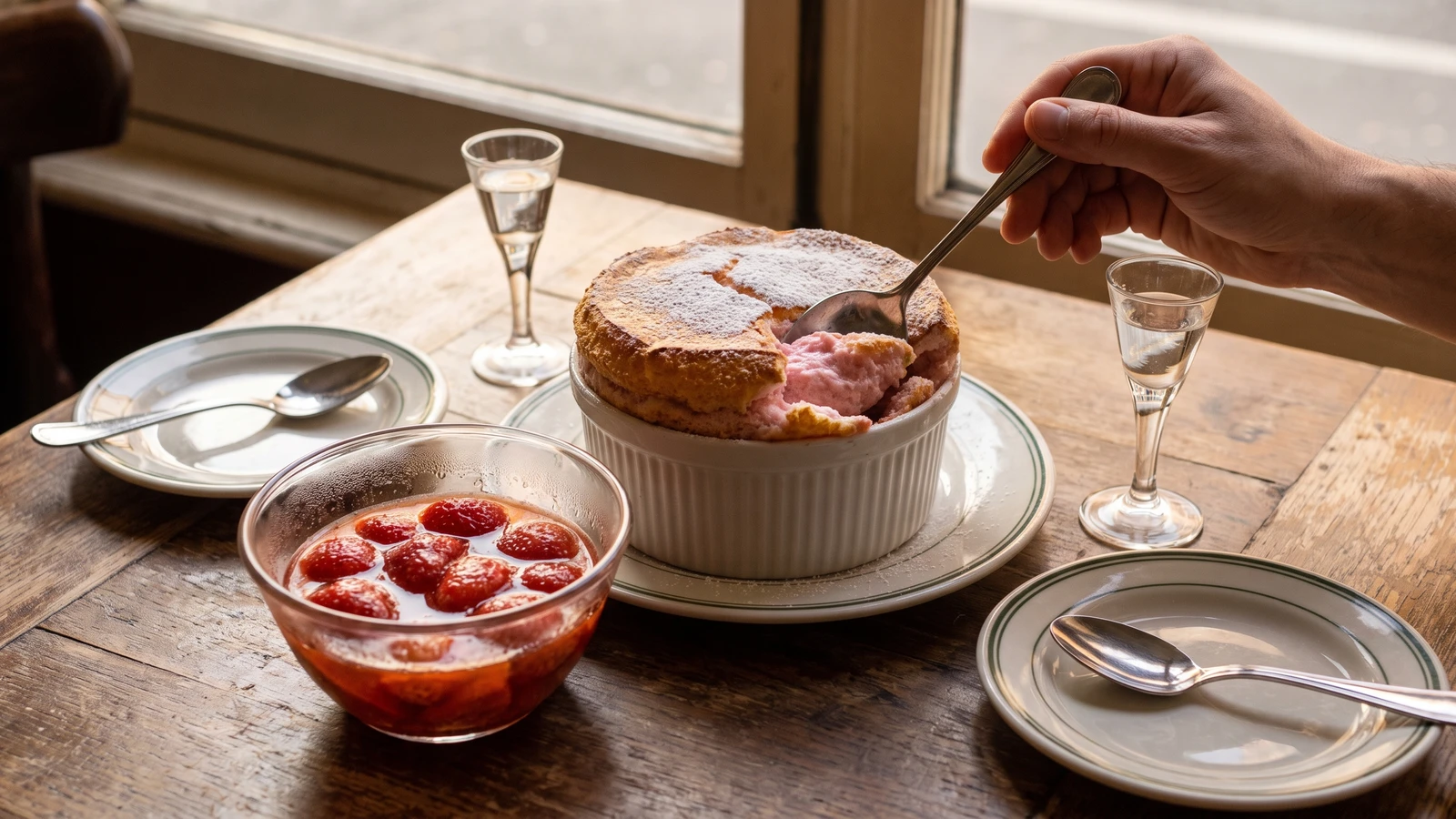
Soufflé aux Fraises rises fragrant with kirsch beside orange-macerated strawberries chilled nearly to ice, a last-minute French dessert built on the clean contrast of hot, tender soufflé and cold, vivid fruit.
Soufflé aux Fraises teaches one true thing: the rise is prepared in the mixing bowl, not rescued in the oven. Glossy egg whites, folded without squeezing out their air, give you the proud golden cap; the oven merely finishes what your hands began.
Here the strawberries do not go into the batter. The soufflé itself is scented with kirsch, while ripe berries macerated in orange juice arrive nearly iced beside it. Hot against cold, cherry spirit against bright fruit, tender interior against juicy berries: that contrast is the dish, and turning the fruit into a purée would erase it.
The original entry could be brief because it assumed a pastry station with a finished base ready, an even professional oven, and someone waiting to carry the dish the instant it rose. At home, the brigade scaffolding becomes one saucepan, one mixing bowl, and one 1.5-liter dish scaled for four. What cannot change is the last-minute folding and immediate service. One cook, one stove, one evening. Whip the whites only to glossy medium-firm peaks, then fold with a light hand; that is the step that matters most.
Hot sweet soufflés belong to the Parisian grand-kitchen repertoire, where pastry cooks built many flavors on a thickened milk base and lifted them with egg whites only when service called. This version's title can mislead: the baked soufflé is scented with kirsch, while orange-macerated strawberries arrive iced alongside, so the fruit contributes temperature and acidity rather than purée. Generations of bourgeois home cooks kept the dish alive because its foundation is modest and its effect comes from timing, not elaborate equipment.
Quantity
3 cups (720 ml / 450 g)
hulled and halved or quartered if large
Quantity
1/2 cup (120 ml / 124 g)
Quantity
2 tablespoons (30 ml / 25 g)
for the strawberries
Quantity
1 tablespoon (15 ml / 14 g)
softened, for the dish
Quantity
2 tablespoons (30 ml / 25 g)
for the dish
Quantity
2 tablespoons (30 ml / 28 g)
for the soufflé base
Quantity
1/4 cup (60 ml / 30 g)
Quantity
1 cup (240 ml / 247 g)
Quantity
1/4 cup (60 ml / 50 g)
for the soufflé base
Quantity
4
separated and brought to room temperature
Quantity
1
brought to room temperature
Quantity
2 tablespoons (30 ml / 29 g)
Quantity
3 tablespoons (45 ml / 38 g)
for whipping the whites
Quantity
1/8 teaspoon (0.6 ml / 0.8 g)
Quantity
1 tablespoon (15 ml / 8 g)
for finishing
| Ingredient | Quantity |
|---|---|
| ripe strawberrieshulled and halved or quartered if large | 3 cups (720 ml / 450 g) |
| freshly squeezed orange juice | 1/2 cup (120 ml / 124 g) |
| granulated sugarfor the strawberries | 2 tablespoons (30 ml / 25 g) |
| unsalted buttersoftened, for the dish | 1 tablespoon (15 ml / 14 g) |
| granulated sugarfor the dish | 2 tablespoons (30 ml / 25 g) |
| unsalted butterfor the soufflé base | 2 tablespoons (30 ml / 28 g) |
| plain flour | 1/4 cup (60 ml / 30 g) |
| whole milk | 1 cup (240 ml / 247 g) |
| granulated sugarfor the soufflé base | 1/4 cup (60 ml / 50 g) |
| large eggsseparated and brought to room temperature | 4 |
| large egg whitebrought to room temperature | 1 |
| kirsch | 2 tablespoons (30 ml / 29 g) |
| granulated sugarfor whipping the whites | 3 tablespoons (45 ml / 38 g) |
| fine sea salt | 1/8 teaspoon (0.6 ml / 0.8 g) |
| confectioners' sugarfor finishing | 1 tablespoon (15 ml / 8 g) |
Stir the orange juice with 2 tablespoons (30 ml / 25 g) granulated sugar until the sugar dissolves. Fold in the strawberries without crushing them, cover, and refrigerate for 45 minutes. The juice should turn scarlet and lightly syrupy while the berries remain distinct, not slump into compote.
Set a heavy baking sheet on the lower-middle rack and heat the oven to 400°F (200°C). Brush the softened butter over the inside of a 1.5-liter straight-sided soufflé dish, working upward from base to rim, then coat it evenly with 2 tablespoons (30 ml / 25 g) sugar and tap out the excess. Chill the prepared dish while you make the base. At this home scale, a paper collar is brigade scaffolding and can go; straight buttered sides, the sugar coating, and enough empty space above the batter provide the honest equivalent.
Melt 2 tablespoons (30 ml / 28 g) butter in a medium heavy saucepan over low heat. Stir in the flour and cook this roux, the butter-and-flour thickener, for 1 minute without letting it color. Whisk in the milk gradually, making each addition smooth before adding the next, then cook for 2 to 3 minutes until the base is very thick and pulls cleanly from the pan. Stir in 1/4 cup (60 ml / 50 g) sugar and remove from the heat. Cool for 5 minutes, then whisk in the four yolks one at a time, followed by the kirsch. The base should fall from the whisk in a heavy ribbon. If it has lumps, press it through a fine sieve while warm; nothing is lost.
Combine the five egg whites, reserving 1 tablespoon of unbeaten white in a small cup. Put the remainder in a spotless, grease-free bowl with the salt and beat until foamy, then until soft peaks form. Add the 3 tablespoons (45 ml / 38 g) sugar gradually and continue beating to a meringue française, a French meringue, that is glossy and medium-firm. Its peak should stand but bend gently at the tip. Dry, clumpy whites expand poorly and are miserable to fold. If you take them slightly too far, whisk in the reserved unbeaten white a teaspoon at a time by hand until the gloss returns. Ça se rattrape.
Stir one-quarter of the meringue briskly into the warm, not hot, kirsch base to lighten it. Add the remaining meringue in two batches, cutting the spatula down through the center, sweeping across the bottom, and lifting the mixture over itself as you turn the bowl. Stop when no broad white streaks remain. A few fine traces do less harm than ten unnecessary folds. Spoon the batter into the chilled dish, stopping about 1 cm below the rim, level the top lightly, and run a clean thumb around the inside edge to form a shallow channel.
Set the dish on the heated baking sheet, immediately lower the oven to 375°F (190°C), and bake without opening the door for 20 minutes. Continue for 4 to 8 minutes, until the soufflé has risen proudly above the rim, the cap is deep butter-gold, and the center trembles as one body without a liquid slosh. If the top colors too quickly after the first 20 minutes, lay a loose sheet of foil over it and finish baking. If the center is plainly fluid when checked, return it to the oven for 3 minutes; a small loss of height is better than raw batter.
As soon as the soufflé enters the oven, place the macerated strawberries and their orange juice in the freezer for 15 to 20 minutes. These are fraises glacées, iced strawberries: intensely cold, glossy, and just beginning to firm at the edges, never frozen solid. Transfer them to a chilled serving bowl and keep them cold until the soufflé reaches the table.
Dust the risen cap lightly with confectioners' sugar and carry the soufflé straight to the table. Break the center with two serving spoons and place a generous portion on each plate, then spoon the iced strawberries and their orange syrup alongside, never over the top. The cold fruit would press down the rise, and the clean meeting of hot soufflé and cold berries is the whole composition. À table!
1 serving (about 300g)
Culinary guides, cultural storytelling, and the editorial depth that makes cooking meaningful.
Discover Culinary ExplorerChef Juliette
Five almond preparations, one discipline: remove the skins cleanly, dry every kernel through, then cut, toast, or cloak it in pale caramel without letting its fragrant oils escape.

Chef Juliette
A pastry pantry lesson in one tray: filberts warmed only until their red skins release, rubbed clean, cooled, and chopped into a fragrant mise-en-place for cakes, creams, pralines, and petits fours.

Chef Juliette
The smallest pâtisserie discipline decides whether a cake leaves its mould intact: clarified butter in every corner, followed by the lightest veil of dry flour or fécule.

Chef Juliette
Four whites, one spotless bowl, and a patient change of speed: whisk gently until loosened, then briskly to glossy stiffness, with powdered sugar waiting if the foam begins to granulate.