
Chef Juliette
Various Almond Preparations
Five almond preparations, one discipline: remove the skins cleanly, dry every kernel through, then cut, toast, or cloak it in pale caramel without letting its fragrant oils escape.
A cooking platform built around craft, culture, and the stories behind what we eat.
Created by Chef Juliette
Based on No. 2520, Fruit Soufflé in a Croustade, from Le Guide Culinaire (1907) by Auguste Escoffier
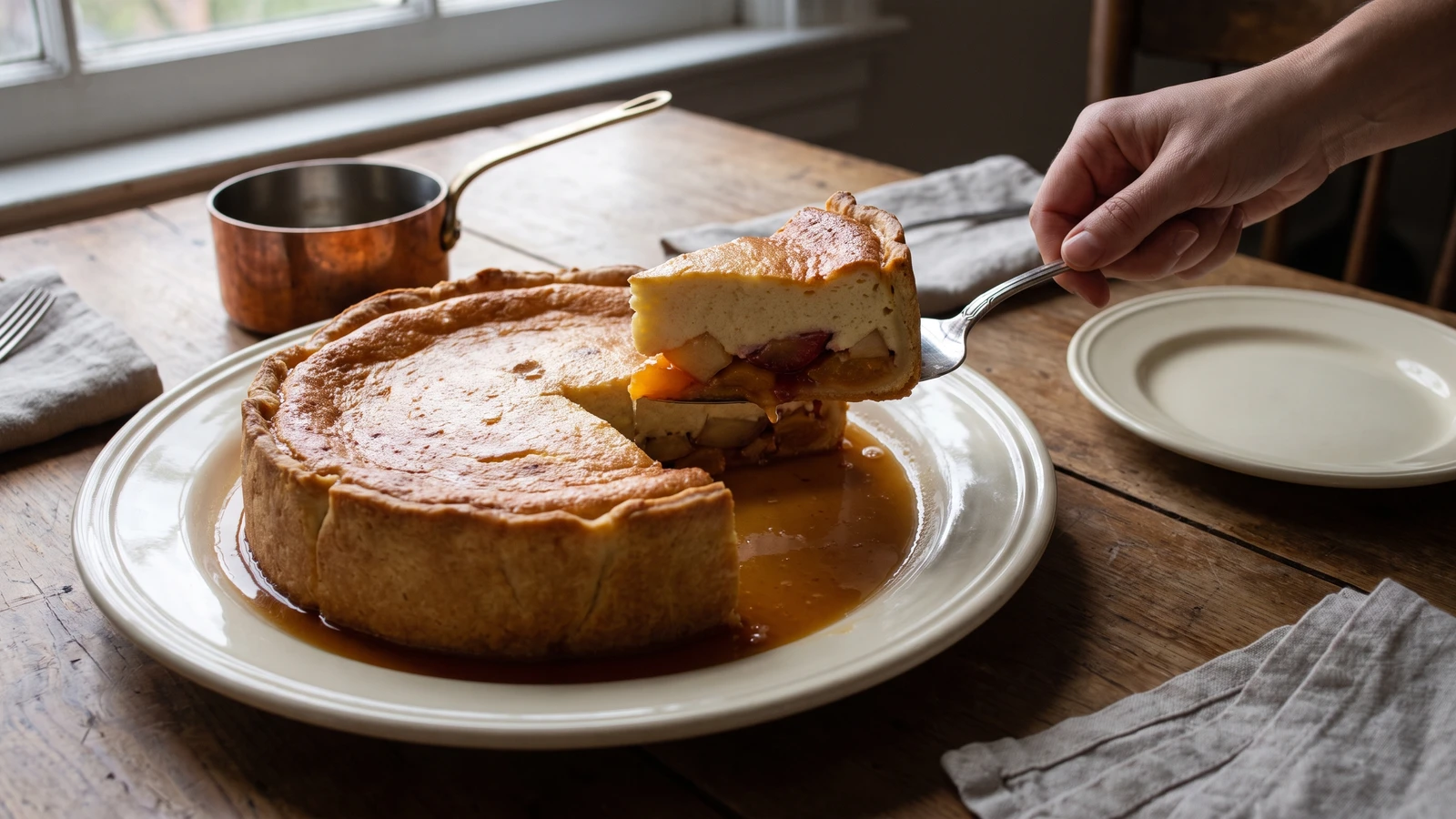
A thin sugared croustade holds vanilla apple and seasonal fruit beneath a tender soufflé crown, baked until the pastry bronzes and the filling rises, then turned out for a warm rum finish.
Soufflé de Fruits en Croustade (fruit soufflé in a pastry case) teaches one discipline above all: control the water. The fruit must be tender, cool, and nearly dry before it meets the beaten whites. Warm or syrupy fruit collapses the rise and softens the pastry from below; properly reduced fruit gives the soufflé something solid to lift against.
The original recipe assumed a pastry station with Croûtes et Croustades (No. 2393) ready in a purpose-made shallow mould, stewed fruits waiting separately, and enough hands to build the soufflé while another cook watched the oven and warmed the rum. At home, an 8-inch straight-sided cake pan replaces the croustade mould, one saucepan handles the fruit and soufflé base in turn, and a hand mixer supplies the whisking arm. The drying box used for empty shells is brigade scaffolding and goes; the thin sugared paste, fruit layers, moderate oven, careful turn-out, and rum finish are the dish and must stay. One cook, one stove, one evening.
The moderate oven is deliberate. Fierce heat sets and darkens the sugared crust before the soufflé can complete its rise. Before you touch the eggs, cool the fruit completely and cook away every loose spoonful of juice; that is the step that matters most.
Soufflé de fruits en croustade belongs to the Parisian classical dining room, where a croustade was a crisp pastry container used for savory garnishes as readily as sweets, while the hot soufflé supplied the last-minute rise. It should not be confused with the apple croustades of Gascony, whose layered pastry and local brandy follow another regional practice; this formula is the grand-kitchen marriage of stewed fruit, sugared paste, vanilla soufflé, and rum at the table.
Quantity
1 prepared 8-inch (20 cm) Croûtes et Croustades (No. 2393)
lined very thinly with sugared short paste and kept unbaked for this formula
Quantity
2 cups (480 ml / 250 g)
peeled and diced
Quantity
2 cups (480 ml / 300 g)
peeled, cored, or stoned as needed and quartered if large
Quantity
1/4 cup (60 ml / 50 g)
divided
Quantity
2 tablespoons (30 ml / 30 g)
divided
Quantity
1
Quantity
1 cup (240 ml / 245 g)
Quantity
2 tablespoons (30 ml / 28 g)
Quantity
1/4 cup (60 ml / 30 g)
Quantity
4
separated
Quantity
1/3 cup (80 ml / 65 g)
Quantity
1/8 teaspoon (0.6 ml / 0.7 g)
Quantity
3 tablespoons (45 ml / 42 g)
| Ingredient | Quantity |
|---|---|
| Croûtes et Croustadeslined very thinly with sugared short paste and kept unbaked for this formula | 1 prepared 8-inch (20 cm) Croûtes et Croustades (No. 2393) |
| tart applepeeled and diced | 2 cups (480 ml / 250 g) |
| mixed seasonal fresh fruitpeeled, cored, or stoned as needed and quartered if large | 2 cups (480 ml / 300 g) |
| caster sugar for stewing the fruitdivided | 1/4 cup (60 ml / 50 g) |
| waterdivided | 2 tablespoons (30 ml / 30 g) |
| vanilla bean | 1 |
| whole milk | 1 cup (240 ml / 245 g) |
| unsalted butter | 2 tablespoons (30 ml / 28 g) |
| plain flour | 1/4 cup (60 ml / 30 g) |
| large eggsseparated | 4 |
| caster sugar for the soufflé | 1/3 cup (80 ml / 65 g) |
| fine salt | 1/8 teaspoon (0.6 ml / 0.7 g) |
| dark rum | 3 tablespoons (45 ml / 42 g) |
Heat the oven to 350°F (180°C), conventional setting, with a rack just below the middle. Have the Croûtes et Croustades (No. 2393) ready in its shallow mould, lined very thinly with sugared paste and still unbaked, then keep it cold while you prepare the fillings. The general drying-box treatment belongs to empty croustade shells; this formula directs a single filled bake, so don't blind-bake it first.
Split the vanilla bean lengthwise, scrape out the seeds, and divide both seeds and pod in half. Put the apples in a small saucepan with half the fruit sugar, half the water, and half the vanilla. Cover and cook gently for 3 minutes, then uncover and stir for 6 to 8 minutes, until the apples are tender and thick enough to hold a furrow drawn through them. Remove the pod and spread the apples on a plate to cool. Use the same pan for the seasonal fruit, adding the remaining fruit sugar and water. Begin with firm pears or cherries, then add quicker-cooking plums, apricots, or berries so every piece becomes tender without losing itself. If the fruit releases a puddle, strain it, boil the liquid alone until syrupy, and fold only a spoonful back into the fruit. Ça se rattrape. Spread the fruit on another plate and cool it completely.
Warm the milk with the remaining vanilla seeds and pod until small bubbles gather at the edge. Cover, leave it for 5 minutes, remove the pod, and pour the milk into a jug. Melt the butter in the same saucepan over gentle heat, stir in the flour, and cook for 1 minute without letting it color. Add the warm milk gradually, whisking after each addition, then cook for 2 to 3 minutes until the base is smooth, glossy, and thick enough to leave a clean trail across the pan. If it forms lumps, take it off the heat and whisk vigorously before continuing. Let it cool for 5 minutes, until warm rather than hot, then beat in the yolks one at a time.
Put the egg whites and salt in an impeccably clean bowl. Whisk at medium speed until they make soft peaks, then add the soufflé sugar gradually and continue only until the whites are glossy and hold supple medium peaks. Dry, clotted whites have gone too far and won't fold cleanly. Stir one-third firmly into the vanilla base to loosen it, then fold in the remainder with broad strokes, turning the bowl and stopping as soon as no white streaks remain.
Spread the cooled vanilla apples evenly over the bottom of the chilled croustade. Arrange the cooled seasonal fruit over them, quartered sides facing down where the pieces are large; together the fruits should fill the mould halfway. Spoon the soufflé preparation over the fruit and bring it gently to the rim without pressing or stirring the layers. Smooth the surface with two light strokes. Any extra can bake separately in a buttered ramekin, but don't overfill the croustade.
Bake immediately for about 25 minutes. Don't open the oven during the first 20 minutes; the sudden loss of heat can drop the centre before it has set. The croustade is ready when the visible pastry rim is evenly bronzed, the soufflé has risen, and its centre springs back softly under a fingertip without feeling liquid underneath. A fierce oven darkens the sugared paste too soon. Moderate heat lets crust and soufflé finish together.
Let the croustade stand for 1 minute, no longer. Set a rimmed, heatproof serving platter over the mould and invert both in one decisive movement, protecting your hands with dry towels. Lift away the mould. If the pastry clings, don't pry at it; wrap the outside of the mould with a towel wrung in hot water for 15 seconds, then try again gently. Measure the rum into a clean small saucepan and warm it over low heat until hot and fragrant but nowhere near boiling. Remove it from the stove, turn off the burner and extractor fan, clear the serving area of candles and bottles, then pour the rum around the croustade, never directly from its bottle. Ignite the rum at the platter's edge with a long match and let the low flame die naturally before cutting. If it doesn't catch, don't chase the flame; serve the warm rum around the croustade. À table!
1 serving (about 200g)
Culinary guides, cultural storytelling, and the editorial depth that makes cooking meaningful.
Discover Culinary ExplorerChef Juliette
Five almond preparations, one discipline: remove the skins cleanly, dry every kernel through, then cut, toast, or cloak it in pale caramel without letting its fragrant oils escape.

Chef Juliette
A pastry pantry lesson in one tray: filberts warmed only until their red skins release, rubbed clean, cooled, and chopped into a fragrant mise-en-place for cakes, creams, pralines, and petits fours.

Chef Juliette
The smallest pâtisserie discipline decides whether a cake leaves its mould intact: clarified butter in every corner, followed by the lightest veil of dry flour or fécule.

Chef Juliette
Four whites, one spotless bowl, and a patient change of speed: whisk gently until loosened, then briskly to glossy stiffness, with powdered sugar waiting if the foam begins to granulate.