
Chef Juliette
Various Almond Preparations
Five almond preparations, one discipline: remove the skins cleanly, dry every kernel through, then cut, toast, or cloak it in pale caramel without letting its fragrant oils escape.
A cooking platform built around craft, culture, and the stories behind what we eat.
Created by Chef Juliette
Based on No. 2513, Souffléd Pudding à la Reine, from Le Guide Culinaire (1907) by Auguste Escoffier
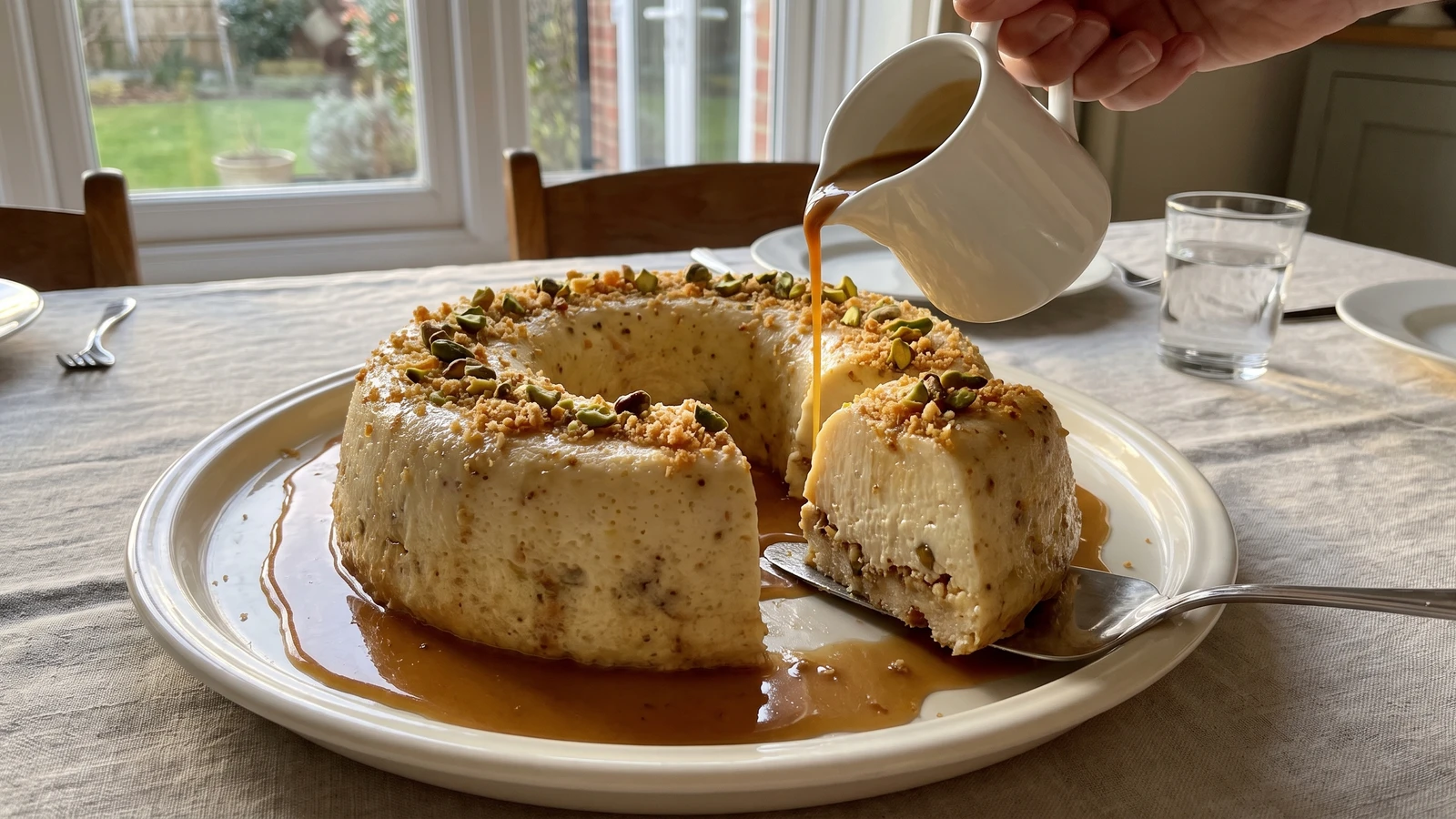
A tender vanilla pudding ring with pistachio and macaroon layers running through it, finished with warm pralin custard. The moulding is the lesson, and a generous coat of butter is your insurance.
Pouding Soufflé à la Reine (Queen-style souffléd pudding) teaches a useful piece of the classical grammar: whipped egg whites provide the lift, but gentle, even cooking must set that lift before it escapes. The bain-marie (hot-water bath) does this quietly, leaving the pudding tender and upright rather than dry at the edge and liquid in the middle.
The source entry assumes a pastry cook with vanilla soufflé preparation ready, a saucier holding crème anglaise (English custard), and Pralin (No. 2352) waiting in dry store. It gives assembly rather than a brigade quantity, so the honest home equivalent is a four-egg panade in one 1.5 litre tube mould, with the custard made while the pudding poaches. Separate stations are scaffolding and can go. The pistachio and macaroon layers, the central tube, and the bain-marie are the dish and must stay. One cook, one stove, one evening.
The one true thing to know before touching a pan is this: butter the mould heavily, twice, and leave no bare patch around the tube. The pudding is delicate where each nut-and-macaroon layer meets the next; a poorly buttered mould grips those seams and tears them during unmoulding.
Pouding Soufflé à la Reine belongs to the Parisian grand-kitchen repertoire, where English moulded puddings entered the French entremets course and acquired the lighter structure of a soufflé. Its accompaniment preserves that exchange in the name crème anglaise, while pistachios, almond macaroons, and praline turned the homely water-bath pudding into celebration food. The title à la Reine does not reliably identify a particular queen; within the canon, it often signals a delicate, richly appointed treatment rather than a sound royal biography.
Quantity
2 tablespoons (30 ml / 28 g)
for the mould
Quantity
½ cup (120 ml / 60 g)
finely chopped and divided
Quantity
¾ cup (180 ml / 75 g)
crushed into coarse crumbs and divided
Quantity
1 cup (240 ml / 245 g)
Quantity
4 tablespoons (60 ml / 57 g)
Quantity
½ cup (120 ml / 60 g)
Quantity
½ cup (120 ml / 100 g)
divided
Quantity
2 teaspoons (10 ml / 10 g)
Quantity
¼ teaspoon (1.25 ml / 1.5 g)
Quantity
4
separated
Quantity
1 cup (240 ml / 245 g)
Quantity
½ cup (120 ml / 120 g)
reserve 1 tablespoon cold
Quantity
4
Quantity
¼ cup (60 ml / 50 g)
Quantity
⅛ teaspoon (0.6 ml / 0.7 g)
Quantity
⅓ cup (80 ml / 45 g) Pralin (No. 2352)
| Ingredient | Quantity |
|---|---|
| softened unsalted butterfor the mould | 2 tablespoons (30 ml / 28 g) |
| shelled unsalted pistachiosfinely chopped and divided | ½ cup (120 ml / 60 g) |
| dry almond macaroonscrushed into coarse crumbs and divided | ¾ cup (180 ml / 75 g) |
| whole milk | 1 cup (240 ml / 245 g) |
| unsalted butter | 4 tablespoons (60 ml / 57 g) |
| plain flour | ½ cup (120 ml / 60 g) |
| granulated sugardivided | ½ cup (120 ml / 100 g) |
| vanilla paste or pure vanilla extract | 2 teaspoons (10 ml / 10 g) |
| fine salt | ¼ teaspoon (1.25 ml / 1.5 g) |
| large eggsseparated | 4 |
| whole milk for the crème anglaise | 1 cup (240 ml / 245 g) |
| heavy creamreserve 1 tablespoon cold | ½ cup (120 ml / 120 g) |
| large egg yolks | 4 |
| granulated sugar for the crème anglaise | ¼ cup (60 ml / 50 g) |
| fine salt for the crème anglaise | ⅛ teaspoon (0.6 ml / 0.7 g) |
| prepared Pralin, nougat-powder form | ⅓ cup (80 ml / 45 g) Pralin (No. 2352) |
Heat the oven to 325°F (160°C) with a rack in the lower middle, and put a kettle of water on to heat. Use half the softened butter to coat every part of a 1.5 litre smooth-sided tube mould, including the tube and its seam. Chill it for 5 minutes, then apply the remaining butter over the first coat. Combine roughly one-quarter of the chopped pistachios and macaroon crumbs, scatter them into the mould, and turn it until the base, sides, and tube are covered. Tap out only the loose excess. Heavy buttering is structural here, not decoration.
Warm the milk with half the granulated sugar until the sugar dissolves and the milk is very hot. In a medium saucepan, melt the butter over low heat, stir in the flour, and cook for 90 seconds without allowing it to colour. Whisk in the hot milk gradually, then stir over medium-low heat until the panade, the cooked flour-and-milk base, becomes smooth, glossy, and thick enough to pull cleanly from the sides of the pan. Remove it from the heat and beat in the vanilla and salt. If the panade has lumps, whisk it firmly and press it through a sieve now; once the eggs enter, rough handling costs lift. Cool for about 5 minutes, then beat in the four yolks one at a time.
Whip the four egg whites in a perfectly clean bowl until they hold soft peaks. Add the remaining pudding sugar gradually and continue whipping only until the whites are glossy and make a softly hooked peak. Dry, clotted whites don't fold cleanly. Stir one-third of the whites into the warm panade to loosen it, then fold in the remainder in two additions with broad turns from the bottom of the bowl. Stop as soon as no large white streaks remain. A few fine streaks are safer than a perfectly uniform but deflated mixture.
Mix the remaining pistachios and macaroon crumbs together and divide them into two portions. Spoon one-third of the soufflé preparation into the mould without pressing it down. Scatter over one portion of the nut mixture, keeping a narrow margin at both the outer wall and central tube, then repeat with another third of the preparation and the remaining mixture. Finish with the last preparation and smooth it lightly. The mould should be no more than three-quarters full. Cover it loosely with a pleated sheet of buttered parchment and foil, leaving space for a modest rise.
Set the mould in a deep roasting tin and place the tin on the oven rack. Pour in enough near-boiling water to reach halfway up the mould, taking care that none enters the pudding. Poach for 45 to 55 minutes, until the pudding has risen slightly, feels resilient at the thickest point, and a fine skewer emerges with moist crumbs but no liquid batter. An instant-read thermometer should register about 180°F to 185°F (82°C to 85°C). The water should tremble, not boil fiercely. If it begins surging, lower the oven to 300°F (150°C) and replace a mugful of bath water with cool water; this protects the edges while the centre catches up.
While the pudding poaches, heat the milk with all but the reserved tablespoon of cream until small bubbles gather at the edge. Whisk the yolks, sugar, and salt in a bowl until smooth, then pour in the hot dairy gradually while whisking. Return everything to the saucepan and stir constantly over low heat until the crème anglaise coats the back of a spoon and a finger drawn through it leaves a clean path, about 180°F to 181°F (82°C to 83°C). Remove it from the heat and whisk in the prepared Pralin (No. 2352) until evenly dispersed. If the custard shows its first fine grains, take it off the heat immediately, whisk in the reserved cold cream, and strain it into a cool bowl. Ça se rattrape. Hold the sauce warm over barely warm water.
Lift the mould from the bain-marie, remove the covering, and let the pudding settle for 8 to 10 minutes. Loosen only the top rim and the tube with a thin knife; don't saw down the sides and cut through the coating. Centre a warm serving platter over the mould and invert both together in one confident movement. If the pudding resists, wrap the mould in a hot damp towel for 20 seconds and try again. If a small layered section tears, press it back into place while warm and veil the seam with a spoonful of custard. Pour a little pralin custard around the base, serve the rest from a jug, and cut generous wedges. À table!
1 serving (about 215g)
Culinary guides, cultural storytelling, and the editorial depth that makes cooking meaningful.
Discover Culinary ExplorerChef Juliette
Five almond preparations, one discipline: remove the skins cleanly, dry every kernel through, then cut, toast, or cloak it in pale caramel without letting its fragrant oils escape.

Chef Juliette
A pastry pantry lesson in one tray: filberts warmed only until their red skins release, rubbed clean, cooled, and chopped into a fragrant mise-en-place for cakes, creams, pralines, and petits fours.

Chef Juliette
The smallest pâtisserie discipline decides whether a cake leaves its mould intact: clarified butter in every corner, followed by the lightest veil of dry flour or fécule.

Chef Juliette
Four whites, one spotless bowl, and a patient change of speed: whisk gently until loosened, then briskly to glossy stiffness, with powdered sugar waiting if the foam begins to granulate.