
Chef Juliette
Almond Pudding
Six almond-lined moulds, gently poached until softly risen, with white-wine sabayon scented by orgeat. The lesson is simple and exact: the bain-marie must tremble, never boil.
A cooking platform built around craft, culture, and the stories behind what we eat.
Created by Chef Juliette
Based on No. 2512, Souffléd Pudding à la Régence, from Le Guide Culinaire (1907) by Auguste Escoffier
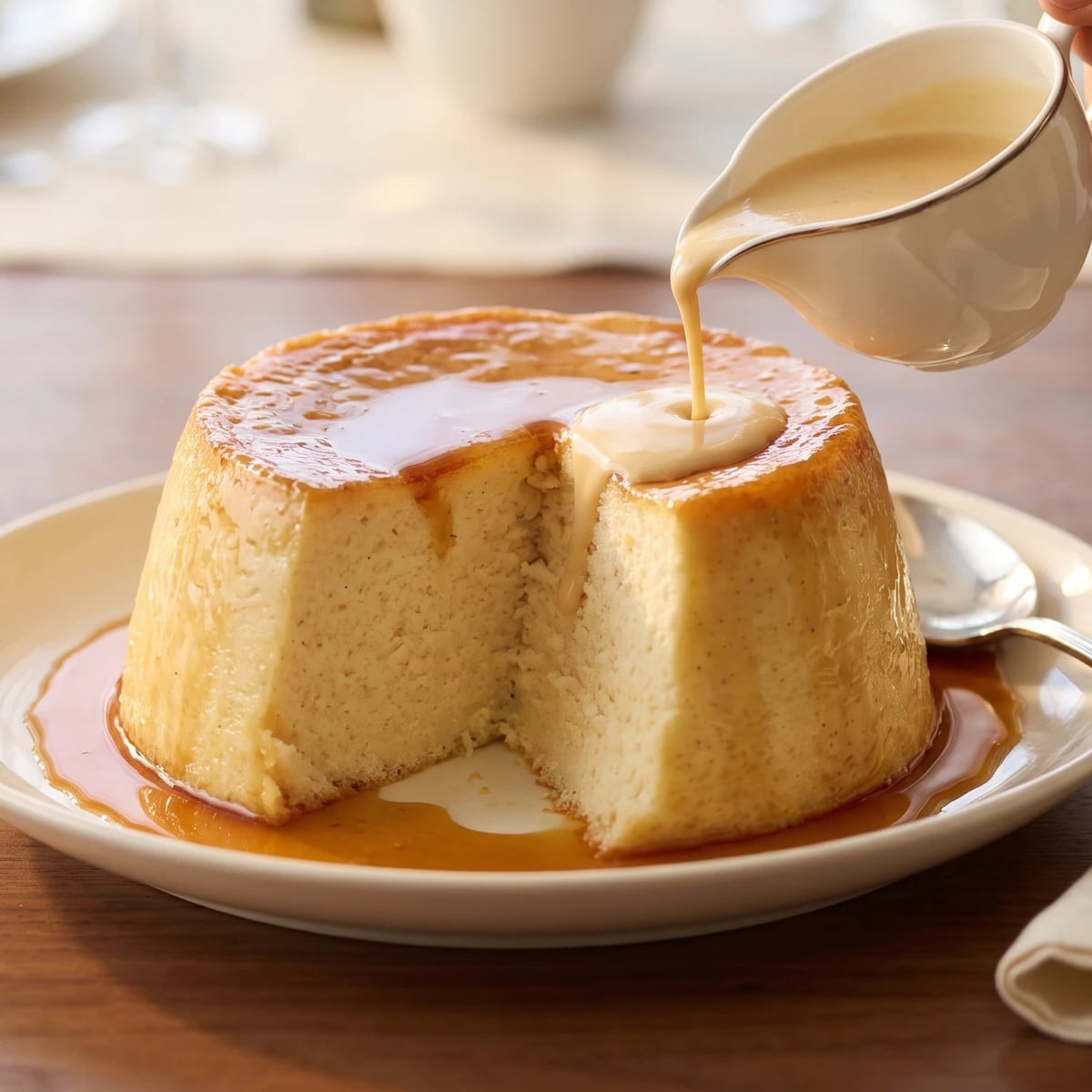
Caramel sets the pace in this vanilla-light Régence pudding, whose airy crumb poaches gently behind an amber shell before meeting a separate ribbon of caramel crème anglaise.
Pouding Soufflé à la Régence (vanilla souffléd pudding poached in caramel) teaches one true thing before you touch a pan: caramel sets the clock, and the cook must be ready before the sugar is. Once it reaches deep amber, you have seconds to pour, turn, and clothe the mould before it hardens. Work calmly, but work at once.
The source assumed a pastry station, a copper sugar pan, sugar stages judged by practiced fingers, and another pair of hands making the sauce. Your honest equivalents are a small stainless-steel saucepan, a thermometer, an electric mixer, and one 1-litre mould. Separate stations and the broken-ice arrangement belonging to the aspic cross-reference are brigade scaffolding, so they go. The caramel clothing, vanilla soufflé preparation, gentle bain-marie, and separate crème anglaise au caramel (caramel English custard) are the dish, so they stay. One cook, one stove, one evening.
When it turns out, the pudding should stand softly beneath a lacquer of flowing amber caramel, airy inside but substantial enough to take a spoon. Set the mould beside the stove, dry and within arm's reach, before the sugar goes on. That readiness decides the dish.
In the classical Paris repertoire, à la Régence is a courtly designation rather than a regional one, marking refinement through careful preparation and service. Here that refinement comes from contrast: a light vanilla pudding enclosed by bitter-edged caramel, with its sauce offered separately rather than poured over in the kitchen. The source's “English custard” is crème anglaise, the French name preserving the custard's English association even after it became part of the French sauce canon.
Quantity
1 litre (4 cups), using the coating motion from Another Method of Preparing Aspics de Filets de Soles (No. 916), technique only; no fish preparation is used
Quantity
3/4 cup (180 ml / 150 g), cooked by The Cooking of Sugar (No. 2344)
Quantity
5 tablespoons (75 ml / 75 g)
divided
Quantity
1 teaspoon (5 ml / 5 g)
Quantity
1 cup (240 ml / 245 g)
Quantity
1 bean, or 2 teaspoons (10 ml / 10 g) extract
bean split lengthwise and scraped
Quantity
4 tablespoons (60 ml / 57 g)
Quantity
1/2 cup (120 ml / 60 g)
Quantity
4
separated
Quantity
1/3 cup (80 ml / 67 g)
Quantity
1/8 teaspoon (0.6 ml / 0.7 g)
Quantity
1 2/3 cups (400 ml / 410 g)
Quantity
7 tablespoons (105 ml / 88 g), cooked by The Cooking of Sugar (No. 2344)
Quantity
2 tablespoons (30 ml / 30 g)
Quantity
5
| Ingredient | Quantity |
|---|---|
| dry metal pudding mould | 1 litre (4 cups), using the coating motion from Another Method of Preparing Aspics de Filets de Soles (No. 916), technique only; no fish preparation is used |
| granulated sugar for clothing the mould | 3/4 cup (180 ml / 150 g), cooked by The Cooking of Sugar (No. 2344) |
| water for the mould carameldivided | 5 tablespoons (75 ml / 75 g) |
| fresh lemon juice | 1 teaspoon (5 ml / 5 g) |
| whole milk for the pudding | 1 cup (240 ml / 245 g) |
| vanilla bean or pure vanilla extractbean split lengthwise and scraped | 1 bean, or 2 teaspoons (10 ml / 10 g) extract |
| unsalted butter | 4 tablespoons (60 ml / 57 g) |
| plain flour | 1/2 cup (120 ml / 60 g) |
| large eggsseparated | 4 |
| caster sugar | 1/3 cup (80 ml / 67 g) |
| fine sea salt | 1/8 teaspoon (0.6 ml / 0.7 g) |
| whole milk for the crème anglaise au caramel | 1 2/3 cups (400 ml / 410 g) |
| granulated sugar for the crème anglaise au caramel | 7 tablespoons (105 ml / 88 g), cooked by The Cooking of Sugar (No. 2344) |
| water for the crème anglaise caramel | 2 tablespoons (30 ml / 30 g) |
| large egg yolks | 5 |
Heat the oven to 325°F (160°C), with a rack in the lower middle. Bring a kettle of water nearly to the boil and set a deep roasting pan nearby. Put the dry mould on a heatproof board beside the stove, with thick oven gloves ready. A bain-marie is a hot-water bath, and here it poaches the pudding gently so the eggs set without turning coarse.
Warm the 1 2/3 cups (400 ml) milk until small bubbles gather at the edge. In a clean medium saucepan, combine the 7 tablespoons (88 g) sugar and 2 tablespoons (30 ml) water, following The Cooking of Sugar (No. 2344). Boil without stirring until the syrup reaches a clear chestnut amber, about 350°F (177°C). Remove it from the heat and add the hot milk in several cautious additions. It will surge and the caramel may seize into a hard mass. This is expected; return the pan to low heat and stir until every piece dissolves. Whisk the five yolks in a bowl. Slowly whisk in half the caramel milk, then return everything to the saucepan. Stir constantly over low heat until the crème anglaise reaches 180 to 183°F (82 to 84°C) and leaves a clean line when you draw a finger across the coated back of the spoon. Do not boil it. If tiny curds appear, stop at once. Ça se rattrape: pour the custard into a cold bowl, blend briefly, and strain through a fine sieve. Cover its surface and let it cool while you make the pudding.
Combine the 3/4 cup (150 g) sugar, 3 tablespoons (45 ml) of the mould-caramel water, and the lemon juice in a small stainless-steel saucepan. Cook by The Cooking of Sugar (No. 2344), swirling the pan only after the sugar has dissolved, until the caramel reaches 352 to 360°F (178 to 182°C) and turns deep amber. If crystals spread through the syrup, add the reserved water, cover for one minute, and dissolve everything gently before beginning the colour stage again. Ça se rattrape. Immediately pour the caramel into the dry mould. Wearing oven gloves, lift and rotate the mould so the caramel runs across the base and well up the sides before it sets. This is clothing the mould, the coating motion carried over from Another Method of Preparing Aspics de Filets de Soles (No. 916); only the motion belongs here, not the aspic or its ice. Set the coated mould upright. If the caramel is black or smells acrid, it cannot be rescued. Let it cool completely, then dissolve it with hot water and begin again.
Heat the pudding milk with the vanilla bean and seeds until just below a simmer, then cover and leave it for 10 minutes. Remove the pod. If using extract, hold it until the base comes off the heat. Melt the butter in a saucepan, stir in the flour, and cook gently for 2 minutes without letting it colour. Whisk in the warm milk little by little, keeping the mixture smooth, then cook until it becomes a thick panade, a cooked base that pulls cleanly from the pan. Take it off the heat, stir in the vanilla extract if using, and cool for 5 minutes. Beat in the four yolks one at a time. The base should be glossy, thick, and just warm, not hot enough to deflate the whites.
Beat the four egg whites with the salt until they hold soft peaks. Add the caster sugar gradually and continue beating only until the whites are glossy and hold a supple medium peak. Dry, clumpy whites do not fold cleanly. If they begin to look grainy, stop the machine and whisk by hand just until the foam becomes cohesive again. Fold one-third of the whites firmly into the panade to lighten it. Add the remaining whites in two portions, cutting down through the centre and turning the mixture up from the bottom until no large white streaks remain. Stop there. A few fine traces are better than batter worked flat.
Spoon the soufflé preparation into the caramel-clothed mould, filling it no more than three-quarters full, and level the surface lightly. Set the mould in the roasting pan, place the pan in the oven, and pour in enough hot water to come halfway up the mould. Poach in the bain-marie for 45 to 55 minutes, until the pudding is risen, resilient under a fingertip, and a thin skewer comes out with moist crumbs rather than liquid batter. The water should barely tremble. If it begins boiling hard, lower the oven by 20°F (10°C) and add a small splash of cool water to the bath. Ça se rattrape; violent water is what toughens the edge.
Lift the mould from the bain-marie and rest it for 7 minutes. Run a thin knife just around the upper rim, place a warm shallow serving dish over the mould, and invert both in one confident motion. Wait several seconds before lifting the mould. If the pudding refuses to release, set only the base of the mould in hot water for 10 seconds and try again. Do not wrench at it; the brief warmth loosens the caramel without tearing the pudding.
Stir the crème anglaise au caramel until smooth and pour it into a sauce boat. Serve the pudding warm, spooning the custard beside each portion so the airy vanilla interior and darker caramel remain distinct until the first bite. The pudding may settle slightly after unmoulding. That is its nature, not a failure. Bring it promptly to the table. À table!
1 serving (about 210g)
Culinary guides, cultural storytelling, and the editorial depth that makes cooking meaningful.
Discover Culinary Explorer
Chef Juliette
Six almond-lined moulds, gently poached until softly risen, with white-wine sabayon scented by orgeat. The lesson is simple and exact: the bain-marie must tremble, never boil.

Chef Juliette
Butter worked to a true pommade carries almonds, eggs, orange-flower water, and cream into a tender pouding, gently set in a bain-marie and brought to the table in the very dish that baked it.

Chef Juliette
Pouding aux biscuits turns crushed ladyfingers, hot milk, kirsch-soaked fruit, butter, and yolks into a tender pudding, with five late-folded whites keeping every spoonful light beneath warm apricot sauce.

Chef Juliette
Liqueur-soaked biscuits, jewel-bright fruit, and vanilla custard are packed into one mould and poached without a bubble. Fill slowly, and every slice holds its cabinet of colours.