
Chef Juliette
Various Almond Preparations
Five almond preparations, one discipline: remove the skins cleanly, dry every kernel through, then cut, toast, or cloak it in pale caramel without letting its fragrant oils escape.
A cooking platform built around craft, culture, and the stories behind what we eat.
Created by Chef Juliette
Based on No. 2497, Fresh-noodle Pudding, from Le Guide Culinaire (1907) by Auguste Escoffier
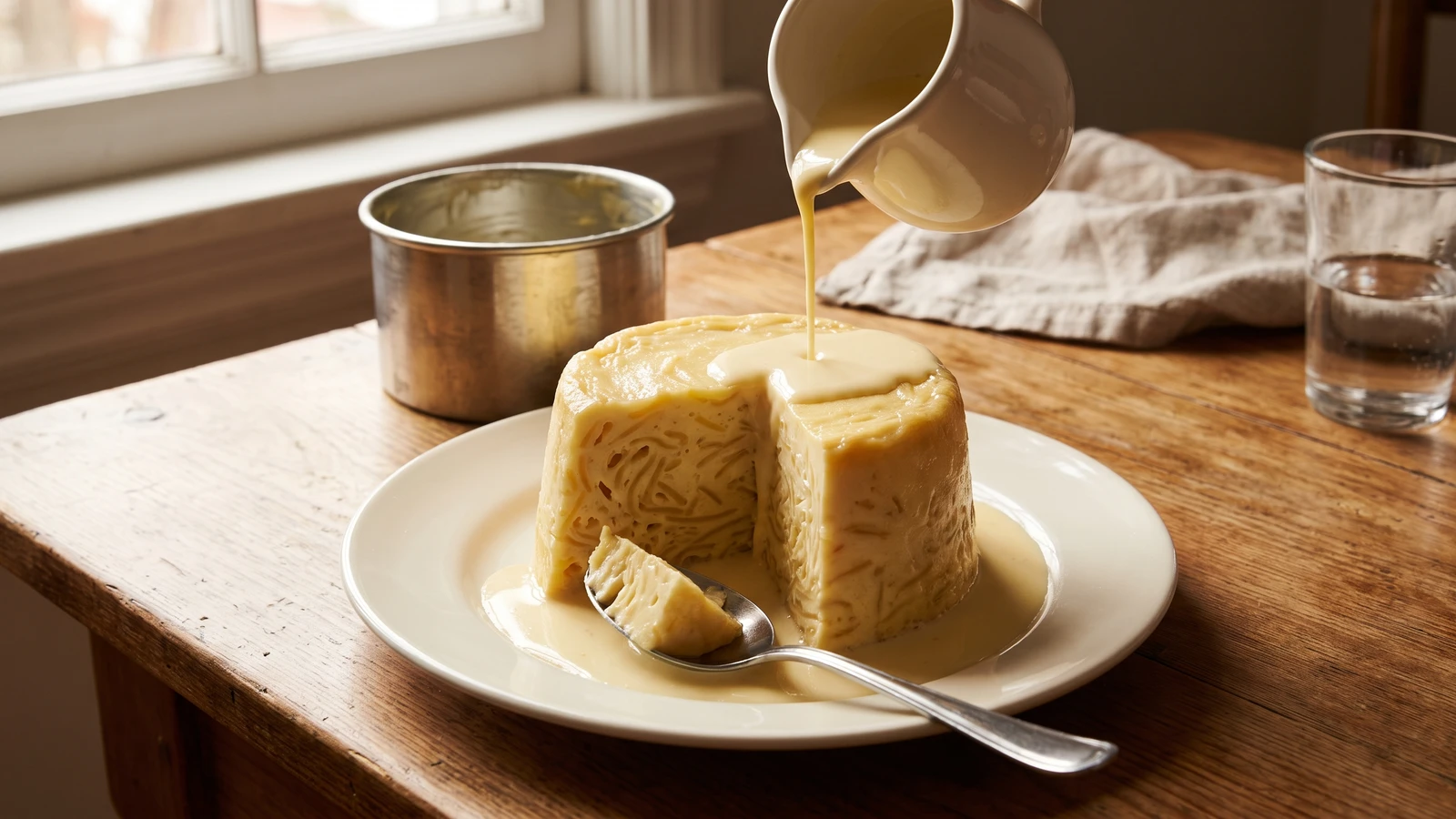
Thin ribbons of fresh egg noodle set in buttery sweet milk, enriched with yolks, lifted with whipped whites, and gently poached in a mould: a tender pudding with real structure.
Pouding de nouilles fraîches (fresh-noodle pudding) teaches a quiet custard truth: the starch must become tender before the eggs ever enter. Roll the noodles nearly translucent. A thick ribbon stays chewy inside the set milk, and no amount of extra poaching repairs it.
The book sends the cook to Tapioca (No. 2493) for the proportions and sequence: boiling milk, sugar, salt, two additions of butter, yolks, whipped whites, then a cylinder mould poached in a bain-marie (water bath). This one needs neither saucier nor salamander. The brigade scaffolding was a large batch, a tall professional mould, and another saucepan waiting; I halve the proportions for a 1-quart home mould and use a heatproof bowl to stop the cooking promptly. The fresh noodles replace the tapioca, exactly as the entry commands. Everything else stays.
The noodles should disappear under your teeth while remaining visible in the slice, held in a buttery custard made light by the whites. Keep the two additions of butter, the gentle poach, and the resting time, because those steps are the dish. Above all, roll the noodles thin before the milk comes near them.
Pouding de nouilles fraîches belongs to the French bourgeois and grand hotel dessert table rather than to one province. The word pouding reflects the French adoption of the English moulded-pudding form, which classical kitchens translated through enriched milk, carefully folded egg whites, and gentle poaching. Fresh noodles usually served the savoury kitchen, but here they became an entremets, proving how readily the canon moved one useful preparation between courses.
Quantity
1 canonical method (No. 2493)
method reference only; apply its proportions and sequence to fresh noodles
Quantity
½ cup plus 2 tablespoons (150 ml / 75 g)
Quantity
1, about 40 g without its shell
Quantity
1 tablespoon (15 ml / 8 g)
for rolling
Quantity
1 teaspoon (5 ml / 5 g)
only if the noodle dough needs it
Quantity
2 cups plus 1 tablespoon (495 ml / 510 g)
Quantity
¼ cup plus 1 teaspoon (65 ml / 57 g)
Quantity
⅛ teaspoon (0.6 ml / 0.75 g)
Quantity
3 tablespoons (45 ml / 43 g)
for cooking the noodles
Quantity
2½ tablespoons (37 ml / 35 g)
for enriching the pudding
Quantity
2 teaspoons (10 ml / 9 g)
softened, for the mould
Quantity
2 teaspoons (10 ml / 6 g)
for the mould
Quantity
3
Quantity
2
Quantity
1 cup (240 ml / about 240 g)
for serving
| Ingredient | Quantity |
|---|---|
| Tapiocamethod reference only; apply its proportions and sequence to fresh noodles | 1 canonical method (No. 2493) |
| all-purpose flour | ½ cup plus 2 tablespoons (150 ml / 75 g) |
| small egg | 1, about 40 g without its shell |
| all-purpose flourfor rolling | 1 tablespoon (15 ml / 8 g) |
| cool water (optional)only if the noodle dough needs it | 1 teaspoon (5 ml / 5 g) |
| whole milk | 2 cups plus 1 tablespoon (495 ml / 510 g) |
| granulated sugar | ¼ cup plus 1 teaspoon (65 ml / 57 g) |
| fine salt | ⅛ teaspoon (0.6 ml / 0.75 g) |
| unsalted butterfor cooking the noodles | 3 tablespoons (45 ml / 43 g) |
| unsalted butterfor enriching the pudding | 2½ tablespoons (37 ml / 35 g) |
| unsalted buttersoftened, for the mould | 2 teaspoons (10 ml / 9 g) |
| finely crushed instant tapiocafor the mould | 2 teaspoons (10 ml / 6 g) |
| large egg yolks | 3 |
| large egg whites | 2 |
| crème anglaise, sabayon, or smooth fruit sauce (optional)for serving | 1 cup (240 ml / about 240 g) |
Make the pâte à nouilles, the fresh egg-noodle dough. Mound the 75 g flour in a bowl, make a hollow, and add the small egg. Draw the flour inward with a fork, then knead for 6 to 8 minutes, until the dough feels smooth, firm, and faintly springy. If dry crumbs refuse to join, add the cool water a few drops at a time; if the dough sticks, dust it lightly with the rolling flour. Wrap and rest for 30 minutes so it rolls without snapping back.
Divide the rested dough in two. Pass each half through a pasta machine, narrowing the setting gradually, or roll firmly by hand, until the sheet is about 1 mm thick and you can see the shadow of your fingers through it. Dust sparingly, fold loosely, and cut into ribbons about ⅛ inch (3 mm) wide. Shake them open and leave them for 10 minutes. Thinness is the dish here: a thick noodle keeps an obstinate chew inside the custard.
Heat the oven to 325°F (165°C). Coat a 1-quart (1-liter) cylinder, charlotte, or deep pudding mould generously with the softened butter, reaching every seam. Sprinkle in the finely crushed instant tapioca, turn the mould until the coating is even, then tap out the excess. Set a folded kitchen towel in a deep roasting pan and place the mould on it; the towel keeps the vessel steady once the water is added.
Follow the milk-cooking sequence of Tapioca (No. 2493). Bring the whole milk, sugar, salt, and 43 g butter just to a boil in a wide ovenproof saucepan. Sprinkle in the noodles gradually while stirring so they remain separate, then return the mixture to a gentle simmer. Transfer the uncovered pan to the oven for 20 minutes, stirring carefully after the first 5 minutes. The noodles are ready when completely tender and surrounded by thickened, glossy milk, with no firm line remaining at their centres.
Scrape the noodle mixture into a wide heatproof bowl, the honest home equivalent of the second saucepan used for brigade work. Stir in the remaining 35 g butter until melted, then let the mixture cool for 5 to 8 minutes, stirring twice, until warm rather than fiercely hot. Beat the yolks together, stir in a spoonful of the warm noodles, then fold the tempered yolks through the bowl. This pause protects the eggs from scrambling while the remaining warmth begins to bind them.
Whip the egg whites to a stiff but glossy froth, firm enough to hold a peak without looking dry. Fold one-third into the noodles to loosen them, then fold in the remainder with broad strokes from the bottom of the bowl. If that first addition melts flat at once, the base is still too hot. Stop, set the bowl over cool water for 5 minutes, and continue with the remaining whites. Ça se rattrape. The finished mixture should look airy, with no large white streaks.
Spoon the mixture into the prepared mould without pressing out its air, leaving about ¾ inch (2 cm) at the top. Cover loosely with buttered parchment and foil. Pour freshly boiled water into the roasting pan until it reaches halfway up the mould, then bake for 40 to 50 minutes. The water should remain calm, never bubbling hard. The pudding is ready when the top feels softly resilient, the centre no longer sloshes, and a thermometer reaches 170 to 175°F (77 to 80°C).
Lift the mould from the bain-marie and let it stand for 7 to 8 minutes, no longer. Run a thin knife around the edge, cover with a warm serving plate, and invert decisively. If the pudding clings, hold a towel dipped in hot water against the base for 20 seconds and try again. Serve warm with crème anglaise, sabayon, or a smooth fruit sauce spooned around it. À table!
1 serving (about 145g)
Culinary guides, cultural storytelling, and the editorial depth that makes cooking meaningful.
Discover Culinary ExplorerChef Juliette
Five almond preparations, one discipline: remove the skins cleanly, dry every kernel through, then cut, toast, or cloak it in pale caramel without letting its fragrant oils escape.

Chef Juliette
A pastry pantry lesson in one tray: filberts warmed only until their red skins release, rubbed clean, cooled, and chopped into a fragrant mise-en-place for cakes, creams, pralines, and petits fours.

Chef Juliette
The smallest pâtisserie discipline decides whether a cake leaves its mould intact: clarified butter in every corner, followed by the lightest veil of dry flour or fécule.

Chef Juliette
Four whites, one spotless bowl, and a patient change of speed: whisk gently until loosened, then briskly to glossy stiffness, with powdered sugar waiting if the foam begins to granulate.