
Chef Juliette
Various Almond Preparations
Five almond preparations, one discipline: remove the skins cleanly, dry every kernel through, then cut, toast, or cloak it in pale caramel without letting its fragrant oils escape.
A cooking platform built around craft, culture, and the stories behind what we eat.
Created by Chef Juliette
Based on No. 2496, Vermicelli Pudding, from Le Guide Culinaire (1907) by Auguste Escoffier
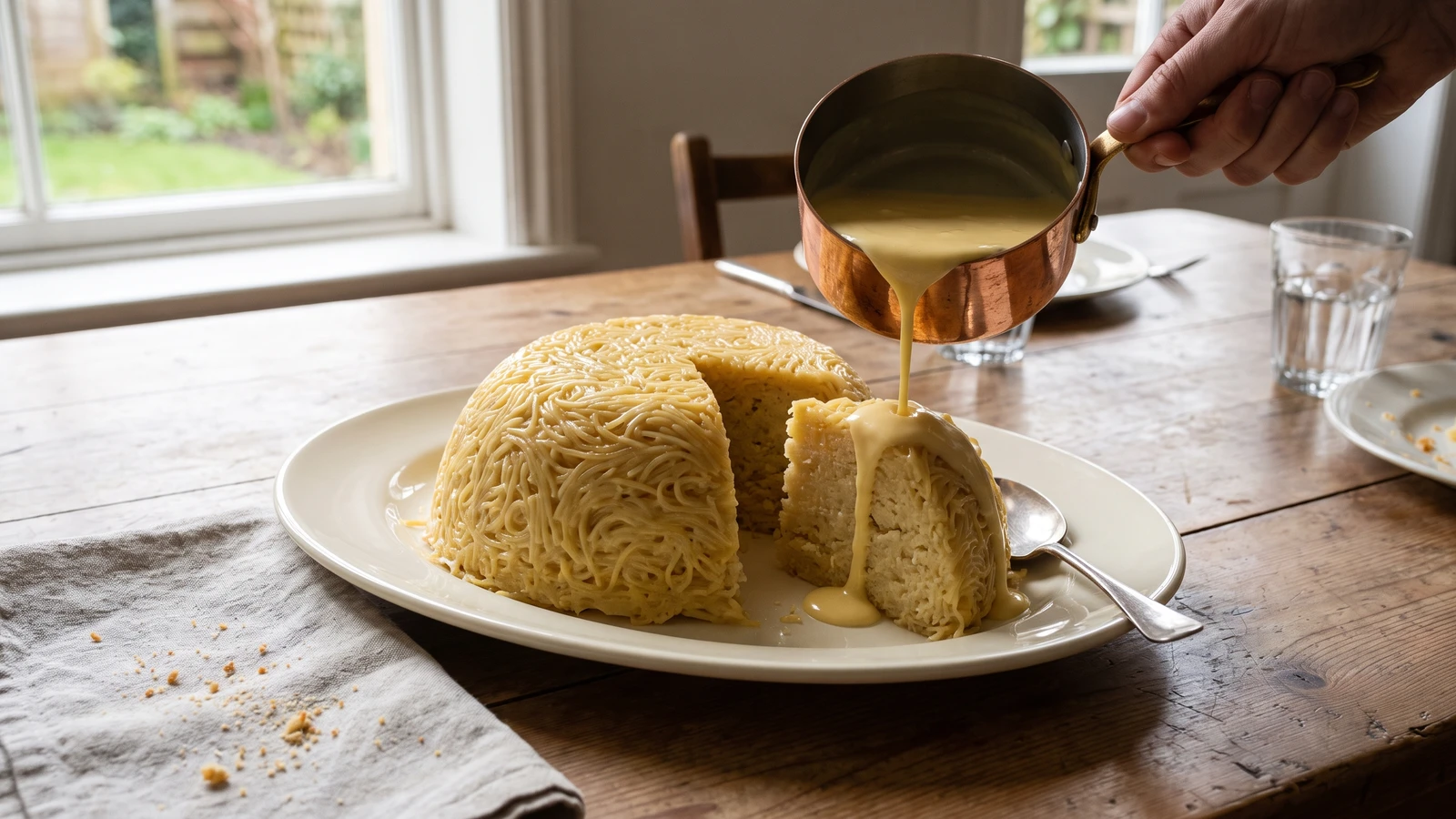
Milk-tender vermicelli, butter, yolks, and folded whites become a light molded pudding, with long strands left nearly whole so the turned dessert wears its own pattern.
Pouding de vermicelle teaches the quiet law of molded custards: the water around the mould must tremble, never boil. Milk-soft strands, yolks, butter, and folded whites will set into something resilient enough to turn out yet tender under the spoon. Before you touch a pan, fix that gentle poach in your mind.
The source sends the cook to Tapioca (No. 2493), replaces its starch with vermicelli, and assumes a generous cylinder mould, two saucepans, and enough hands to cool one mixture while another is whipped. Here the proportions are halved for four people, a 1-quart charlotte mould replaces the professional cylinder, and a mixing bowl replaces the second saucepan. That extra pan was brigade scaffolding. The butter in two additions, stiffly beaten whites, bain-marie, and seven-minute rest are the dish and remain. One cook, one stove, one evening.
Keep the strands lining the mould long enough to make their own pattern. They should trace the finished pudding in butter-gold lines, not disappear into crumbs. The step that decides everything is the bain-marie: hold it below a boil and the pudding sets evenly; let it churn and the custard tightens around the edges before its heart is ready.
Pouding de vermicelle belongs to Parisian cuisine bourgeoise and the classical hotel table, where molded rice, semolina, tapioca, and noodle puddings formed a whole family of warm entremets. Its French name preserves the English word pudding, evidence of how a foreign form entered the national repertoire and acquired the disciplined French mould-and-bain-marie method. The long strands were not decoration added at service; they lined the mould itself, identifying the pudding before its custard or fruit sauce was poured.
Quantity
2 loosely filled cups (4 oz / 113 g)
broken only once if necessary to fit the pan
Quantity
2⅛ cups (500 ml / 515 g)
Quantity
¼ cup (2 oz / 57 g)
Quantity
⅛ teaspoon (0.6 ml / 0.8 g)
Quantity
3 tablespoons (45 ml / 43 g)
Quantity
3
Quantity
2½ tablespoons (37 ml / 35 g)
softened
Quantity
2
at room temperature
Quantity
2 teaspoons (10 ml / 10 g)
softened
Quantity
¼ loosely filled cup (½ oz / 14 g)
left in strands roughly 2 to 3 inches (5 to 8 cm) long
Quantity
1 cup (240 ml / about 250 g)
| Ingredient | Quantity |
|---|---|
| fine wheat vermicelli, replacing the tapioca in Tapioca (No. 2493)broken only once if necessary to fit the pan | 2 loosely filled cups (4 oz / 113 g) |
| whole milk | 2⅛ cups (500 ml / 515 g) |
| granulated sugar | ¼ cup (2 oz / 57 g) |
| fine salt | ⅛ teaspoon (0.6 ml / 0.8 g) |
| unsalted butter | 3 tablespoons (45 ml / 43 g) |
| large egg yolks | 3 |
| unsalted buttersoftened | 2½ tablespoons (37 ml / 35 g) |
| large egg whitesat room temperature | 2 |
| unsalted butter for the mouldsoftened | 2 teaspoons (10 ml / 10 g) |
| fine wheat vermicelli for lining the mouldleft in strands roughly 2 to 3 inches (5 to 8 cm) long | ¼ loosely filled cup (½ oz / 14 g) |
| prepared English custard (optional) | 1 cup (240 ml / about 250 g) |
Heat the oven to 350°F (180°C). Butter a 1-quart (1-liter) straight-sided charlotte or pudding mould thoroughly, reaching every corner. Scatter the reserved vermicelli over the base and sides, pressing the strands lightly into the butter so they adhere. Leave them 2 to 3 inches (5 to 8 cm) long wherever the shape permits; crumbs cannot make the pattern this pudding promises. Chill the prepared mould while you make the base.
Bring the milk, sugar, salt, and 3 tablespoons (43 g) butter to a boil in a 2-quart (2-liter) ovenproof saucepan. Add the main quantity of vermicelli in a loose rain, stirring gently so the strands separate. This follows the governing formula of Tapioca (No. 2493), with vermicelli as the source directs. Slide the uncovered pan into the oven for 20 minutes, stirring carefully after 10 minutes, until the strands are tender and the milk has thickened around them. If the vermicelli gathers into a knot, separate it with two forks. Don't whisk, which breaks the strands and turns the base pasty.
Scrape the vermicelli mixture into a wide heatproof bowl and let it cool for 5 to 8 minutes, until it remains hot but no longer bubbles, about 140°F (60°C). Stir a large spoonful into the yolks, then return that tempered mixture to the bowl and fold thoroughly through the vermicelli. Add the softened 2½ tablespoons (35 g) butter and stir until it melts into a glossy emulsion. If a few yellow threads begin to set, immediately stir in 1 tablespoon of cold milk and move the bowl onto a cool surface. Ça se rattrape when caught at once.
Beat the egg whites until they hold stiff, glossy peaks but still look supple. Fold one-third into the vermicelli base to loosen it, then fold in the remainder with broad strokes from the bottom of the bowl. Keep the air you worked to build. If the first addition disappears instantly, the base is still too hot; stop, wait another 5 minutes, and continue only when the next spoonful remains visibly light.
Spoon the mixture carefully into the lined mould so the exterior strands stay in place, then level the surface without pressing out the air. Set the mould in a deep roasting pan and pour in hot water to come halfway up its sides. Reduce the oven to 325°F (160°C) and poach for 45 to 55 minutes, until the top springs back gently and the centre feels resilient rather than liquid. The water should barely quiver. If it begins bubbling hard, lower the oven and add a cup of cool water to the roasting pan. Ça se rattrape; what matters is calming the bath before the pudding curdles at its edges.
Lift the mould from the bain-marie and leave it untouched for 7 to 8 minutes, exactly as the source instructs. Loosen only the upper rim with a thin knife, cover the mould with a warm serving platter, and invert both together in one confident movement. If the pudding clings, wrap the mould briefly in a towel dipped in hot water, wait 20 seconds, and lift again. Never shake it; a warm mould releases more cleanly than a frightened cook.
Serve the pouding de vermicelle warm or at room temperature, with English custard pooled lightly around its base. The source also permits sabayon or a smooth fruit sauce, both served separately so the long-strand pattern remains visible. Bring the whole pudding to the table before cutting it into generous wedges. À table!
1 serving (about 275g)
Culinary guides, cultural storytelling, and the editorial depth that makes cooking meaningful.
Discover Culinary ExplorerChef Juliette
Five almond preparations, one discipline: remove the skins cleanly, dry every kernel through, then cut, toast, or cloak it in pale caramel without letting its fragrant oils escape.

Chef Juliette
A pastry pantry lesson in one tray: filberts warmed only until their red skins release, rubbed clean, cooled, and chopped into a fragrant mise-en-place for cakes, creams, pralines, and petits fours.

Chef Juliette
The smallest pâtisserie discipline decides whether a cake leaves its mould intact: clarified butter in every corner, followed by the lightest veil of dry flour or fécule.

Chef Juliette
Four whites, one spotless bowl, and a patient change of speed: whisk gently until loosened, then briskly to glossy stiffness, with powdered sugar waiting if the foam begins to granulate.