
Chef Juliette
Various Almond Preparations
Five almond preparations, one discipline: remove the skins cleanly, dry every kernel through, then cut, toast, or cloak it in pale caramel without letting its fragrant oils escape.
A cooking platform built around craft, culture, and the stories behind what we eat.
Created by Chef Juliette
Based on No. 2495, Semolina Pudding, from Le Guide Culinaire (1907) by Auguste Escoffier
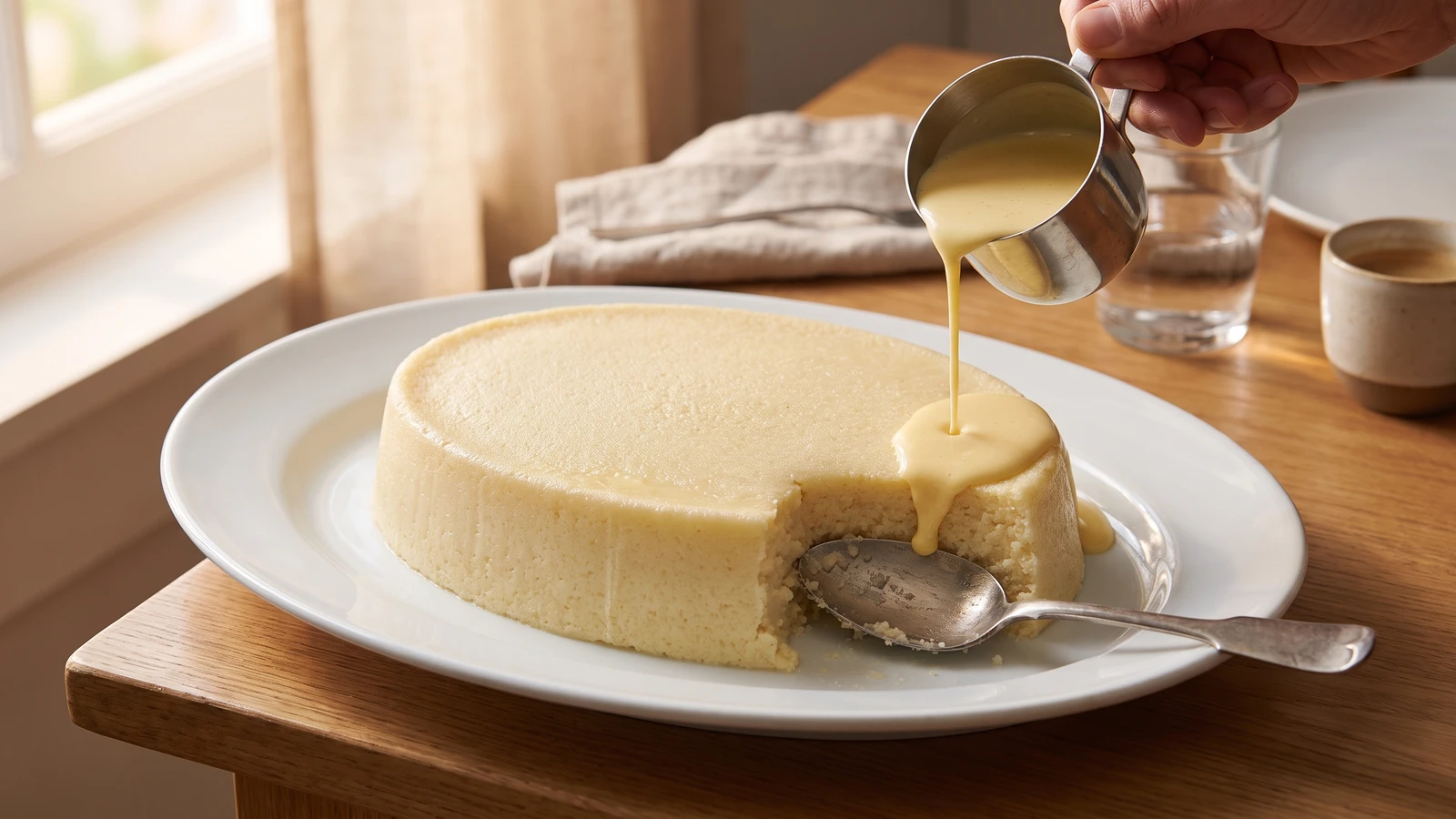
Gâteau de semoule turns sweet milk and economical grain into a tender moulded pudding, lifted with yolks and whipped whites, then gently poached until resilient enough to turn out.
Gâteau de semoule (semolina pudding) teaches one essential lesson: the grain must be completely cooked before the eggs touch it. Yolks can enrich semolina and whipped whites can lighten it, but neither can soften a gritty centre once the pudding has set. Taste the grain, not the clock.
The source builds on Tapioca (No. 2493) and assumes a large cylinder mould, a second saucepan waiting, and a deep poaching pan suited to a professional batch. Here its proportions are halved exactly for four, a 1-quart mould replaces the larger cylinder, and a heatproof bowl does the second saucepan's work because no further stove heat is needed. That transfer is brigade scaffolding. The bain-marie, the gentle water bath that protects the eggs, is the dish and stays exactly where it belongs. One cook, one stove, one evening.
Turned out, the gâteau de semoule should hold its shape while yielding softly to the spoon, ivory within and lightly freckled by the semolina coating. The whites make it tender rather than lofty, and the butter gives the plain grain its richness. Before you enrich the mixture, taste several grains and make certain each is swollen and soft. That is the step that decides everything.
Gâteau de semoule belongs to the French cuisine bourgeoise table rather than to one province: milk, sugar, eggs, and an economical grain made a sustaining household sweet. From family kitchens it passed into the classical repertoire, where a cylinder mould, a bain-marie, and separately beaten whites gave simple milk porridge the poise of a turned pudding. Despite the word gâteau, it is not a flour-and-crumb cake; the name describes its moulded form, while caramel and raisin versions are household cousins rather than requirements of this plain formula.
Quantity
⅔ cup (160 ml / 113 g), replacing the tapioca in Tapioca (No. 2493)
Quantity
2 cups plus 2 tablespoons (500 ml / 515 g)
Quantity
¼ cup (60 ml / 57 g)
Quantity
⅛ teaspoon (0.6 ml / 0.75 g)
Quantity
3 tablespoons (45 ml / 43 g)
cut into pieces
Quantity
3
Quantity
2½ tablespoons (37 ml / 35 g)
softened
Quantity
2
Quantity
1 tablespoon (15 ml / 14 g)
softened
Quantity
1 tablespoon (15 ml / 12 g)
| Ingredient | Quantity |
|---|---|
| fine semolina | ⅔ cup (160 ml / 113 g), replacing the tapioca in Tapioca (No. 2493) |
| whole milk | 2 cups plus 2 tablespoons (500 ml / 515 g) |
| granulated sugar | ¼ cup (60 ml / 57 g) |
| fine salt | ⅛ teaspoon (0.6 ml / 0.75 g) |
| unsalted buttercut into pieces | 3 tablespoons (45 ml / 43 g) |
| large egg yolks | 3 |
| unsalted buttersoftened | 2½ tablespoons (37 ml / 35 g) |
| large egg whites | 2 |
| unsalted butter for the mouldsoftened | 1 tablespoon (15 ml / 14 g) |
| granulated semolina for the mould | 1 tablespoon (15 ml / 12 g) |
Heat the oven to 325°F (165°C) and bring a kettle of water to the boil for the bain-marie. Butter a 1-quart (1-litre) straight-sided cylinder or charlotte mould generously, reaching into every corner. Add the granulated semolina, rotate the mould until the interior wears a thin, even sandy coat, then tap out the excess. Butter, not oil. The coating helps the tender pudding release without giving it a greasy surface.
Following the base method of Tapioca (No. 2493), combine the milk, sugar, salt, and 3 tablespoons of butter in a lidded ovenproof saucepan. Bring to a full boil over medium heat, stirring along the bottom so the milk cannot catch. Rain in the fine semolina slowly while whisking, never dumping it in one heap, then return the mixture to a gentle bubble. Cover and cook in the oven for 20 minutes, stirring once halfway through. Taste several grains at the end: they must be swollen and soft with no chalky centre. If they remain gritty, cover and return the pan to the oven for 5 minutes, then taste again. Ça se rattrape, but only before the eggs go in.
Transfer the cooked semolina to a wide heatproof bowl and let it stand for 2 minutes, stirring twice to release the fiercest heat. Beat in the yolks one at a time, working promptly so each disappears before the next is added, then beat in the softened butter until the mixture is glossy and completely uniform. Keep it off the stove now. Direct heat after the yolks enter can scramble them.
Beat the egg whites until they hold stiff but still moist peaks. Stir one-quarter of the whites firmly into the semolina to loosen its weight, then fold in the remainder with broad turns from the bottom of the bowl. Stop as soon as no white streaks remain. The aim is a tender pudding, not a towering soufflé, so preserve the air without fussing over every last bubble.
Spoon the mixture into the prepared mould and smooth the top without pressing out the air. Set the mould in a deep roasting pan, place the pan on the oven rack, then pour in enough boiling water to reach halfway up the mould. Bake for 45 to 55 minutes. The water should barely tremble, never boil hard, and the pudding is ready when its centre feels resilient under a light fingertip and springs gently back. If the centre still feels liquid beneath the surface, give it another 5 minutes and test again.
Lift the mould from the bain-marie and let the pudding stand for 8 minutes, no longer. Run a thin knife around the rim, cover the mould with a serving platter, and invert both in one confident motion. Wait several seconds before lifting the mould. If the pudding clings, lay a hot damp towel over the upturned mould for 20 seconds and try again. Serve with crème anglaise, the source's English custard, a sabayon, or a fruit sauce. À table!
1 serving (about 210g)
Culinary guides, cultural storytelling, and the editorial depth that makes cooking meaningful.
Discover Culinary ExplorerChef Juliette
Five almond preparations, one discipline: remove the skins cleanly, dry every kernel through, then cut, toast, or cloak it in pale caramel without letting its fragrant oils escape.

Chef Juliette
A pastry pantry lesson in one tray: filberts warmed only until their red skins release, rubbed clean, cooled, and chopped into a fragrant mise-en-place for cakes, creams, pralines, and petits fours.

Chef Juliette
The smallest pâtisserie discipline decides whether a cake leaves its mould intact: clarified butter in every corner, followed by the lightest veil of dry flour or fécule.

Chef Juliette
Four whites, one spotless bowl, and a patient change of speed: whisk gently until loosened, then briskly to glossy stiffness, with powdered sugar waiting if the foam begins to granulate.