
Chef Juliette
Example: Omelet With Rum
Omelette au rhum teaches two kinds of heat: set the sugared eggs softly, then warm the rum just enough to catch, bathing the butter-gold roll in a brief blue flame at the table.
A cooking platform built around craft, culture, and the stories behind what we eat.
Created by Chef Juliette
Based on No. 2468, Chinese Surprise Omelet, from Le Guide Culinaire (1907) by Auguste Escoffier
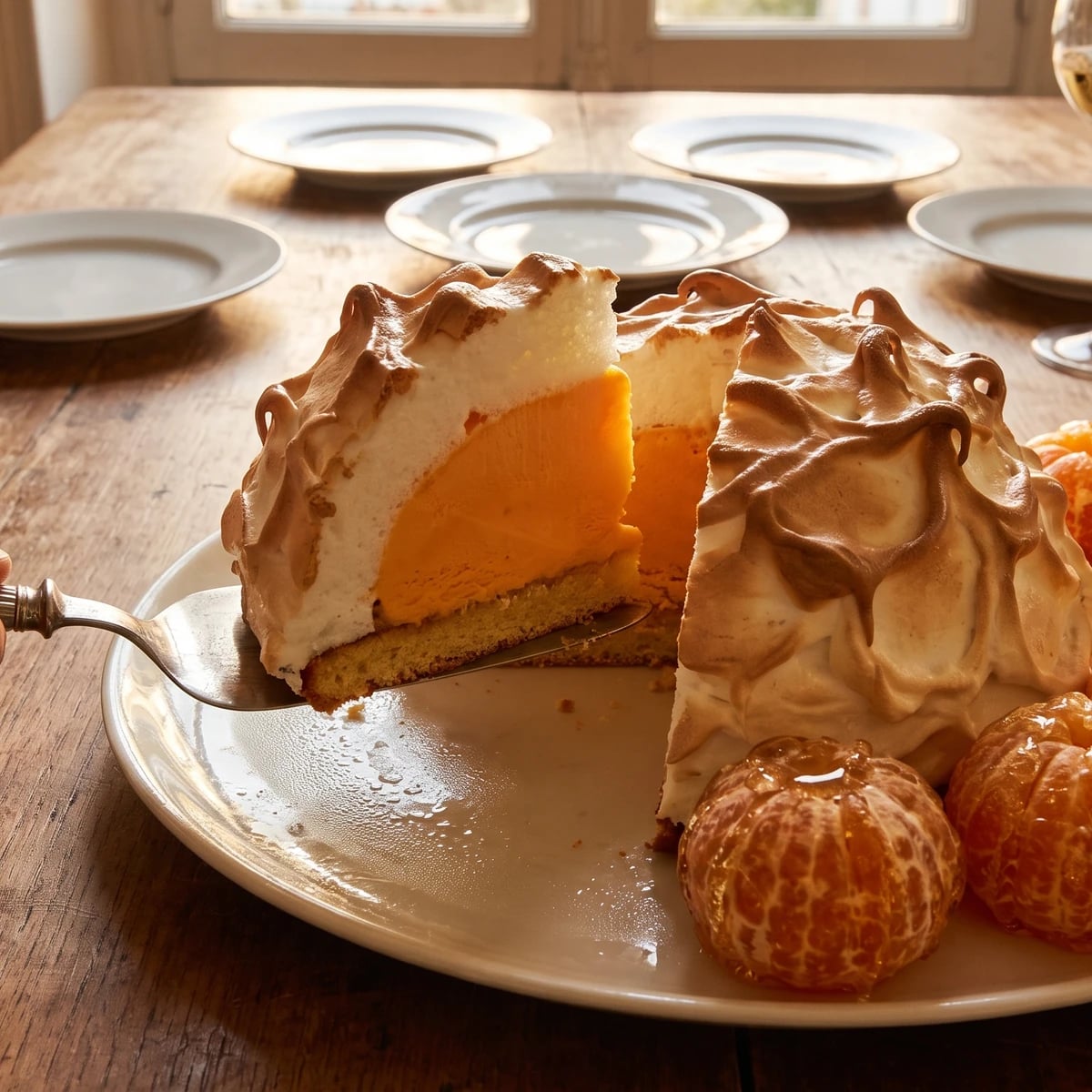
Tangerine ice under a deep-bronzed meringue shell, with whole tangerines caught in clear large-crack sugar: a dinner-party surprise built on one calm rule, freeze hard and seal completely.
Omelette surprise chinoise (tangerine baked Alaska) teaches the most theatrical truth in pastry: cold survives a fierce oven when the meringue is thick, continuous, and the center enters frozen solid. The heat colors the outside before it can travel inward. Leave one bare seam, however, and the trick becomes a puddle.
The original procedure assumed a pastry section handing over tangerine ice, génoise, meringue, and large-crack sugar at precisely the right moments, followed by a salamander for the final bronze. At home, a small bowl molds the ice, the freezer does the holding, a fiercely heated oven replaces the salamander, and a sugar thermometer replaces testing molten syrup by hand. The brigade relay was scaffolding and goes. The tangerine ice, complete meringue seal, and whole fruits glazed at large crack are the dish and stay, scaled to six for one cook, one stove, one evening.
The finished dome should arrive deeply bronzed outside, brilliant orange and frozen within, with six clear-shelled tangerines shining around it. Dry those fruits before glazing, but before you touch a pan, remember the step that decides the omelette surprise chinoise: freeze the molded ice until hard, then bury every millimeter beneath meringue.
Omelette surprise belongs to the grand Paris dining-room repertoire, where a frozen center hidden beneath insulating meringue turned a brief visit to the oven into part of the service. This variation replaces vanilla ice cream with tangerine ice and adds whole tangerines in large-crack sugar, joining the flavor of the interior to the table decoration. Here, chinoise belongs to classical French menu vocabulary associated with the tangerine garnish, not to a Chinese cooking method.
Quantity
2 cups (480 ml / 500 g)
finely strained
Quantity
1 tablespoon (15 ml / 6 g)
finely grated
Quantity
2/3 cup (160 ml / 135 g)
Quantity
1/2 cup (120 ml / 120 g)
Quantity
2
Quantity
1/3 cup (80 ml / 65 g)
Quantity
1/2 cup (120 ml / 60 g)
sifted
Quantity
2 tablespoons (30 ml / 28 g)
melted and cooled
Quantity
1 teaspoon (5 ml / 5 g)
softened
Quantity
5
preferably pasteurized and at room temperature
Quantity
1 cup (240 ml / 200 g)
Quantity
6
peeled whole with every thread of pith removed
Quantity
1 batch (No. 2344), about 1½ cups (360 ml / 350 g) finished glaze
| Ingredient | Quantity |
|---|---|
| fresh tangerine juicefinely strained | 2 cups (480 ml / 500 g) |
| tangerine zestfinely grated | 1 tablespoon (15 ml / 6 g) |
| granulated sugar for the tangerine ice | 2/3 cup (160 ml / 135 g) |
| water | 1/2 cup (120 ml / 120 g) |
| large eggs | 2 |
| superfine sugar for the génoise | 1/3 cup (80 ml / 65 g) |
| cake floursifted | 1/2 cup (120 ml / 60 g) |
| unsalted buttermelted and cooled | 2 tablespoons (30 ml / 28 g) |
| unsalted butter for the pansoftened | 1 teaspoon (5 ml / 5 g) |
| large egg whitespreferably pasteurized and at room temperature | 5 |
| superfine sugar for the meringue | 1 cup (240 ml / 200 g) |
| small seedless tangerinespeeled whole with every thread of pith removed | 6 |
| The Cooking of Sugar, large-crack glaze | 1 batch (No. 2344), about 1½ cups (360 ml / 350 g) finished glaze |
Warm the water and granulated sugar together just until the sugar dissolves, then cool the syrup completely. Stir in the strained tangerine juice and zest and chill until very cold. Churn in an ice-cream machine, pack into a plastic-lined 15 cm or 6 inch bowl, smooth the surface, and freeze for at least 4 hours, until solid through the center. Without a machine, freeze the mixture in a shallow metal pan, scrape it thoroughly every 30 minutes, then process it briefly until smooth before molding. If the dome slumps when tested, return it to the bowl and freeze longer. Ça se rattrape, but only while the ice remains off the sponge.
Heat the oven to 190°C or 375°F. Butter and line a 20 cm or 8 inch round cake pan. Whisk the eggs and superfine sugar over a bain-marie, a warm water bath, until the mixture feels barely warm, then remove it from the heat and beat until pale, thick, and able to hold a ribbon on its surface. Fold in the flour in three additions, followed by the cooled melted butter. Spread the batter in the pan and bake for 9 to 12 minutes, until golden and springy at the center. Cool completely, then trim the génoise into a disc about 2 cm or 3/4 inch wider than the frozen mold.
Peel the six tangerines without separating their segments, remove every white thread, and blot them very gently with clean towels. Leave them uncovered on a rack for at least 1 hour, turning once, until the surface feels dry rather than slick. This cannot be hurried: moisture clouds the sugar, thins its shell, and makes it slide from the fruit.
Place the génoise on a parchment-lined metal baking sheet. Unmold the tangerine ice onto its center and remove the plastic. Return the whole assembly to the freezer for at least 20 minutes while the meringue is made. The ice must be hard enough that firm pressure from a fingertip leaves no hollow.
Beat the egg whites in a perfectly clean bowl until they hold soft peaks. Add the superfine sugar gradually, one spoonful at a time, beating until the meringue is dense, glossy, and stiff enough to stand upright from the whisk. Rub a little between two fingers; if it feels strongly gritty, keep beating. If the meringue loosens after the sugar goes in, set the bowl briefly over barely warm water and continue whisking until it gains body, then whisk off the heat until the bowl feels cool.
Cover the tangerine ice and the exposed edge of the génoise with meringue at least 2 cm or 3/4 inch thick. Seal the join at the base first, then sweep the remaining meringue upward into broad peaks. Inspect the entire dome for bare spots, because one gap gives the oven a direct road to the ice. If the ice begins to soften or leak, stop and freeze the assembly for 30 minutes before patching it. Ça se rattrape. Freeze the sealed omelette surprise chinoise while the oven heats to its highest setting, ideally 260°C or 500°F.
Have The Cooking of Sugar (No. 2344) ready at the large-crack stage just before the omelette goes into the oven. Holding each thoroughly dried tangerine on a sturdy wooden skewer, dip it quickly into the sugar, let the excess drain, and set it on a silicone mat until the shell hardens. Never touch the liquid sugar. If the first coating turns cloudy or slips, moisture remains on the fruit; let the failed shell cool, crack it away, dry the fruit again, and redip only when the surface is completely dry.
Bake the frozen omelette surprise chinoise in the upper third of the fiercely hot oven for 3 to 5 minutes, just until the meringue peaks turn deep gold and bronze. Do not wait for perfectly even color; restraint keeps the center frozen. Transfer it immediately to a chilled oval platter with two broad spatulas and surround it with the six glazed tangerines, exactly as the dish requires. Carry it whole to the table, cut with a warm, dry knife, and give each serving one glazed fruit. À table!
1 serving (about 355g)
Culinary guides, cultural storytelling, and the editorial depth that makes cooking meaningful.
Discover Culinary Explorer
Chef Juliette
Omelette au rhum teaches two kinds of heat: set the sugared eggs softly, then warm the rum just enough to catch, bathing the butter-gold roll in a brief blue flame at the table.

Chef Juliette
Omelette aux Abricots rolls tender eggs around bright apricot jam, then flashes icing sugar beneath fierce heat, giving a caramelized top while the center stays soft.

Chef Juliette
A butter-gold sweet omelette wrapped around warm, spice-dark mincemeat, rolled while its centre stays creamy, then glossed with rum and set alight at the Christmas table.

Chef Juliette
Omelette soufflée à la vanille turns ribboned yolks and whites beaten stiff into one golden, vanilla-scented oval, simply piped, glazed with icing sugar, and carried straight from oven to table.