
Chef Juliette
Various Almond Preparations
Five almond preparations, one discipline: remove the skins cleanly, dry every kernel through, then cut, toast, or cloak it in pale caramel without letting its fragrant oils escape.
A cooking platform built around craft, culture, and the stories behind what we eat.
Created by Chef Juliette
Based on No. 2467, Surprise Omelet Mylord, from Le Guide Culinaire (1907) by Auguste Escoffier
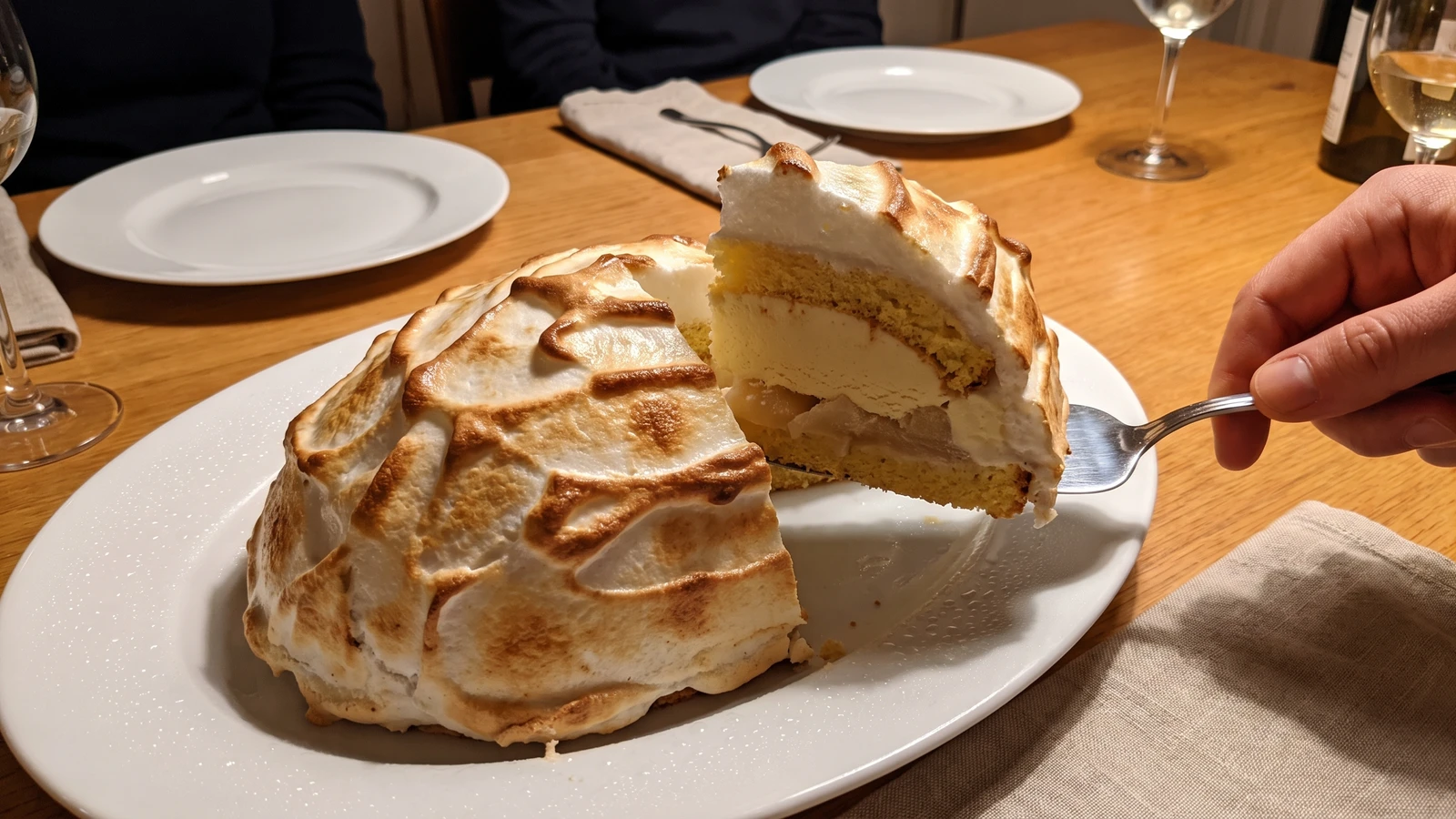
Vanilla ice cream and drained stewed pears rise in alternating layers over fine Génoise, sealed beneath bronzed meringue that proves fierce heat and deep cold can share one dessert.
Omelette Surprise Mylord (Norwegian omelet with vanilla ice cream and pears) teaches insulation, but the one true thing to know before touching a pan is simpler: drain the pears hard. Loose syrup melts the ice cream, soaks the Pâte à Génoise Fine (No. 2376), and slackens the meringue from beneath. Cold, dry layers are what make the surprise possible.
The original assumed brigade-sized preparations waiting in the pastry kitchen, ample freezer space, and a salamander fierce enough to bronze the dessert in moments. At home, use one small Génoise cushion, a quarter batch of Ordinary Meringue (No. 2382), a metal sheet, an ordinary freezer, and the hottest broiler you own. The bulk batches were brigade scaffolding and can go. Alternating coats of vanilla ice cream and pear, a complete meringue seal, and very fast browning are the dish itself and must stay. One cook, one stove, one evening.
When it reaches the table, the meringue should be ivory beneath chestnut-brown ridges, the Génoise tender, and the frozen centre clearly striped with pear. Freeze the layered core until it is absolutely solid before covering it. That firmness buys you the few crucial minutes under the broiler.
Omelette surprise, also called omelette norvégienne, belongs to the Parisian grand-kitchen repertoire, where pastry cooks made a spectacle from the insulating power of sponge and meringue around frozen cream. Its Norwegian name is a fanciful contrast between a cold interior and a browned exterior, not a claim of Norwegian origin. The Mylord variation is distinguished by alternating vanilla ice cream with stewed pears on a cushion of fine Génoise, rather than treating fruit as a decoration alongside.
Quantity
3 medium, about 1¼ lb (570 g)
peeled, cored, and cut into ¼-inch (6 mm) slices
Quantity
¾ cup (180 ml / 150 g)
Quantity
2 cups (475 ml / 475 g)
Quantity
⅛ batch, baked as one 7-inch (18 cm) round about ¾ inch (2 cm) thick, approximately 7 oz (200 g), Pâte à Génoise Fine (No. 2376)
Quantity
3 cups (710 ml / 600 g)
softened only until spreadable
Quantity
¼ batch, about 3 cups (710 ml / 170 g), Ordinary Meringue (No. 2382)
freshly made
| Ingredient | Quantity |
|---|---|
| firm-ripe pearspeeled, cored, and cut into ¼-inch (6 mm) slices | 3 medium, about 1¼ lb (570 g) |
| granulated sugar | ¾ cup (180 ml / 150 g) |
| water | 2 cups (475 ml / 475 g) |
| Pâte à Génoise Fine | ⅛ batch, baked as one 7-inch (18 cm) round about ¾ inch (2 cm) thick, approximately 7 oz (200 g), Pâte à Génoise Fine (No. 2376) |
| firm vanilla ice creamsoftened only until spreadable | 3 cups (710 ml / 600 g) |
| Ordinary Meringuefreshly made | ¼ batch, about 3 cups (710 ml / 170 g), Ordinary Meringue (No. 2382) |
Bring the sugar and water to a simmer in a wide saucepan, stirring only until the sugar dissolves. Add the pear slices and hold them at a gentle simmer for 6 to 10 minutes, until a knife enters easily but the slices still keep their shape. Lift them into a fine sieve and leave them to drain for 20 minutes, then spread them in one layer on a clean towel and chill completely. Press another towel lightly over the top before assembly. If syrup appears underneath, drain and blot them again. Ça se rattrape. What cannot be rescued is syrup buried inside the frozen layers.
Set the Pâte à Génoise Fine (No. 2376) on a sheet of baking parchment laid over a rimless metal baking sheet. The round should be level and no thicker than ¾ inch (2 cm), enough to support the frozen centre without becoming a great mattress of cake. Place the sheet and Génoise in the freezer for 20 minutes. Use metal here, never a glass or delicate ceramic platter that may crack beneath the broiler.
Divide the ice cream into three equal portions and the drained pears into two. Spread one portion of ice cream over the Génoise, leaving a ½-inch (1 cm) border. Lay half the pears closely over it without overlapping heavily, cover with the second portion of ice cream, add the remaining pears, and finish with the last ice cream. Make each layer slightly narrower than the one beneath it so the finished centre forms a low dome. Work quickly. If the ice cream begins to run rather than spread, stop and freeze the dessert for 10 minutes before continuing. Freeze the completed core until rigid throughout, at least 4 hours.
Set an oven rack 7 to 8 inches (18 to 20 cm) below the broiler and preheat it at its highest setting for a full 10 minutes. Take the frozen dessert out only when the broiler is ready. Reserve 2 tablespoons of the Ordinary Meringue (No. 2382), then cover the dome with the rest in an even coat at least ¾ inch (2 cm) thick. Carry it over the exposed Génoise and right down to the parchment so no ice cream or cake remains visible. Raise loose ridges with the spatula. A gap is a door for the heat, so patch every one. If the meringue drags or the core softens, return it to the freezer for 10 minutes, then finish the seal.
Slide the metal sheet beneath the broiler and watch without looking away. Rotate it once or twice as the ridges turn chestnut brown, usually within 2 to 4 minutes. The valleys should remain ivory and the base should still feel rigid. If a patch of ice cream begins to escape, pull the dessert out at once, freeze it for 10 minutes, seal the opening with the reserved meringue, and brown only that patch briefly. Ça se rattrape. A mottled bronze is preferable to a perfectly coloured puddle.
Use two broad spatulas to transfer the omelette surprise to a chilled serving platter. Bring it to the table immediately and cut with a thin knife dipped in hot water and wiped completely dry between slices. Each portion should show Génoise beneath distinct coats of vanilla ice cream and pear, all held beneath the bronzed meringue. À table!
1 serving (about 250g)
Culinary guides, cultural storytelling, and the editorial depth that makes cooking meaningful.
Discover Culinary ExplorerChef Juliette
Five almond preparations, one discipline: remove the skins cleanly, dry every kernel through, then cut, toast, or cloak it in pale caramel without letting its fragrant oils escape.

Chef Juliette
A pastry pantry lesson in one tray: filberts warmed only until their red skins release, rubbed clean, cooled, and chopped into a fragrant mise-en-place for cakes, creams, pralines, and petits fours.

Chef Juliette
The smallest pâtisserie discipline decides whether a cake leaves its mould intact: clarified butter in every corner, followed by the lightest veil of dry flour or fécule.

Chef Juliette
Four whites, one spotless bowl, and a patient change of speed: whisk gently until loosened, then briskly to glossy stiffness, with powdered sugar waiting if the foam begins to granulate.