Culinary Explorer

A cooking platform built around craft, culture, and the stories behind what we eat.
Discover Culinary Explorer
Sardines à la Diable

Sardines à la Diable

Created by Chef Juliette

Based on No. 2325, Sardines à la Diable, from Le Guide Culinaire (1907) by Auguste Escoffier

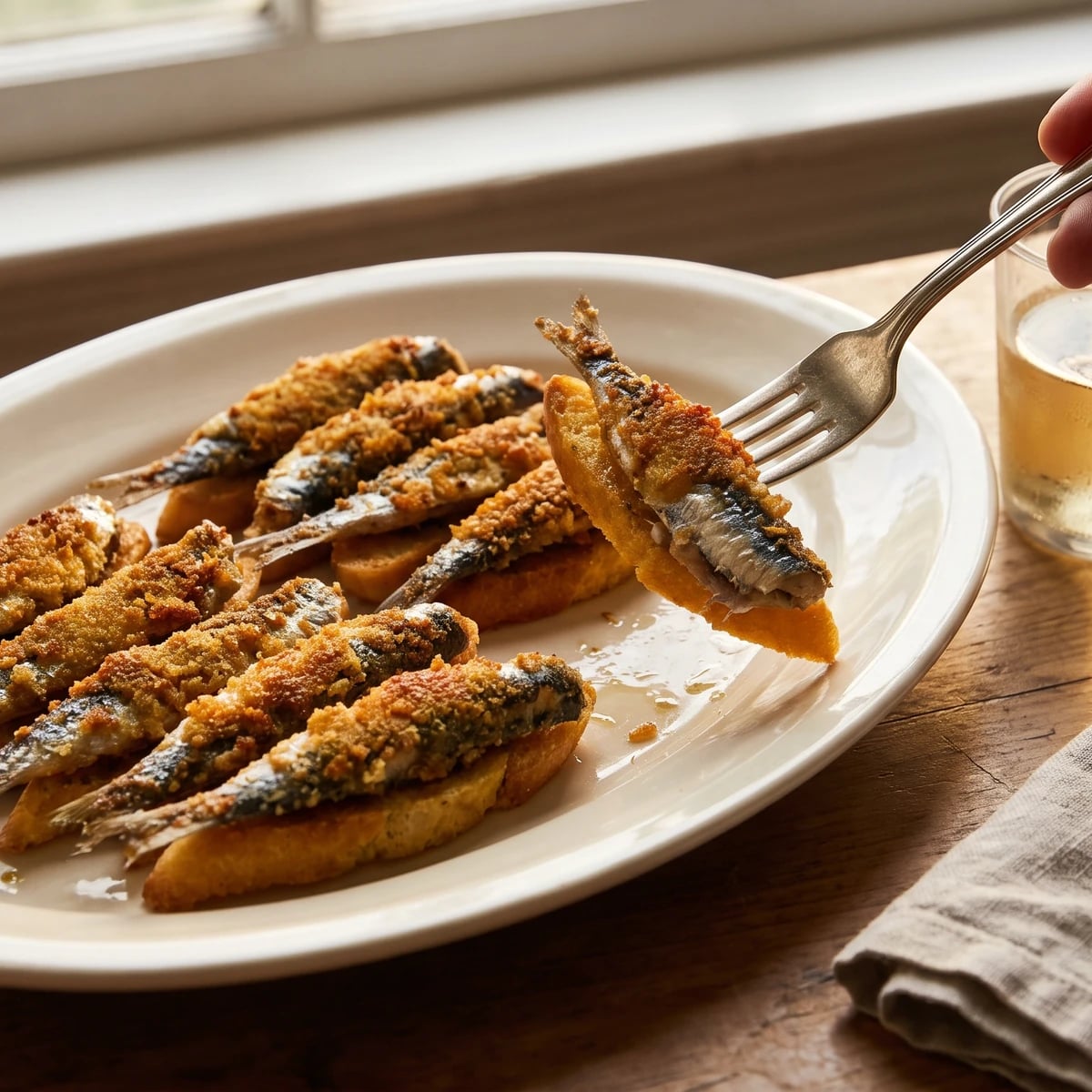
Sardines, Dijon mustard, cayenne, and a fierce last-minute fry: the crisp shell sets before the tender fish can break, and each piece lands on a croûton cut to match.

Appetizers & Snacks
French
Dinner Party
Quick Meal
45 min
Active Time
20 min cook1 hr 5 min total
Yield4 servings

Sardines à la Diable (mustard-and-cayenne crumbed sardines on butter-fried croûtons) teach one uncompromising principle: delicate fish must meet properly hot fat. The heat sets the crust before the sardine can shed its coating, drink oil, or fall to pieces. Hot and fast is the dish.

The original recipe assumed a bowl of Anglaise (for Egg-and-bread-crumbing) (No. 174) always ready, a deep fryer held at service heat, and several hands to skin fish, shape croûtons, and fry everything at the final moment. Your honest equivalent is twelve sardines for four people, a frying thermometer, and one deep skillet used first for the buttered croûtons and then for the fish. One cook, one stove, one evening.

The separate frying station was brigade scaffolding, so it goes. Skinning and boning fresh sardines, coating them with mustard and cayenne, treating them pané à l’anglaise, and serving them immediately on shaped croûtons are the dish itself, so every one stays. Before the first sardine enters the pan, bring the oil fully to 365°F (185°C); that single reading decides the result.

Sardines à la Diable belong to the codified Parisian classical table, although the fish reached city kitchens from both France’s Atlantic and Mediterranean ports. Classical cooks turned an inexpensive, fragile fish into a formal hors-d’œuvre through pané à l’anglaise and precisely shaped croûtons, applying the same discipline used for richer ingredients. Here, à la diable means the pointed heat of mustard and cayenne, not a regional claim and not a separate sauce.

The technique, the tradition, and the story behind every dish.

Discover Culinary Explorer

Ingredients

medium fresh sardines

Quantity

12 (about 1¼ pounds / 560 g total)

heads and innards removed

Dijon mustard

Quantity

3 tablespoons (45 ml / 45 g)

cayenne pepper

Quantity

¼ teaspoon (1.25 ml / 0.5 g)

all-purpose flour

Quantity

½ cup (120 ml / 65 g)

Anglaise (for Egg-and-bread-crumbing)

Quantity

½ cup (120 ml / 125 g) Anglaise (for Egg-and-bread-crumbing) (No. 174)

fine dry breadcrumbs

Quantity

1½ cups (360 ml / 150 g)

firm white sandwich bread

Quantity

12 thin slices (about 10 ounces / 280 g)

unsalted butter

Quantity

6 tablespoons (90 ml / 85 g)

neutral frying oil

Quantity

3 cups (720 ml / 660 g), or enough to reach ¾ inch (2 cm) up the skillet

Equipment Needed

  • Small flexible fish knife
  • Fish-bone tweezers
  • 11 to 12-inch (28 to 30 cm) deep heavy skillet
  • Clip-on frying thermometer
  • Wire rack set over a tray
  • Thin fish spatula

Instructions

  1. 1

    Bone the sardines

    Keep the sardines cold as you work. Open each fish along the belly and lay it flat, flesh side up. Lift the backbone from the head end and draw it toward the tail, removing any remaining pin bones with tweezers. Turn the fish over and gently peel away the skin without stretching the flesh. Pat both sides thoroughly dry and return each prepared sardine to the cold. If one splits, set the pieces neatly together rather than discarding them; ça se rattrape, because the coating will hold them once fried.

  2. 2

    Fry the croûtons

    Trim each bread slice into a tapered oval roughly matching the length and outline of a prepared sardine. Exact portraiture belonged to the brigade; matching the fish closely enough to support it is the honest home version. Melt the butter in a broad skillet over medium heat and fry the croûtons in batches until evenly golden and crisp on both sides, adding the butter gradually so its milk solids do not blacken. If the butter turns bitter and dark, wipe out the pan and begin the next batch with fresh butter. Hold the finished croûtons uncovered on a wire rack.

  3. 3

    Apply the diable

    Stir the cayenne into the Dijon mustard. Lay the cold, dry sardines flesh side up and spread each with a thin, even film, then turn and coat the other side. Thin means complete, not heavy; too much mustard makes the crumb jacket slide away in the fat. This sharp layer is the à la diable character, so carry it from edge to edge.

  4. 4

    Bread à l’anglaise

    Arrange the flour, Anglaise (for Egg-and-bread-crumbing) (No. 174), and fine breadcrumbs in three shallow dishes. Dust each sardine lightly with flour and shake away every loose patch, dip it thoroughly in the Anglaise, let the excess drain, then press it gently into the crumbs. This is pané à l’anglaise, the flour, prepared coating, and crumbs forming a jacket that sets on contact with hot fat. Lay the breaded sardines in one layer on a rack for five minutes so the coating can settle.

  5. 5

    Fry hot and fast

    Wipe the skillet clean, add the frying oil to a depth of ¾ inch (2 cm), and heat it to 365°F (185°C). Fry three sardines at a time for 45 to 60 seconds on the first side, then turn once and fry the second side until the crust is crisp and deep gold and the fish is opaque within, another 30 to 45 seconds. Keep the oil above 350°F (175°C) between batches and never crowd the pan. If the first sardine does not sizzle fiercely at once, lift it out within seconds, let the oil recover, press fresh crumbs onto any damp patch, and try again. Ça se rattrape.

  6. 6

    Dish at once

    Lift each fried sardine with a thin spatula and drain it on a clean rack for no more than half a minute. Set one sardine directly onto each warm butter-fried croûton, following its shape, and arrange three per person without stacking. Serve immediately, while the crust still gives cleanly under the teeth and the fish remains tender. À table!

Chef Tips

  • Buy sardines with clear eyes, red gills, firm silver bodies, and a clean sea smell. Ask the fishmonger to remove the heads and innards, but do the skinning and boning yourself so the delicate fillets reach the coating intact.
  • Fresh anchovies and smelts can be treated exactly the same way, as the original entry directs. Use enough small fish to make three modest portions per person, and shorten the frying time when they are slimmer than the sardines.
  • A thermometer earns its place here. Breadcrumbs can look golden while cool oil is still soaking into them, but 365°F (185°C) gives the egg coating the immediate set this fragile fish needs.
  • Serve with a cold Muscadet Sèvre-et-Maine. Its firm acidity answers the buttered croûtons, mustard, and frying fat without covering the sardines.
  • These do not improve by waiting or reheating. Fry only when everyone is ready to eat, and never apologize for making the table wait thirty seconds for crisp fish.

Advance Preparation

  • Prepare the Anglaise (for Egg-and-bread-crumbing) (No. 174) up to 4 hours ahead according to its own entry, cover it, and keep it cold. Whisk it briefly before breading.
  • The sardines can be skinned and boned up to 4 hours ahead, then held in one layer between absorbent paper in the cold. Cut the bread croûtons at the same time.
  • Fry the croûtons up to 1 hour before serving and keep them uncovered on a rack at room temperature. Apply the mustard and breadcrumbs no more than 20 minutes before frying, or the crust begins to soften.

Frequently Asked Questions

Nutrition Information

1 serving (about 250g)

Calories
820 calories
Total Fat
45 g
Saturated Fat
13 g
Trans Fat
1 g
Unsaturated Fat
31 g
Cholesterol
185 mg
Sodium
800 mg
Total Carbohydrates
58 g
Dietary Fiber
4 g
Sugars
5 g
Protein
42 g

Note: Chef personas and recipes are created with AI assistance. Cook with care: follow safe food-handling practices, check doneness with a thermometer when needed, and adapt for allergies and your kitchen.

Where cooking meets culture.

Culinary guides, cultural storytelling, and the editorial depth that makes cooking meaningful.

Discover Culinary Explorer

More from Savouries

Browse the full collection