
Chef Juliette
Smelt (Éperlans)
Tiny éperlans, lightly floured and fried until their tails stand crisp, arrive in a generous heap on a napkin with fried parsley and grooved lemon, a weeknight lesson in heat and restraint.
A cooking platform built around craft, culture, and the stories behind what we eat.
Created by Chef Juliette
Based on No. 2313, Croquettes de Camembert, from Le Guide Culinaire (1907) by Auguste Escoffier
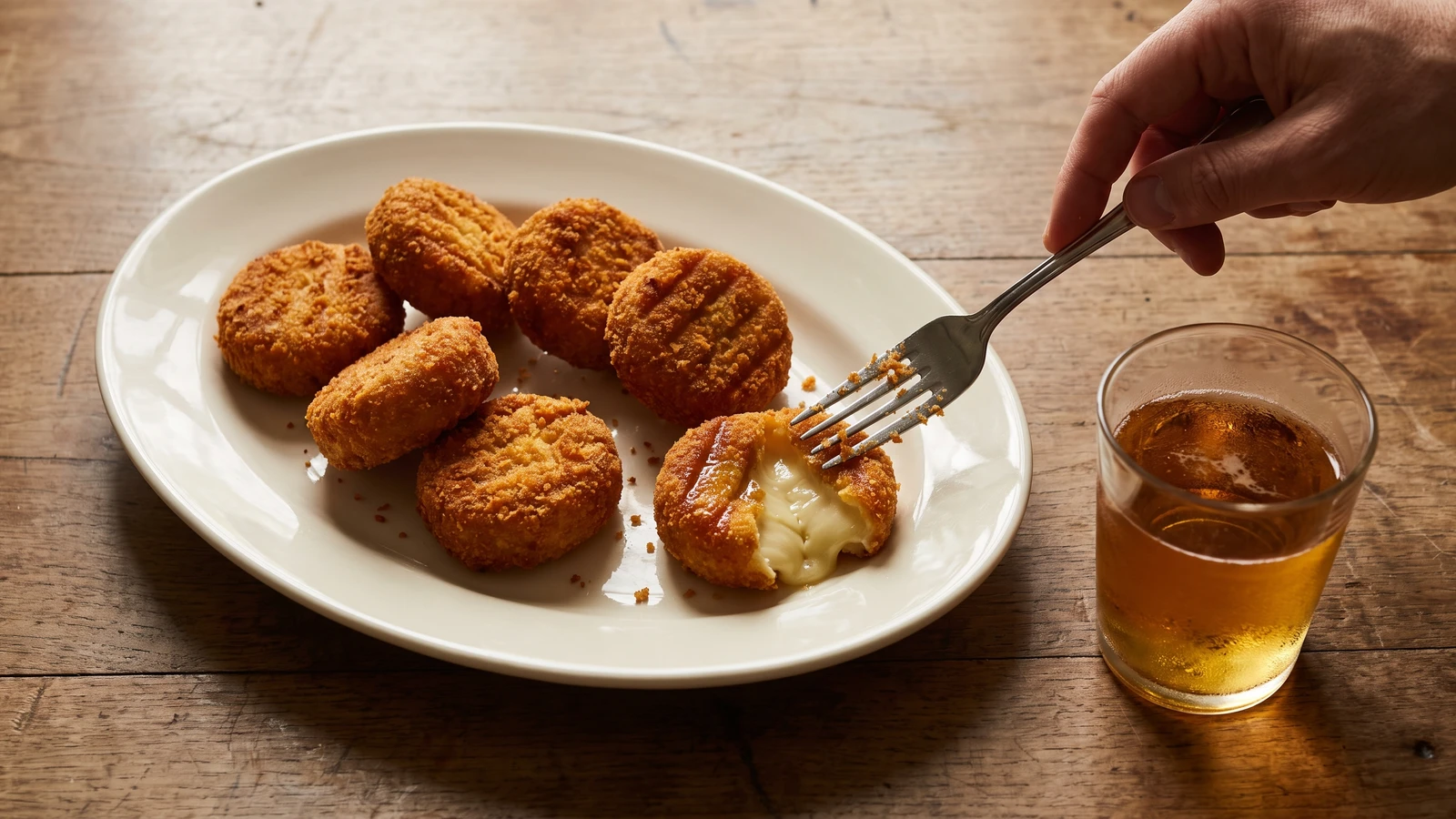
Small Camembert quoits with a crisp double crumb and a rich, yielding centre. Chill the flour-and-rice paste hard before shaping, because the cold is what keeps the cheese inside the crust.
Croquettes de Camembert (Camembert croquettes) teach the first law of filled frying: the crust can protect only what the cold has already made firm. The centre is a cooked paste of Normandy cheese, flour, crème de riz, milk, and butter, not a bare piece of cheese. Chilled hard and panée à l’anglaise (egg-coated and breadcrumbed) twice, each quoit fries into a bronze shell around a rich, yielding middle.
The original kitchen assumed a brigade-sized batch, crème de riz waiting in the dry store, trays passing through a cold room, and a fryer held ready by another pair of hands. At home, half the written proportions make eight generous croquettes. Superfine white rice flour is the honest equivalent of the old rice cream, a shallow tray and refrigerator replace the cold room, and a heavy pot with a thermometer replaces the station fryer. Only the scale and equipment have changed; the full measure of butter, the cooked paste, the quoit shape, and the double coating stay. One cook, one stove, one evening.
The brigade logistics were scaffolding. Cooking the paste until it leaves the pan clean, cooling it until rigid, and sealing every surface beneath two coats are the dish itself. Before you heat the oil, give the paste its full cold rest. That is the one step that decides everything.
Camembert belongs to Normandy’s Pays d’Auge and takes its name from the village of Camembert in Orne, where the soft, bloomy-rinded cheese became a defining part of the local dairy table. Croquettes traveled between bourgeois households and grand kitchens as a disciplined way to turn a rich paste into neat portions protected by an egg-and-crumb casing. This canonical version is sometimes mistaken for cheese breaded directly, but its flour-and-rice-cream base is essential: it gives ripe Camembert enough structure to be moulded into quoits and fried without surrendering to the fat.
Quantity
3 tablespoons plus 2 teaspoons (55 ml / 28 g)
Quantity
3 tablespoons (45 ml / 28 g)
Quantity
⅓ cup plus 1 tablespoon (95 ml / 98 g)
cold
Quantity
about 2 cups diced (225 g / 8 oz)
rind trimmed; weigh after trimming
Quantity
5 tablespoons (75 ml / 70 g)
diced
Quantity
¼ teaspoon (1.25 ml / 1.5 g)
Quantity
⅛ teaspoon (0.6 ml / 0.25 g)
Quantity
⅛ teaspoon (0.6 ml / 0.25 g)
Quantity
⅓ cup (80 ml / 40 g)
Quantity
½ cup (120 ml / 120 g) Anglaise (for Egg-and-bread-crumbing) (No. 174)
chilled and whisked smooth
Quantity
1½ cups (360 ml / 150 g)
Quantity
6 cups (1.5 L / 1.38 kg), or enough for a 5 cm depth
| Ingredient | Quantity |
|---|---|
| plain flour | 3 tablespoons plus 2 teaspoons (55 ml / 28 g) |
| crème de riz (rice cream; superfine white rice flour) | 3 tablespoons (45 ml / 28 g) |
| whole milkcold | ⅓ cup plus 1 tablespoon (95 ml / 98 g) |
| cleaned Camembertrind trimmed; weigh after trimming | about 2 cups diced (225 g / 8 oz) |
| unsalted butterdiced | 5 tablespoons (75 ml / 70 g) |
| fine sea salt | ¼ teaspoon (1.25 ml / 1.5 g) |
| cayenne | ⅛ teaspoon (0.6 ml / 0.25 g) |
| freshly grated nutmeg | ⅛ teaspoon (0.6 ml / 0.25 g) |
| plain flour for dredging | ⅓ cup (80 ml / 40 g) |
| Anglaise (for Egg-and-bread-crumbing)chilled and whisked smooth | ½ cup (120 ml / 120 g) Anglaise (for Egg-and-bread-crumbing) (No. 174) |
| fine dry white breadcrumbs | 1½ cups (360 ml / 150 g) |
| neutral frying oil, such as sunflower or peanut oil | 6 cups (1.5 L / 1.38 kg), or enough for a 5 cm depth |
Trim the rind from the Camembert, then weigh 225 g of the cleaned cheese and cut it into small dice. Line a shallow tray or plate with baking parchment. Have the butter, salt, cayenne, and nutmeg measured before the pan goes onto the heat; once the paste begins thickening, it needs your uninterrupted attention.
Whisk the 28 g plain flour and the crème de riz with the cold milk in a heavy saucepan until perfectly smooth. Add the diced Camembert, butter, salt, cayenne, and nutmeg, then set the pan over medium-low heat. Stir constantly with a firm spatula, scraping the floor and corners, until the cheese and butter melt into the starches and the mixture becomes a thick, glossy paste that pulls from the sides and leaves a clean trail across the pan floor, about 8 to 12 minutes. If butter begins pooling, take the pan off the heat and beat vigorously until it draws back into the paste, then return to gentler heat. Ça se rattrape. Do not add more flour, because the written ratio already supplies all the structure required.
Scrape the hot paste onto the lined tray and spread it into an even layer about 1.5 cm thick. Press a second sheet of parchment directly against the surface so no skin forms. Let it lose its fierce heat for 15 minutes, then refrigerate for at least 2 hours, until cold and genuinely firm rather than merely cool. If a fingertip leaves a deep impression, give it longer. Flour cannot compensate for warm cheese paste.
Divide the cold paste into 8 equal portions, about 55 g each. With hands lightly dusted in the dredging flour, roll each portion into a ball, flatten it into a round about 6 cm across and 1.5 cm thick, then open a neat 1.5 cm hole through the centre to make a small quoit. Smooth any cracks now. If the paste slumps, sticks heavily, or refuses to hold the hole, return every portion to the refrigerator for 20 to 30 minutes. Ça se rattrape, but only with cold, not with a burial of extra flour.
Arrange the dredging flour, the Anglaise (for Egg-and-bread-crumbing) (No. 174), and the breadcrumbs in three shallow dishes. Roll each quoit lightly in flour and shake off every loose patch. Dip it completely in the Anglaise (for Egg-and-bread-crumbing) (No. 174), paying attention to the centre hole, then press it into the breadcrumbs. Dip it a second time in the Anglaise (for Egg-and-bread-crumbing) (No. 174) and coat it again with breadcrumbs. The second coat is not brigade fuss; it is the resisting crust that keeps the cheese paste inside. Patch any bare place with more Anglaise and crumbs, then chill the coated croquettes for 20 minutes.
Pour the oil into a deep, heavy pot no more than halfway full and heat it to 180°C. Lower in two croquettes at a time and fry until evenly deep gold, about 2 to 3 minutes, turning once if needed. Let the oil return to 180°C between batches; cooler fat delays the setting of the crust and invites leaks. If the first croquette releases a thread of filling, stop and lift it out, chill the remaining croquettes for another 20 minutes, and patch any visible crack with the reserved Anglaise (for Egg-and-bread-crumbing) (No. 174) and breadcrumbs before continuing.
Lift the croquettes onto a wire rack and leave them for 2 minutes, just long enough for excess oil to fall away and the crust to settle. Serve them bare on a warm platter while the shell remains crisp and the Camembert centre is soft. They need no sauce and no decorative greenery. À table!
1 serving (about 150g)
Culinary guides, cultural storytelling, and the editorial depth that makes cooking meaningful.
Discover Culinary ExplorerChef Juliette
Tiny éperlans, lightly floured and fried until their tails stand crisp, arrive in a generous heap on a napkin with fried parsley and grooved lemon, a weeknight lesson in heat and restraint.

Chef Juliette
Brandade de Morue turns salt cod, warm olive oil, and milk into a pale, silky emulsion: keep everything warm and add the oil slowly, then crown the generous dome with butter-fried bread.

Chef Juliette
Salt cod worked warm with cream, one patient spoonful at a time, until the rough flakes become a glossy Nîmes paste, domed generously and ringed with butter-fried croutons for the table.

Chef Juliette
Wine-poached char packed in its earthenware crock beneath butter gold: a make-ahead first course that turns careful cooling, thorough boning, and one unbroken seal into quiet abundance.