
Chef Juliette
Smelt (Éperlans)
Tiny éperlans, lightly floured and fried until their tails stand crisp, arrive in a generous heap on a napkin with fried parsley and grooved lemon, a weeknight lesson in heat and restraint.
A cooking platform built around craft, culture, and the stories behind what we eat.
Created by Chef Juliette
Based on No. 2304, Canapes or Toast, from Le Guide Culinaire (1907) by Auguste Escoffier
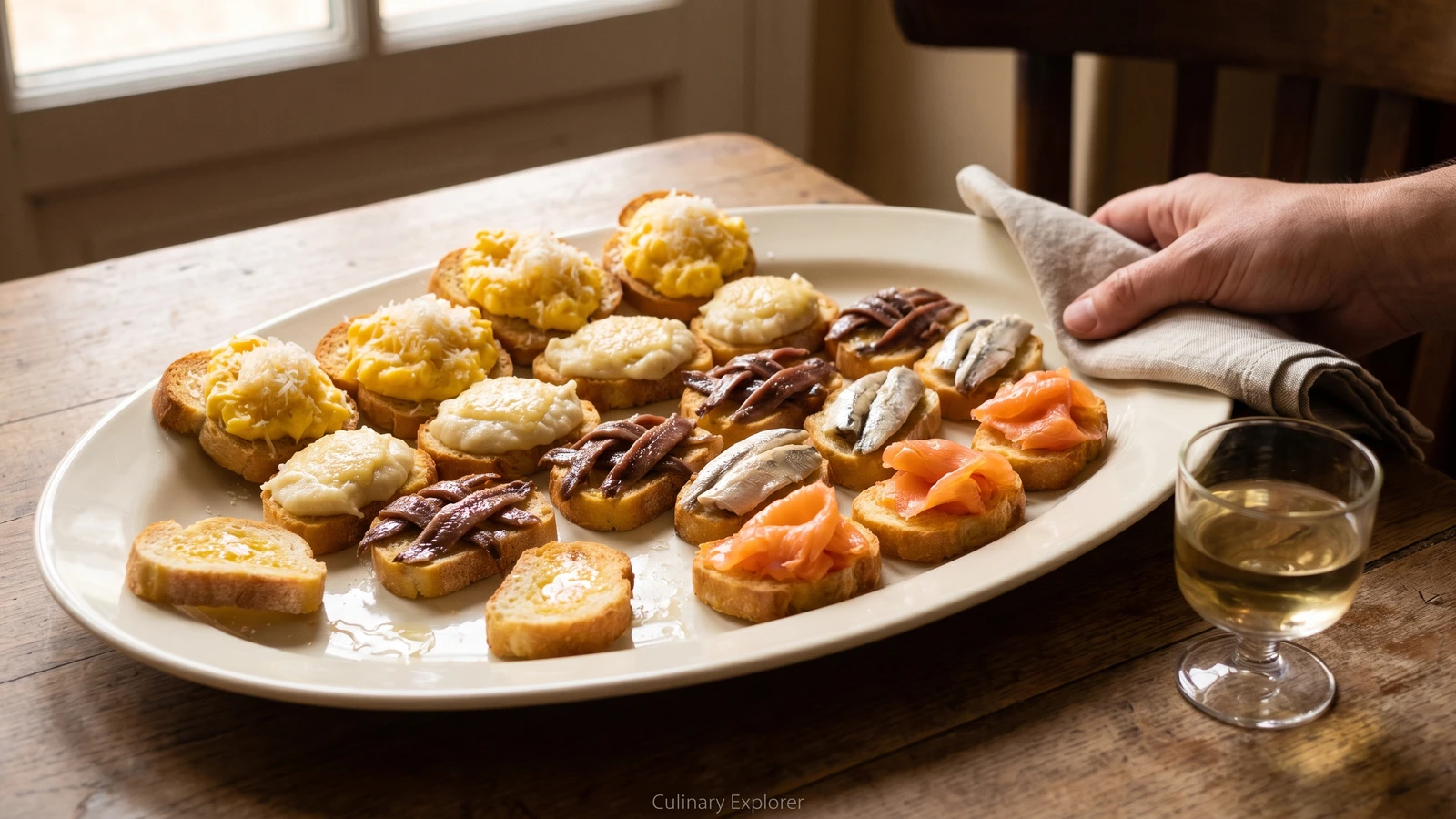
Five classic garnishes, one decisive foundation: small French canapés buttered while hot, so scrambled egg, haddock purée, anchovy, sardine, and smoked salmon sit on tender toast rather than brittle crumbs.
Canapés et toasts assortis (assorted garnished toasts) teach proportion. The one true thing to know before you touch a pan is this: butter the toast while it is still hot. The butter sinks into the warm crumb, keeping it tender beneath its garnish instead of leaving you with a dry biscuit that scatters over the first clean shirt it meets.
The original assumed a cold-larder cook trimming fanciful shapes, a piping bag filled for speed, and a salamander waiting to glaze each tray. At home, two teaspoons replace the piping bag, a broiler supplies the salamander's fierce top heat, and thirty pieces replace brigade trays. Five garnishes stand for the immense family: scrambled egg, smoked haddock purée, anchovy, sardine, and smoked salmon. Fancy shapes and piping are scaffolding and can go. The lightly toasted, generously buttered base is the dish and must stay.
Make the Béchamel and haddock purée first, arrange the cold fish next, and scramble the eggs last. The Canapés and Toast (No. 316) should be buttered the instant they leave the grill; that is the step that decides whether every bite is supple or dry.
Canapés belong to French hors-d'œuvre service, particularly the Parisian dining room and the grand-kitchen cold larder, where small trimmed breads carried seasoned butters, fish, shellfish, meats, or cheese. The name is also the French word for a sofa, a small joke about the garnish seated upon its bread, and the preparation traveled naturally from formal service to bistro counters and home apéritifs. Contrary to the hard-cracker versions sometimes served, the classical base is lightly grilled and generously buttered while hot so it remains tender beneath the garnish.
Quantity
30 Canapés and Toast (No. 316), about 1½ inches (4 cm) across
prepared through hot buttering
Quantity
2 cups (480 ml / 480 g)
for poaching
Quantity
1 small fillet (3 oz / 85 g)
skin on and checked for pin bones
Quantity
1 teaspoon (5 ml / 5 g)
Quantity
2 teaspoons (10 ml / 5 g)
Quantity
⅓ cup (80 ml / 82 g)
divided
Quantity
2 teaspoons (10 ml / 9 g)
softened
Quantity
3
Quantity
1 tablespoon (15 ml / 14 g)
Quantity
1 tablespoon (15 ml / 15 g)
Quantity
1 teaspoon (5 ml / 5 g)
Quantity
3 tablespoons (45 ml / 15 g)
finely grated
Quantity
6 fillets (¾ oz / 20 g)
drained
Quantity
3 small fish (3 oz / 85 g drained weight)
drained
Quantity
6 thin slices (3 oz / 85 g)
Quantity
1 small pinch
Quantity
1 small pinch
| Ingredient | Quantity |
|---|---|
| Canapés and Toastprepared through hot buttering | 30 Canapés and Toast (No. 316), about 1½ inches (4 cm) across |
| cold waterfor poaching | 2 cups (480 ml / 480 g) |
| smoked haddock filletskin on and checked for pin bones | 1 small fillet (3 oz / 85 g) |
| unsalted butter for the Béchamel | 1 teaspoon (5 ml / 5 g) |
| all-purpose flour | 2 teaspoons (10 ml / 5 g) |
| whole milkdivided | ⅓ cup (80 ml / 82 g) |
| unsalted butter for the haddock puréesoftened | 2 teaspoons (10 ml / 9 g) |
| large eggs | 3 |
| unsalted butter for the eggs | 1 tablespoon (15 ml / 14 g) |
| heavy cream | 1 tablespoon (15 ml / 15 g) |
| heavy cream for rescuing the eggs (optional) | 1 teaspoon (5 ml / 5 g) |
| Parmesanfinely grated | 3 tablespoons (45 ml / 15 g) |
| oil-packed anchovy filletsdrained | 6 fillets (¾ oz / 20 g) |
| oil-packed sardinesdrained | 3 small fish (3 oz / 85 g drained weight) |
| smoked salmon | 6 thin slices (3 oz / 85 g) |
| fine sea salt | 1 small pinch |
| ground white pepper | 1 small pinch |
Melt 1 teaspoon butter in the smallest saucepan you own over low heat. Stir in the flour and cook for 1 minute, until the roux foams but takes no colour. Add ¼ cup (60 ml) of the milk in three additions, whisking each one smooth before the next, then simmer gently for 2 minutes. The Béchamel, the white roux sauce, should be smooth and thick enough to hold the trace of the whisk. If it lumps, take it off the heat and whisk hard, then press it through the fine-mesh sieve. Do not discard it. Ça se rattrape.
Put the water and haddock in a small pan and bring them just below a simmer. Lower the heat and poach for 4 to 5 minutes, until the flesh is opaque and separates into moist flakes. Drain it, remove the skin and any remaining bones, then rub the warm fish through the fine-mesh sieve. Beat in the Béchamel and 2 teaspoons softened butter until the purée is smooth and holds a soft mound. If it spreads, stir it over low heat for a minute; if it is stiff, loosen it with reserved milk, 1 teaspoon at a time.
Split each anchovy fillet lengthwise into two narrow strips. Lift the skin from the sardines, open each fish along its natural seam, and remove the backbone to make 6 neat fillets. Separate the smoked salmon into 6 thin slices and fold each loosely upon itself. Keep all three garnishes cool while the warm preparations are finished.
Beat the eggs with the salt and white pepper just until the yolks and whites join. Melt 1 tablespoon butter in a small skillet over low heat, add the eggs, and stir continuously with a flexible spatula, scraping the floor and corners. Pull the pan from the heat whenever the curds form too quickly. Stop when the eggs are softly set, glossy, and free of raw liquid, then stir in 1 tablespoon cream. If they tighten before you can assemble, beat in the optional teaspoon of cold cream off the heat. They will soften again.
Heat the broiler with a rack about 6 inches (15 cm) below the element. Arrange 12 freshly prepared Canapés and Toast (No. 316) on a broiler-safe sheet pan and place the other 18 on the serving platter. Work while their butter still glistens and the crumb remains supple. If they have cooled but are still tender, warm them briefly before topping; do not toast them a second time or they will dry through.
Set rounded spoonfuls of scrambled egg upon 6 Canapés and Toast (No. 316), then make 6 matching domes of haddock purée. Sprinkle both kinds lightly with Parmesan. Broil for 30 to 60 seconds, just until the cheese melts and freckles gold. Watch without moving away. This glazing is a finish, not a second cooking; remove individual pieces with a spatula if they colour before their neighbours.
Cross two narrow anchovy strips into a simple lattice on each of 6 Canapés and Toast (No. 316). Lay the sardine fillets lengthwise on 6 more, then settle the smoked salmon folds on the final 6. Mix the warm and cold varieties across the platter without regimenting them, and serve immediately while the toast is tender, the eggs are soft, and the glazed purées still gleam. À table!
1 serving (about 115g)
Culinary guides, cultural storytelling, and the editorial depth that makes cooking meaningful.
Discover Culinary ExplorerChef Juliette
Tiny éperlans, lightly floured and fried until their tails stand crisp, arrive in a generous heap on a napkin with fried parsley and grooved lemon, a weeknight lesson in heat and restraint.

Chef Juliette
Brandade de Morue turns salt cod, warm olive oil, and milk into a pale, silky emulsion: keep everything warm and add the oil slowly, then crown the generous dome with butter-fried bread.

Chef Juliette
Salt cod worked warm with cream, one patient spoonful at a time, until the rough flakes become a glossy Nîmes paste, domed generously and ringed with butter-fried croutons for the table.

Chef Juliette
Wine-poached char packed in its earthenware crock beneath butter gold: a make-ahead first course that turns careful cooling, thorough boning, and one unbroken seal into quiet abundance.