
Chef Juliette
Allumettes
Allumettes make one demand before the tray reaches the oven: reduce the Gruyère Béchamel until it holds on a knife, so the puff paste rises into butter-gold layers instead of soaking flat.
A cooking platform built around craft, culture, and the stories behind what we eat.
Created by Chef Juliette
Based on No. 2303, Camembert Frit, from Le Guide Culinaire (1907) by Auguste Escoffier
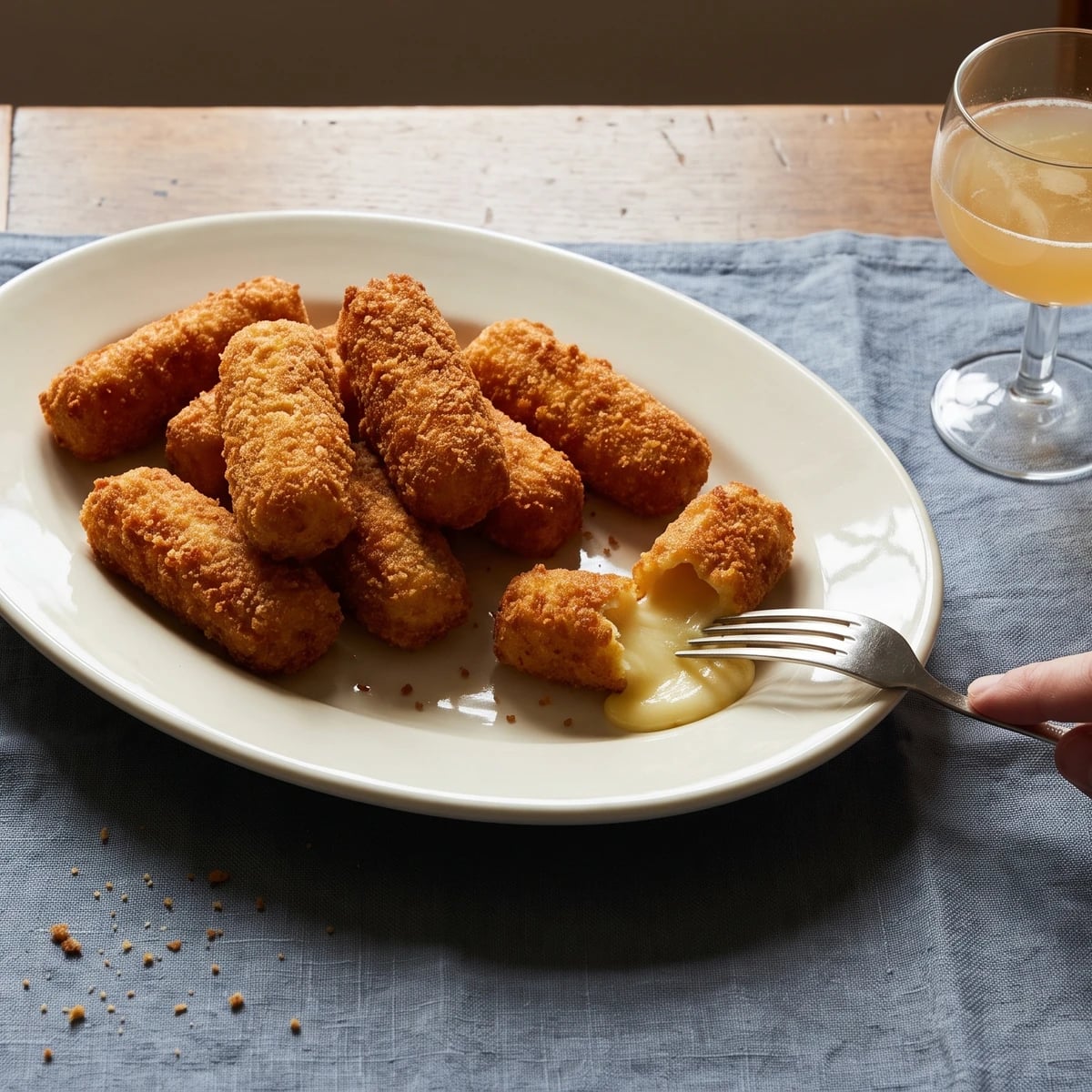
The double coat is the dish: rindless Camembert lozenges, warmed with cayenne and fried at the last moment, with a crisp shell strong enough to hold their molten Normandy heart.
Camembert frit (fried Camembert) teaches one uncompromising lesson: the double coat is the dish. Beneath it, rindless cheese becomes fluid almost as soon as it meets the fat. One thin crumb may look handsome for half a minute, then split and empty itself into the pan. Before you touch the oil, know the truth: every face, edge, and corner must be sealed twice.
The original entry assumed a professional frying bath held fiercely hot and brigade hands ready to bread and send each order at the last moment. Your honest equivalent is one chilled 250-gram wheel, a narrow heavy saucepan, a thermometer, and a brief rest in the refrigerator so one cook can finish the breading before the guests sit down. The only changes are scale and control. The large fryer and service station were scaffolding, so they go. Removing the rind, adding cayenne, coating twice à l’anglaise, and frying in very hot fat at the last moment are the dish, so every one stays.
Done properly, the lozenges arrive deep gold and crisp, with molten ivory Camembert held inside like a secret. Press the second coat firmly onto the corners and inspect each piece for bare patches before it reaches the pan. That final seal decides everything.
Camembert belongs to the village of Camembert in Normandy’s Pays d’Auge, where small cow’s-milk wheels with a bloomy white rind became one of the region’s defining cheeses. Camembert frit is a grand-kitchen treatment of that Norman cheese rather than a farmhouse preservation method: the rind is cleared away, the paste is cut into lozenges, and the pieces are sealed à l’anglaise for the frying bath. It is often made with the rind left on or only one coat, but the canonical preparation insists on rindless cheese and two coats because the crust must contain a paste that becomes fluid in hot fat.
Quantity
1 wheel (8.8 oz / 250 g)
thoroughly chilled
Quantity
⅛ teaspoon (0.6 ml / 0.25 g)
Quantity
½ cup (120 ml / 60 g)
Quantity
½ cup (120 ml / 115 g) Anglaise (for Egg-and-bread-crumbing) (No. 174)
prepared and chilled
Quantity
1½ cups (360 ml / 150 g)
Quantity
4 cups (960 ml / 880 g)
or enough for a 2-inch (5 cm) depth
| Ingredient | Quantity |
|---|---|
| Camembertthoroughly chilled | 1 wheel (8.8 oz / 250 g) |
| cayenne pepper | ⅛ teaspoon (0.6 ml / 0.25 g) |
| plain flour | ½ cup (120 ml / 60 g) |
| Anglaise (for Egg-and-bread-crumbing)prepared and chilled | ½ cup (120 ml / 115 g) Anglaise (for Egg-and-bread-crumbing) (No. 174) |
| fine dry white breadcrumbs | 1½ cups (360 ml / 150 g) |
| neutral high-heat frying oilor enough for a 2-inch (5 cm) depth | 4 cups (960 ml / 880 g) |
Keep the Camembert cold while you work. With a thin, sharp knife, shave away the white rind from the top, bottom, and circumference, taking the crust but as little of the paste as possible. Cut the naked wheel into 8 elongated, lozenge-like pieces of even thickness, then sprinkle the cayenne lightly over every side. If the cheese softens and drags beneath the knife, stop and refrigerate it for 10 minutes before continuing.
Arrange the flour, the Anglaise (for Egg-and-bread-crumbing) (No. 174), and the fine breadcrumbs in three shallow dishes. Roll one lozenge lightly in flour and tap away the excess, dip it completely in the Anglaise, then press it into the breadcrumbs. Dip it into the Anglaise a second time and apply a second complete layer of crumbs, without another flour coating. Repeat with the remaining pieces. Run your fingertips over every edge and corner; if you find a bare patch, dab it with Anglaise and press on more crumbs. Ça se rattrape. The second coat cannot be decorative or timid, because it is the wall holding back the molten cheese.
Set the coated lozenges on a rack or parchment-lined tray and refrigerate them uncovered for 30 minutes. During the final 10 minutes, pour the oil into a narrow heavy saucepan to a depth of 2 inches (5 cm), keeping the pan no more than half full, and heat it to 350°F (180°C). The fat must set the egg and crumbs immediately. Oil below 345°F (175°C) soaks the coating before it hardens; oil much hotter darkens the crumbs before the center softens.
Fry 2 or 3 lozenges at a time so the oil remains between 345°F and 350°F (175°C and 180°C). Turn them once and cook for 60 to 90 seconds, just until the coating is evenly deep gold. Let the oil recover its heat before adding the next batch. If a piece begins to leak, lift it out immediately and place it leak-side up on the rack so the crust can set. Bring the oil back to temperature, inspect the remaining pieces, and patch any weak spot with Anglaise and breadcrumbs before frying. Ça se rattrape.
Lift each lozenge onto a wire rack and let it drain for 30 to 45 seconds. Paper traps moisture beneath the crust, while a rack keeps the underside crisp. Serve two lozenges per person at once, while the crumb is firm and the Camembert inside flows when opened. They need no sauce or decorative garnish; the cheese, cayenne, and double coat have already finished the argument. À table!
1 serving (about 105g)
Culinary guides, cultural storytelling, and the editorial depth that makes cooking meaningful.
Discover Culinary Explorer
Chef Juliette
Allumettes make one demand before the tray reaches the oven: reduce the Gruyère Béchamel until it holds on a knife, so the puff paste rises into butter-gold layers instead of soaking flat.

Chef Juliette
Beignets soufflés teach the discipline of moderate frying: tiny Gruyère-studded choux nubs must swell into airy hollows before their thin shells colour, giving a dinner party one crisp, generous mouthful after another.

Chef Juliette
Golden, crumbed cigars with a thick Béchamel and Gruyère heart, sealed in fine pâte à nouilles and fried at the last moment: a lesson in cold filling, close wrapping, and fearless heat.

Chef Juliette
Choux au fromage teach the discipline of drying pâte à choux: golden shells that sound hollow, filled with cayenne-warmed fondue au fromage and crowned with Parmesan Chantilly for a generous celebration tray.