
Chef Juliette
Smelt (Éperlans)
Tiny éperlans, lightly floured and fried until their tails stand crisp, arrive in a generous heap on a napkin with fried parsley and grooved lemon, a weeknight lesson in heat and restraint.
A cooking platform built around craft, culture, and the stories behind what we eat.
Created by Chef Juliette
Based on No. 2301, Beurrecks à la Turque, from Le Guide Culinaire (1907) by Auguste Escoffier
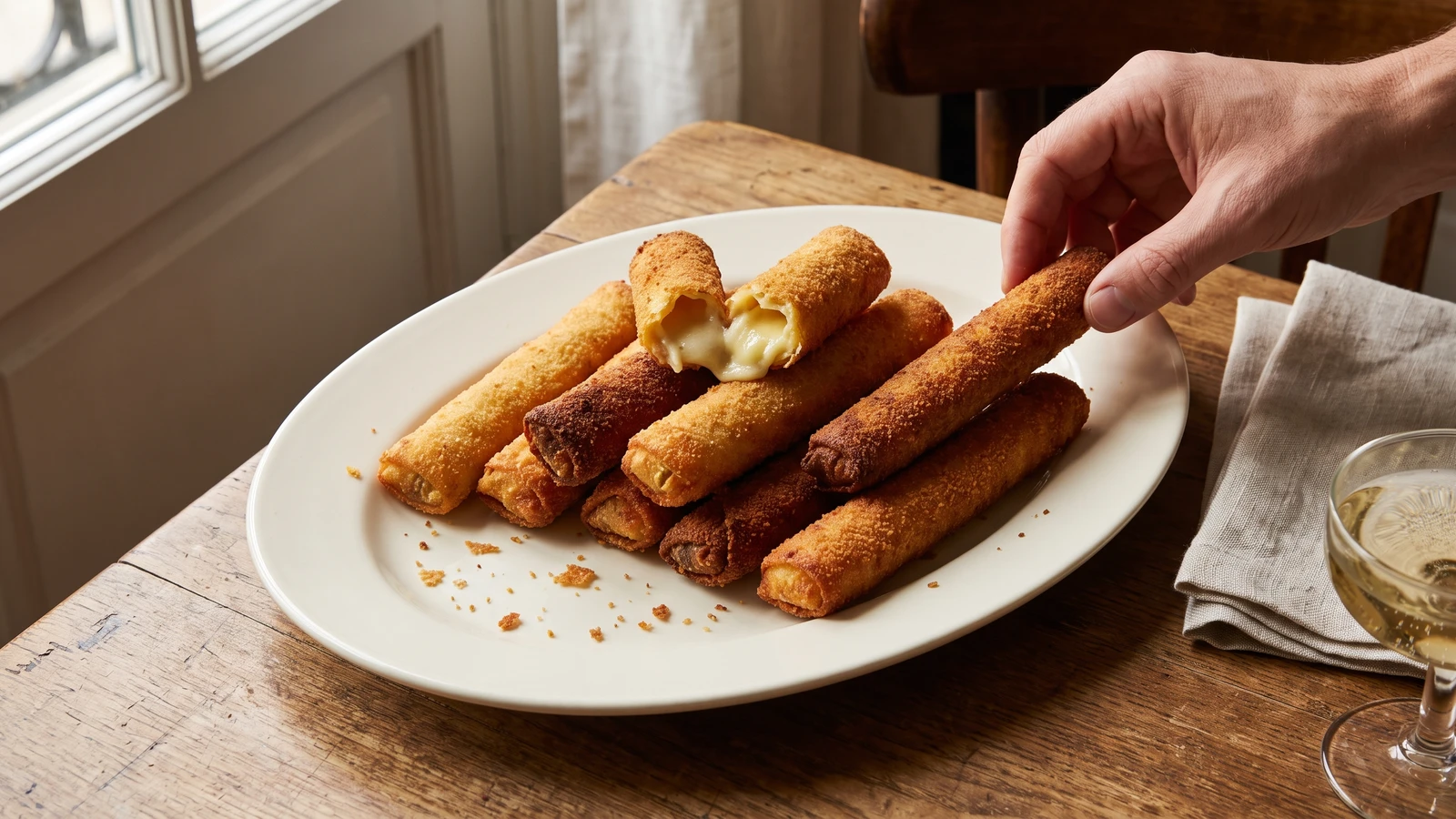
Golden, crumbed cigars with a thick Béchamel and Gruyère heart, sealed in fine pâte à nouilles and fried at the last moment: a lesson in cold filling, close wrapping, and fearless heat.
Beurrecks à la Turque (Turkish-style cheese cigars) teach the discipline of the sealed croquette: the filling must be cold, the wrapper snug, and the frying fat fiercely hot before the first cigar goes in. That is the one true thing to know before you touch the pan. Warm filling or timid fat softens the crust, lets it drink oil, and gives the Gruyère an exit.
The grand-kitchen formula assumed a saucier reducing Béchamel, sheets of pâte à nouilles, a thin fresh egg noodle paste, already rolled, a cold room, and a fryer held ready for service. It needed neither the stockpot nor the salamander. At home, one cup of prepared Béchamel reduces in a small saucepan, fresh pasta rolls under a pin or through a machine, and a thermometer keeps a Dutch oven honest. The brigade quantity disappears because it is scaffolding. Equal volumes of reduced Béchamel and diced Gruyère, the fine pasta sleeve, the coating à l’anglaise, and the last-minute frying remain because they are the dish. One cook, one stove, one evening.
Done properly, the Beurrecks arrive deep gold and dry beneath the fingers, with a crisp crumb shell around a creamy ivory centre marked by softened pockets of Gruyère. Chill the shaped filling until it holds a clean cigar without slumping, then guard the temperature of the fat. Everything depends on those two moments.
The name Beurrecks is the French classical spelling of börek, but this formula belongs to the cosmopolitan grand-kitchen hors-d’œuvre repertoire rather than to any single French region. French cooks translated the filled pastry into their own grammar with reduced Béchamel, Gruyère, fine pâte à nouilles, and a crust panée à l’anglaise before frying. The phrase à la Turque names the inspiration, while the roux-built filling and breadcrumb armour reveal how completely the dish was adapted at the French table.
Quantity
1 cup (240 ml / 245 g)
Quantity
2/3 cup (160 ml / 110 g)
cut into 3 mm dice
Quantity
1/8 teaspoon (0.6 ml / 0.25 g)
Quantity
4 ounces (115 g)
rolled into very thin egg pasta sheets
Quantity
1 tablespoon (15 ml / 15 g)
for sealing
Quantity
1/2 cup (120 ml / 65 g)
Quantity
3/4 cup (180 ml / 180 g) Anglaise (for Egg-and-bread-crumbing) (No. 174)
prepared and chilled
Quantity
1 1/2 cups (360 ml / 150 g)
Quantity
6 cups (1.5 L / 1.38 kg)
sunflower or peanut oil
| Ingredient | Quantity |
|---|---|
| prepared Béchamel sauce | 1 cup (240 ml / 245 g) |
| Gruyèrecut into 3 mm dice | 2/3 cup (160 ml / 110 g) |
| cayenne pepper | 1/8 teaspoon (0.6 ml / 0.25 g) |
| fresh pâte à nouillesrolled into very thin egg pasta sheets | 4 ounces (115 g) |
| cold waterfor sealing | 1 tablespoon (15 ml / 15 g) |
| plain flour | 1/2 cup (120 ml / 65 g) |
| Anglaise (for Egg-and-bread-crumbing)prepared and chilled | 3/4 cup (180 ml / 180 g) Anglaise (for Egg-and-bread-crumbing) (No. 174) |
| fine dry breadcrumbs | 1 1/2 cups (360 ml / 150 g) |
| neutral frying oilsunflower or peanut oil | 6 cups (1.5 L / 1.38 kg) |
Put the Béchamel in a small heavy saucepan and bring it to the gentlest simmer. Cook for 8 to 12 minutes, stirring constantly across the bottom and into the corners, until only 2/3 cup (160 ml / about 165 g) remains and the spatula leaves a clean path that stays open for several seconds. This reduction is the foundation: a loose sauce cannot be imprisoned inside a fried crust. If the bottom catches, stop stirring, pour the unscorched sauce into a clean pan without scraping the burnt film, and continue gently.
Let the reduced Béchamel stand for 5 minutes so it is warm rather than hot, then fold in the equal volume of Gruyère dice and the cayenne. Spread the mixture about 1 cm thick on a lightly moistened plate, cover its surface, and refrigerate for 45 to 60 minutes. Divide the firm filling into 12 portions, about 22 g each, and roll each into a cigar roughly 6 cm long. If the portions slump, return them to the cold for 15 minutes. Don't add crumbs to stiffen them, because that changes the filling instead of correcting the temperature.
Roll the pâte à nouilles thinner than 1 mm, thin enough that a shadow shows through it, and cut twelve rectangles about 8 by 10 cm. Keep the unused pasta covered so it stays supple. Lay a filling cigar across the lower third of each rectangle, brush the edges sparingly with water, fold the sides over the ends, and roll closely into a completely sealed parcel. Press the seam without crushing the filling and set it seam-side down. If the pasta tears, cover the hole with a paper-thin dampened scrap and press its edges flat. Ça se rattrape.
Arrange three shallow dishes in order: flour, the prepared Anglaise (for Egg-and-bread-crumbing) (No. 174), and fine breadcrumbs. Roll each Beurreck lightly in flour and shake away the excess, coat it completely with the Anglaise, then press it gently through the crumbs. This panure à l’anglaise, the flour, prepared coating, and breadcrumb armour, must have no bald spots or exposed seams. Dip any bare patch back into the Anglaise and cover it with crumbs. Chill the coated Beurrecks for 15 minutes so the crust settles.
Pour the oil into a deep, heavy pot, filling it no more than halfway, and heat it to 190°C (375°F). Fry three Beurrecks at a time for 2 to 3 minutes, turning once, until evenly deep gold. Let the fat return to 190°C between batches; this heat sets the crust immediately, while cooler fat soaks the crumbs and encourages the cheese to escape. If the first Beurreck leaks, lift it out at once, restore the temperature, and inspect the uncooked pieces. Patch any weak seam with flour, a little Anglaise, and crumbs, then chill it for 10 minutes before trying again. Drain on a wire rack and serve the moment the last batch is ready. À table!
1 serving (about 230g)
Culinary guides, cultural storytelling, and the editorial depth that makes cooking meaningful.
Discover Culinary ExplorerChef Juliette
Tiny éperlans, lightly floured and fried until their tails stand crisp, arrive in a generous heap on a napkin with fried parsley and grooved lemon, a weeknight lesson in heat and restraint.

Chef Juliette
Brandade de Morue turns salt cod, warm olive oil, and milk into a pale, silky emulsion: keep everything warm and add the oil slowly, then crown the generous dome with butter-fried bread.

Chef Juliette
Salt cod worked warm with cream, one patient spoonful at a time, until the rough flakes become a glossy Nîmes paste, domed generously and ringed with butter-fried croutons for the table.

Chef Juliette
Wine-poached char packed in its earthenware crock beneath butter gold: a make-ahead first course that turns careful cooling, thorough boning, and one unbroken seal into quiet abundance.