
Chef Juliette
Smelt (Éperlans)
Tiny éperlans, lightly floured and fried until their tails stand crisp, arrive in a generous heap on a napkin with fried parsley and grooved lemon, a weeknight lesson in heat and restraint.
A cooking platform built around craft, culture, and the stories behind what we eat.
Created by Chef Juliette
Based on No. 2267, Tomates Farcies à la Portugaise, from Le Guide Culinaire (1907) by Auguste Escoffier
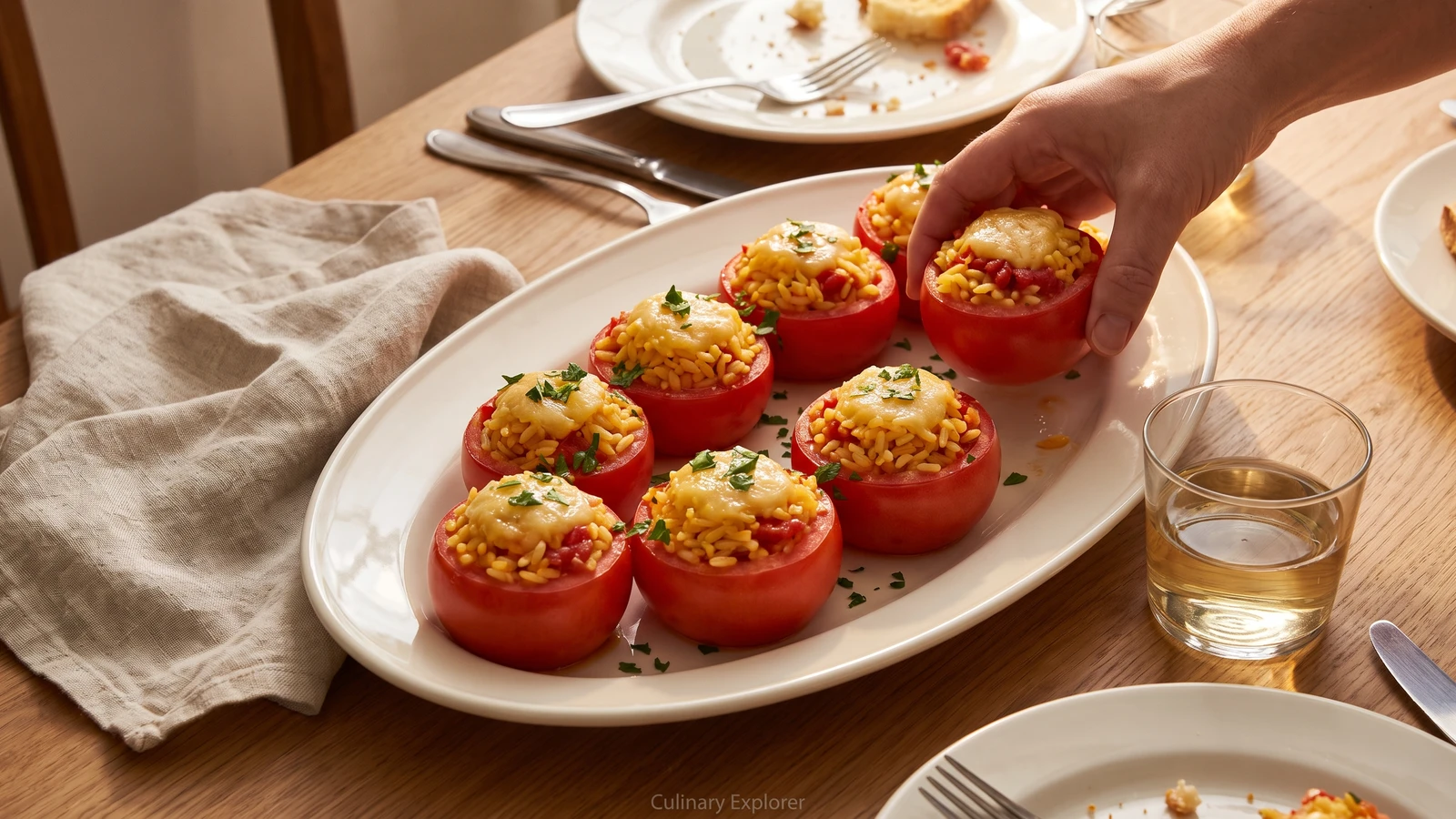
Tomates Farcies à la Portugaise teach proportion and shape: buttery pilaff rice folded with exactly one-quarter its volume of tomato concassée, then raised into proud domes under a bright scatter of parsley.
Tomates Farcies à la Portugaise (tomatoes filled with pilaff rice and tomato) teach that proportion and form can be the dish. The rice takes exactly one-quarter its own volume of tomato concassée, and the filling rises in a smooth, regular dome. Flatten it level with the shell and the plate looks unfinished, however good the rice tastes.
The brigade entry assumed finished pilaff, prepared concassée, and a stockpot never off the fire, each ready when the tomatoes reached the pass. At home, one tight-lidded saucepan makes the pilaff while the tomato cups drain, and two plum tomatoes provide the concassée. Those separate stations were scaffolding. The four-to-one proportion and the dome are the dish, and they stay exactly as written, scaled to eight tomatoes for four people. One cook, one stove, one evening.
The salamander mentioned for the cheese-topped meat or egg variations does not belong to this rice filling, so the home broiler stays off. Keep the concassée dry enough that every grain remains distinct; if the mixture begins to slump, ça se rattrape, and the method shows you where to stop and drain. The one step that matters most is measuring the finished pilaff before folding in the tomato.
Tomates Farcies à la Portugaise belong to the French classical dining room and bourgeois home table, where à la Portugaise became a menu-name for preparations organized around tomato rather than a transcription of one Portuguese household recipe. In this entry the garnish travels inside the vegetable itself: pilaff rice takes a measured quarter-volume of concassed tomato, and its visible dome announces the preparation. The name reflects the classical canon’s habit of marking flavor families with place-names, not a claim that Portugal has only one way to stuff a tomato.
Quantity
8 medium (about 2½ pounds / 1.1 kg)
Quantity
2 medium (about 10 ounces / 280 g), yielding ½ cup (120 ml / 120 g)
peeled, seeded, and concassed
Quantity
⅔ cup (160 ml / 125 g)
Quantity
2 tablespoons (30 ml / 28 g)
divided
Quantity
¼ cup (60 ml / 40 g)
finely chopped
Quantity
1 cup (240 ml / 240 g)
heated
Quantity
1
Quantity
1 teaspoon (5 ml / 6 g)
divided
Quantity
¼ teaspoon (1 ml / 0.6 g)
Quantity
Up to 2 tablespoons (30 ml / 30 g)
Quantity
2 tablespoons (30 ml / 8 g)
finely chopped
| Ingredient | Quantity |
|---|---|
| medium firm ripe tomatoes | 8 medium (about 2½ pounds / 1.1 kg) |
| plum tomatoespeeled, seeded, and concassed | 2 medium (about 10 ounces / 280 g), yielding ½ cup (120 ml / 120 g) |
| long-grain white rice | ⅔ cup (160 ml / 125 g) |
| unsalted butterdivided | 2 tablespoons (30 ml / 28 g) |
| yellow onionfinely chopped | ¼ cup (60 ml / 40 g) |
| light chicken stock or unsalted vegetable stockheated | 1 cup (240 ml / 240 g) |
| bay leaf | 1 |
| fine saltdivided | 1 teaspoon (5 ml / 6 g) |
| ground white pepper | ¼ teaspoon (1 ml / 0.6 g) |
| hot water (optional) | Up to 2 tablespoons (30 ml / 30 g) |
| flat-leaf parsleyfinely chopped | 2 tablespoons (30 ml / 8 g) |
Cut a thin lid from the stem end of each round tomato. Scoop out the seeds and soft center with a teaspoon, leaving the walls and base intact. Sprinkle ¼ teaspoon of the salt among the cavities, then turn the tomatoes cut-side down on a rack or clean towel for at least 20 minutes. The draining matters: water trapped inside the cups loosens the pilaff and spoils the dome. If you pierce a base, ça se rattrape. Set that tomato snugly between two intact ones on the serving platter so they support it.
Score a shallow cross in the base of each plum tomato. Lower them into boiling water for 20 seconds, then cool them immediately in cold water and slip off the skins. Halve them, remove the seeds and watery gel, then concass the firm flesh, which simply means chop it roughly into small pieces. Drain the concassée in a fine-mesh sieve for 10 minutes and measure ½ cup. It should look juicy and bright without leaving a puddle beneath the sieve.
Melt 1½ tablespoons of the butter in a heavy saucepan over medium-low heat. Add the onion and cook without coloring until translucent, about 3 minutes. Stir in the rice and cook for 2 minutes, turning every grain through the butter until its edges look faintly translucent. Add the hot stock, bay leaf, ½ teaspoon of the salt, and the white pepper. Bring to a bare simmer, cover tightly, and cook over the lowest heat for 15 minutes. Remove the pan from the heat and leave it covered for 10 minutes, then discard the bay leaf and fluff the grains with a fork.
Fold the remaining ½ tablespoon of butter through the warm pilaff and let it stand uncovered for 5 minutes. Measure the finished rice loosely by volume, without packing it. You should have about 2 cups. For every 1 cup of pilaff, fold in exactly ¼ cup of the well-drained concassée, giving the expected 2 cups of rice its ½ cup of tomato. Taste and use the remaining salt if needed. If the mixture slumps or releases liquid, stop and drain it in the fine-mesh sieve for one minute, then spread it on a plate for 5 minutes. Ça se rattrape. Do not add spare rice, which would change the defining proportion.
Blot the insides of the tomato cups and divide the pilaff among them, filling each lightly to the rim. Add another rounded spoonful on top and coax it into a smooth, regular dome with the back of a damp teaspoon. Shape gently rather than packing the grains dense. Sprinkle every dome with chopped parsley and arrange the tomatoes on a platter. Serve them warm or at cool room temperature, with no cheese and no broiling. A flat fill reads as an accident; the dome makes the dish deliberate. À table!
1 serving (about 400g)
Culinary guides, cultural storytelling, and the editorial depth that makes cooking meaningful.
Discover Culinary ExplorerChef Juliette
Tiny éperlans, lightly floured and fried until their tails stand crisp, arrive in a generous heap on a napkin with fried parsley and grooved lemon, a weeknight lesson in heat and restraint.

Chef Juliette
Brandade de Morue turns salt cod, warm olive oil, and milk into a pale, silky emulsion: keep everything warm and add the oil slowly, then crown the generous dome with butter-fried bread.

Chef Juliette
Salt cod worked warm with cream, one patient spoonful at a time, until the rough flakes become a glossy Nîmes paste, domed generously and ringed with butter-fried croutons for the table.

Chef Juliette
Wine-poached char packed in its earthenware crock beneath butter gold: a make-ahead first course that turns careful cooling, thorough boning, and one unbroken seal into quiet abundance.