Chef Juliette
Suet Dumpling
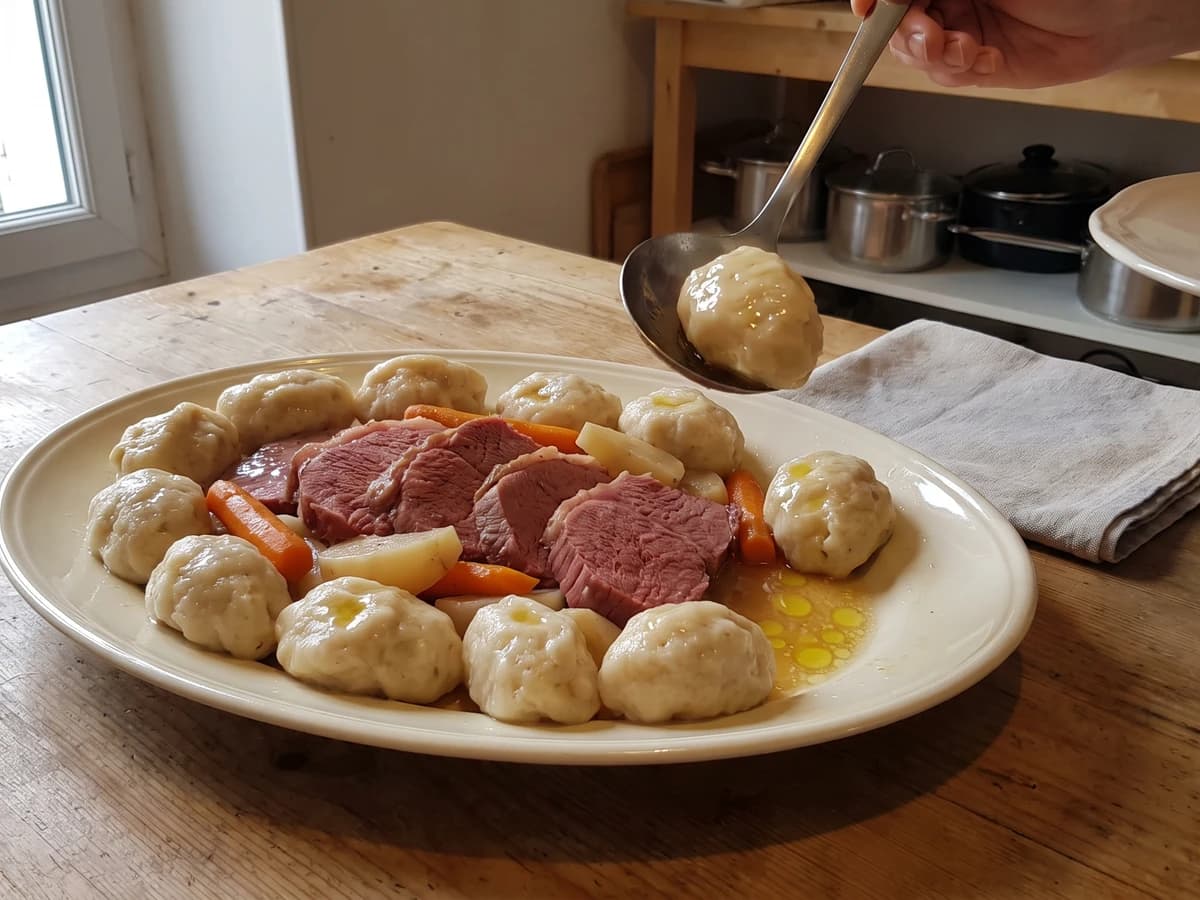
Boulettes au suif, poached beside salt beef, turn equal weights of flour and finely chopped suet into tender, rich dumplings. Keep the beef liquor at a bare tremble and the old garnish works beautifully at home.
A cooking platform built around craft, culture, and the stories behind what we eat.
Created by Chef Juliette
Based on No. 2162, Laitues Farcies, from Le Guide Culinaire (1907) by Auguste Escoffier
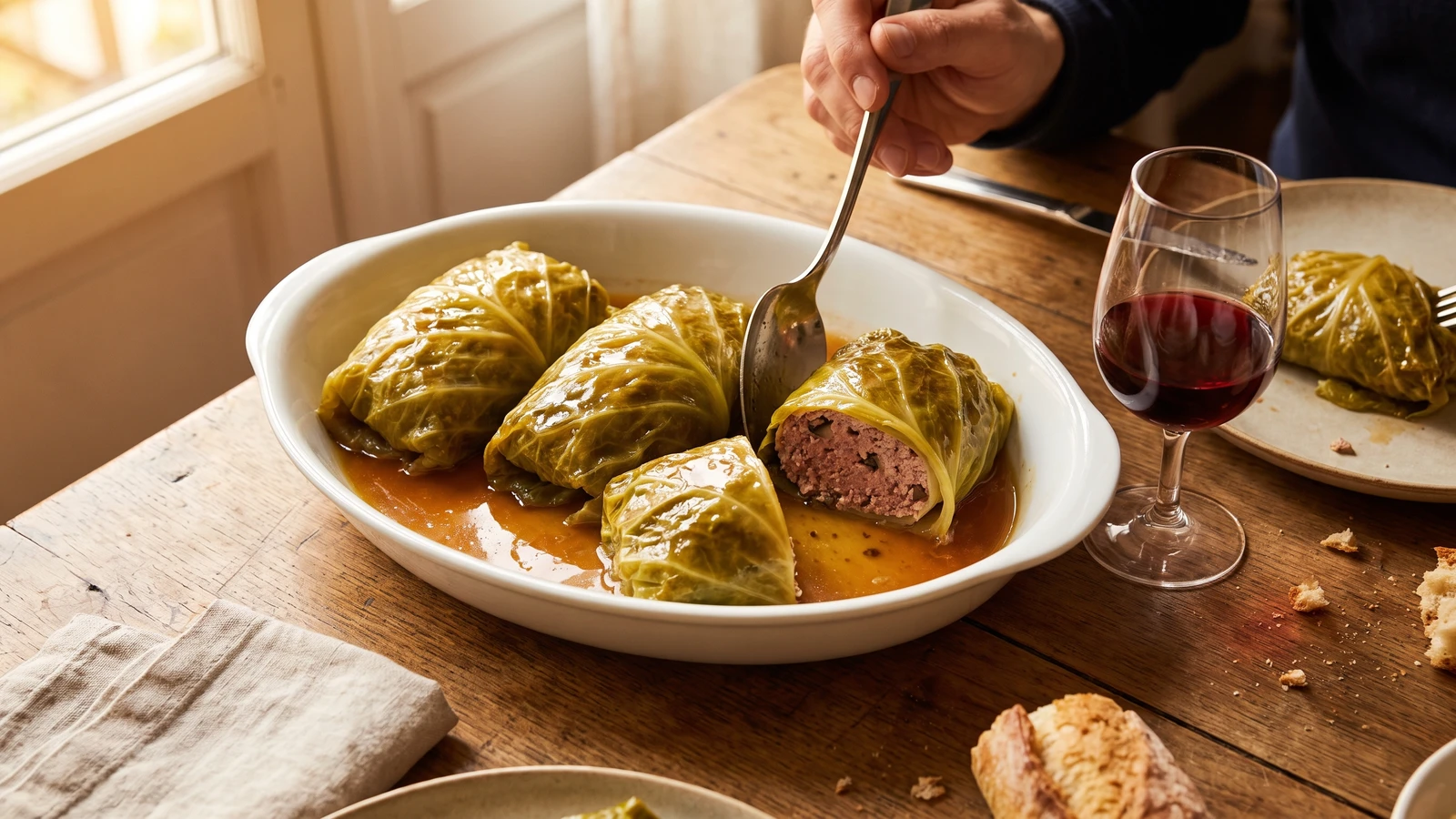
Whole lettuces opened at the heart, packed with forcemeat and dry duxelle, tied back into shape, then braised until tender and lacquered with their own juices.
Laitues farcies (stuffed lettuces) teach the discipline of removing water before adding flavor. The lettuce must be blanched until pliable, cooled, then pressed dry, and the mushroom preparation must fall from the spoon in soft, dry clumps. If either carries water into the parcel, the forcemeat weeps and the sauce thins.
The original entry assumed a bowl of Ordinary or Dry Duxelle (No. 223) beside the cook, the braising liquor and thickened veal gravy of Laitues Braisées au Jus (No. 2160) already waiting, a stockpot never off the fire, and a saucier free to reduce the finish while other hands blanched and tied. At home, prepare those linked components ahead, scale the assembly to four small lettuces, and choose the simple timbale service the book permits instead of building a crown with fried croûtons. The crown is brigade scaffolding. The intact stems, the two-to-one volume of forcemeat to duxelle, and the gentle braise are the dish. One cook, one stove, one evening.
Done properly, each parcel holds its rounded shape beneath tender olive-green leaves, with savory forcemeat at the center and a glossy veil of concentrated jus outside. Before you touch the braising pan, make certain the lettuce and the duxelle are dry. Everything depends on it.
Laitues farcies belong to the Parisian classical vegetable repertoire, which treated firm-headed market lettuces as braising vegetables and garnitures for roasted meat, not only as salad. The technique passed in both directions between cuisine bourgeoise and grand kitchens: households used stuffing to extend meat, while formal service refined the parcel with forcemeat, mushroom duxelle, and reduced jus. Cooked lettuce is no novelty in France; generations of cooks relied on its intact stem to hold the softened leaves together.
Quantity
4 (about 1¼ pounds / 560 g total)
washed carefully, stems left intact
Quantity
3 quarts (2.8 liters / 2.8 kg)
for blanching
Quantity
1 tablespoon (15 ml / 18 g)
for the blanching water
Quantity
2 quarts (1.9 liters / 1.9 kg)
Quantity
1 cup (240 ml / 250 g)
prepared, seasoned, and well chilled
Quantity
½ cup (120 ml / 100 g) Ordinary or Dry Duxelle (No. 223)
completely cooled
Quantity
1 home-scale quantity for Laitues Braisées au Jus (No. 2160), enough for 4 lettuces
| Ingredient | Quantity |
|---|---|
| small firm butter lettuceswashed carefully, stems left intact | 4 (about 1¼ pounds / 560 g total) |
| waterfor blanching | 3 quarts (2.8 liters / 2.8 kg) |
| fine sea saltfor the blanching water | 1 tablespoon (15 ml / 18 g) |
| ice water | 2 quarts (1.9 liters / 1.9 kg) |
| good fine veal-and-pork forcemeatprepared, seasoned, and well chilled | 1 cup (240 ml / 250 g) |
| Ordinary or Dry Duxellecompletely cooled | ½ cup (120 ml / 100 g) Ordinary or Dry Duxelle (No. 223) |
| braising and finishing components | 1 home-scale quantity for Laitues Braisées au Jus (No. 2160), enough for 4 lettuces |
Have the Ordinary or Dry Duxelle (No. 223), the chilled forcemeat, and the braising and finishing components for Laitues Braisées au Jus (No. 2160) ready at the stove. Measure one volume of duxelle for every two volumes of forcemeat; the listed weights are practical approximations, but the book's ratio is by bulk. Press a spoon through the duxelle. If liquid shines around it or it smears wetly across the bowl, return it to a brisk skillet until the moisture has evaporated, then spread it out and cool it completely. Ça se rattrape, but do this before it meets the meat.
Bring the water and salt to a full boil in a wide pot. Lower in the lettuces two at a time and keep them submerged, turning gently, until the outer leaves wilt and the heads become pliable without losing their shape, about 2 to 3 minutes. Lift them directly into the ice water. Cooling stops the cooking and preserves enough strength in the leaves for opening and tying.
Drain the lettuces stem-side down, then cradle each between clean towels and press firmly with both palms until the towels stop taking on water. Work around the whole head without twisting or crushing the stem. If water still beads between the leaves, change to a dry towel and press again. A damp lettuce dilutes the filling from inside, and no amount of sauce reduction can repair that properly.
Fold the completely cooled Ordinary or Dry Duxelle (No. 223) into the chilled forcemeat just until evenly distributed. Do not beat it or let it warm. The mixture should hold a rounded spoonful without releasing moisture. If it has softened from handling, chill it for 10 minutes before filling the lettuces.
Stand one lettuce on its intact stem. Beginning at the crown, ease the leaves outward layer by layer until the compact heart is exposed, never cutting into the stem that holds the parcel together. Divide the filling into four equal portions and press one portion around the heart, keeping it compact rather than spreading it to the leaf tips. Fold the leaves back over the filling in their original order, inner leaves first and broad outer leaves last, reconstructing the natural rounded head.
Secure each reconstructed lettuce with two light loops of kitchen twine crossing at right angles. Tie firmly enough to hold the leaves, but never so tightly that the filling is squeezed out during cooking. If an outer leaf splits, overlap its edges and catch them beneath the string. Ça se rattrape, and the braise will settle the repair into place.
Braise the tied parcels by the covered, gentle method specified for Laitues Braisées au Jus (No. 2160), using its components scaled for four lettuces. Allow about 40 to 50 minutes, turning the parcels with care if that preparation directs, until the leaves yield readily to a small knife and the center of the veal-and-pork forcemeat reaches 160°F / 71°C. The liquid must barely tremble. A hard boil tears the leaves and tightens the filling.
Lift the cooked lettuces onto a warm tray and snip away every piece of twine. Finish the braising liquor with the thickened veal gravy as directed in Laitues Braisées au Jus (No. 2160), reducing it to nappe, the point at which it coats the back of a spoon in a glossy film. If it remains thin, reduce it longer. If it tightens before the lettuces are ready, loosen it with a spoonful of reserved braising liquor.
Arrange the four lettuces close together in a warm, low serving dish, the simple timbale-style presentation allowed by the source. Spoon the reduced sauce over each parcel and let a little pool around them. If one tries to open after the string is removed, turn it seam-side down with two spoons and coat it generously. Never apologize at your own table. À table!
1 serving (about 250g)
Culinary guides, cultural storytelling, and the editorial depth that makes cooking meaningful.
Discover Culinary ExplorerChef Juliette
Boulettes au suif, poached beside salt beef, turn equal weights of flour and finely chopped suet into tender, rich dumplings. Keep the beef liquor at a bare tremble and the old garnish works beautifully at home.

Chef Juliette
Bread, flour, frangipane, and rice become four cool, supple panades for binding forcemeats, each changing body and flavor while preserving tenderness. The finest Mousselines need none, and knowing that distinction is the lesson.

Chef Juliette
Panade au pain is bread, milk, salt, heat, and attention: stir until the paste releases cleanly, butter it against a skin, and you have the quiet binder behind tender French farces.

Chef Juliette
Panade de farine teaches the drying stroke behind pâte à choux: flour meets boiling buttered water, then stays over the fire until the paste gathers, smooths, and quits the pan cleanly.