Chef Juliette
Suet Dumpling
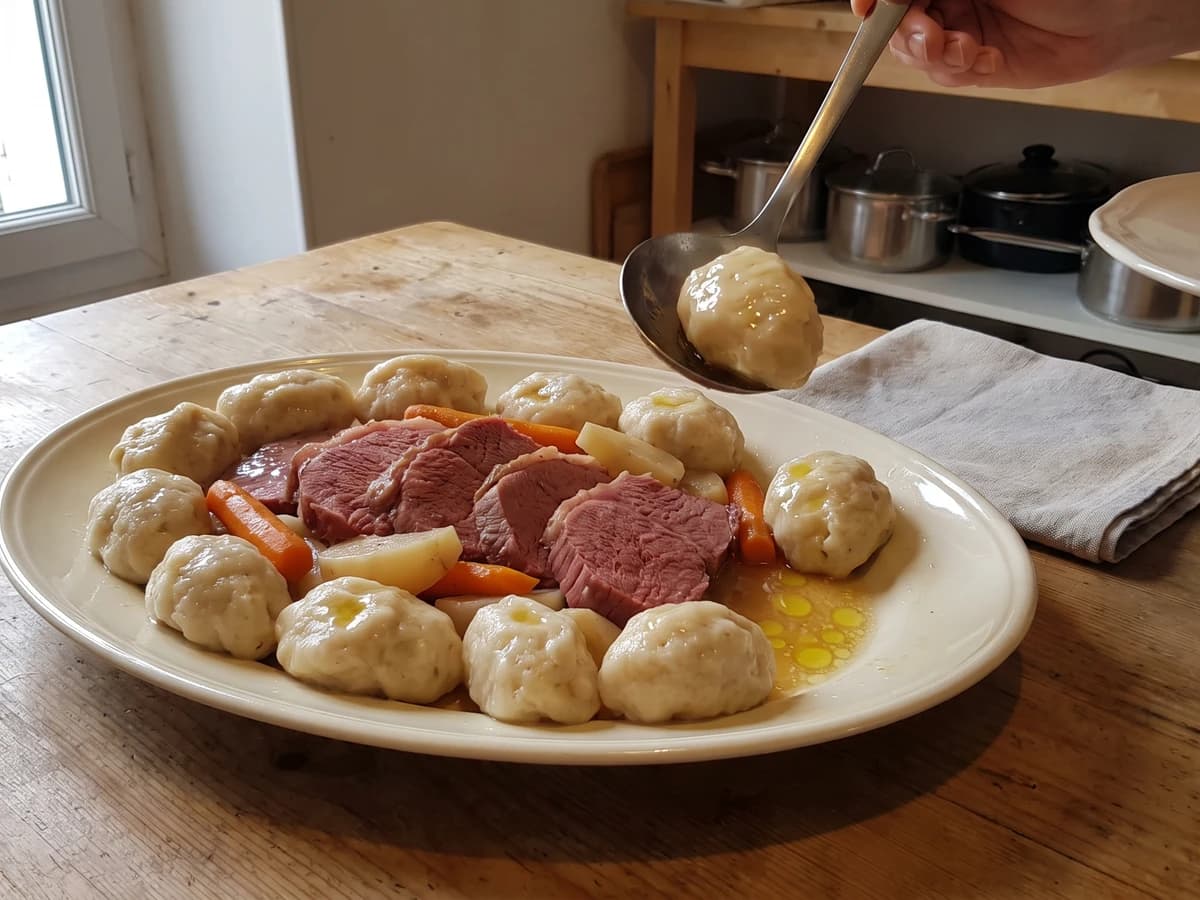
Boulettes au suif, poached beside salt beef, turn equal weights of flour and finely chopped suet into tender, rich dumplings. Keep the beef liquor at a bare tremble and the old garnish works beautifully at home.
A cooking platform built around craft, culture, and the stories behind what we eat.
Created by Chef Juliette
Based on No. 2160, Laitues Braisées au Jus, from Le Guide Culinaire (1907) by Auguste Escoffier
Whole lettuce learns the discipline of the braise: blanch, press, tie, and cook gently over bacon and roots, then crown it with butter-fried croûtons and a glossy veil of reduced liquor and veal gravy.
Laitues Braisées au Jus (braised lettuces with jus) teach one severe and useful principle: water must leave before flavor can enter. Lettuce carries more moisture than its delicate leaves suggest. Press it carelessly and the braising liquor turns pale and loose; press it properly, then cook it gently over bacon and roots, and the leaves absorb a deep, savory jus while keeping their shape.
The original assumed a stock never off the fire, a saucier ready with thickened veal gravy, and a braising pan built for dozens of lettuces. At home, one batch of Braised Vegetables (No. 275), a wide lidded sauté pan, and a small measure of good veal gravy do the same work for four. I have changed the scale, not the structure. The formal crown may become a simple timbale when dinner is less ceremonial, because that arrangement is service scaffolding; blanching, pressing, tying, the bacon-and-root braise, and the final reduction are the dish itself. One cook, one stove, one evening.
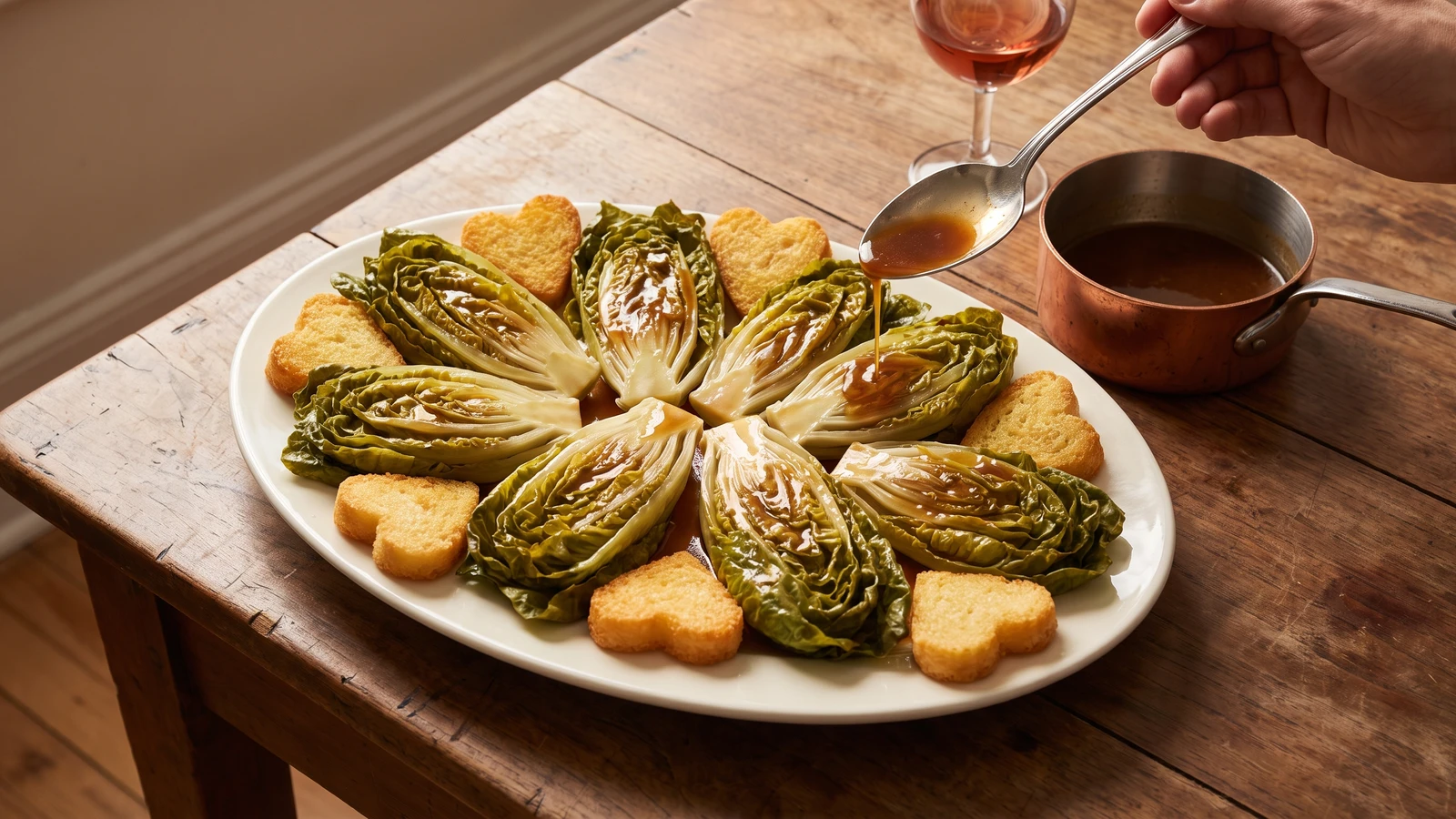
When they reach the table, the lettuces should be tender enough to yield beneath a fork yet still recognizable, their olive-green folds shining beneath a brown-gold glaze. Press them firmly between towels before tying, but never wring them. That quiet step decides everything that follows.
Laitues braisées au jus belong to the Parisian cuisine bourgeoise table and the classical garnish repertoire, where cooked lettuce accompanied roast veal, lamb, or poultry instead of appearing as salad. Household cooks already knew that firm lettuces could take a slow braise; the grand kitchen formalized the bacon-and-root bed, tied bundles, crown arrangement, and reduced veal-enriched jus. The surprise is not that lettuce was cooked, but that raw lettuce became so dominant that this older, practical use came to seem unusual.
Quantity
1 home-scale batch Braised Vegetables (No. 275), made with 4 small butterhead lettuces (about 2 lb / 900 g total) and yielding 1¼ cups (300 ml / 300 g) reserved braising liquor
completed through the braise
Quantity
½ cup (120 ml / 125 g), or ¼ cup (60 ml / 65 g) concentrated veal demi-glace loosened with ¼ cup (60 ml / 60 g) unsalted veal stock
warmed
Quantity
4 slices
crusts removed
Quantity
3 tablespoons (45 ml / 42 g)
Quantity
as needed
Quantity
as needed
Quantity
1 home-scale batch Cabbages for Garnish.—C (No. 2106)
use its filling and packet method before braising
| Ingredient | Quantity |
|---|---|
| Braised Vegetablescompleted through the braise | 1 home-scale batch Braised Vegetables (No. 275), made with 4 small butterhead lettuces (about 2 lb / 900 g total) and yielding 1¼ cups (300 ml / 300 g) reserved braising liquor |
| thickened veal gravywarmed | ½ cup (120 ml / 125 g), or ¼ cup (60 ml / 65 g) concentrated veal demi-glace loosened with ¼ cup (60 ml / 60 g) unsalted veal stock |
| firm white sandwich breadcrusts removed | 4 slices |
| unsalted butter | 3 tablespoons (45 ml / 42 g) |
| fine salt | as needed |
| freshly ground white pepper | as needed |
| Cabbages for Garnish.—C, optional stuffed service (optional)use its filling and packet method before braising | 1 home-scale batch Cabbages for Garnish.—C (No. 2106) |
Prepare the lettuces as one home-scale batch of Braised Vegetables (No. 275), using four small butterheads and tying them in two bundles of two after they have been blanched, cooled, pared, and pressed. Keep the bacon-and-root foundation and gentle covered braise exactly as that preparation directs; those elements build the flavor and must stay. During pressing, lay the lettuces between clean towels and bear down evenly with your palms, never twisting. If a wrapper leaf tears, overlap it around the core and secure it with twine; the bundle will hold.
When a small knife enters each lettuce core with only slight resistance, lift the bundles from their liquor and drain them for 5 minutes. Strain 1¼ cups of the braising liquor through a fine sieve, spoon off the surface fat, and hold ¼ cup aside. Remove every piece of twine, cut each lettuce lengthwise through its core, and gently open the rounded end of each half into a broad fan. Keep the core intact so the leaves remain gathered at the base.
Pour 1 cup of the strained braising liquor into a wide sauté pan and boil briskly until reduced by half, about 6 to 10 minutes. Stir in the thickened veal gravy and simmer until the jus naps the back of a spoon, meaning it leaves a glossy, even coat rather than running off like broth. Taste before adding salt, since both bacon and reduction concentrate seasoning. If the jus tightens or grows too salty, Ça se rattrape: stir in the reserved liquor one spoonful at a time. If it remains thin, continue reducing instead of reaching for flour.
Cut the bread into eight hearts about 2 inches wide. Melt the butter in a skillet over medium heat and wait until its foam begins to subside, then fry the croûtons in a single layer until crisp and deep gold on both sides, about 2 minutes per side. Lower the heat if the butter darkens before the bread colors. Drain briefly on a rack or clean towel and season with the smallest pinch of salt.
Warm an oval platter or deep round serving dish. If the lettuce halves have cooled, arrange them in a clean wide pan with 2 tablespoons of the reserved liquor, cover, and warm over gentle heat for 3 to 4 minutes. Drain them again before plating. Water left beneath the leaves will dilute the finished jus, so give them a moment and let gravity do its work.
Arrange the eight lettuce halves around the warm oval platter with their cores pointing inward and their opened leaves fanning toward the rim. Alternate each half with a heart-shaped croûton, its point facing outward. Spoon the veal-enriched jus generously over the lettuce while leaving the upper faces of the croûtons mostly dry and crisp. For the quieter timbale service permitted by the original, nestle the halves in a warm deep dish, tuck the croûtons around them, and coat in the same way. Serve at once. À table!
1 serving (about 255g)
Culinary guides, cultural storytelling, and the editorial depth that makes cooking meaningful.
Discover Culinary ExplorerChef Juliette
Boulettes au suif, poached beside salt beef, turn equal weights of flour and finely chopped suet into tender, rich dumplings. Keep the beef liquor at a bare tremble and the old garnish works beautifully at home.

Chef Juliette
Bread, flour, frangipane, and rice become four cool, supple panades for binding forcemeats, each changing body and flavor while preserving tenderness. The finest Mousselines need none, and knowing that distinction is the lesson.

Chef Juliette
Panade au pain is bread, milk, salt, heat, and attention: stir until the paste releases cleanly, butter it against a skin, and you have the quiet binder behind tender French farces.

Chef Juliette
Panade de farine teaches the drying stroke behind pâte à choux: flour meets boiling buttered water, then stays over the fire until the paste gathers, smooths, and quits the pan cleanly.