
Chef Juliette
Artichauts à la Barigoule
Artichauts à la Barigoule turns tender artichokes into little braising vessels, packed with mushrooms and fat bacon, wrapped, wine-braised, then dressed with only a spoonful of dark, concentrated sauce.
A cooking platform built around craft, culture, and the stories behind what we eat.
Created by Chef Juliette
Based on No. 2043, Asparagus with Various Sauces, from Le Guide Culinaire (1907) by Auguste Escoffier
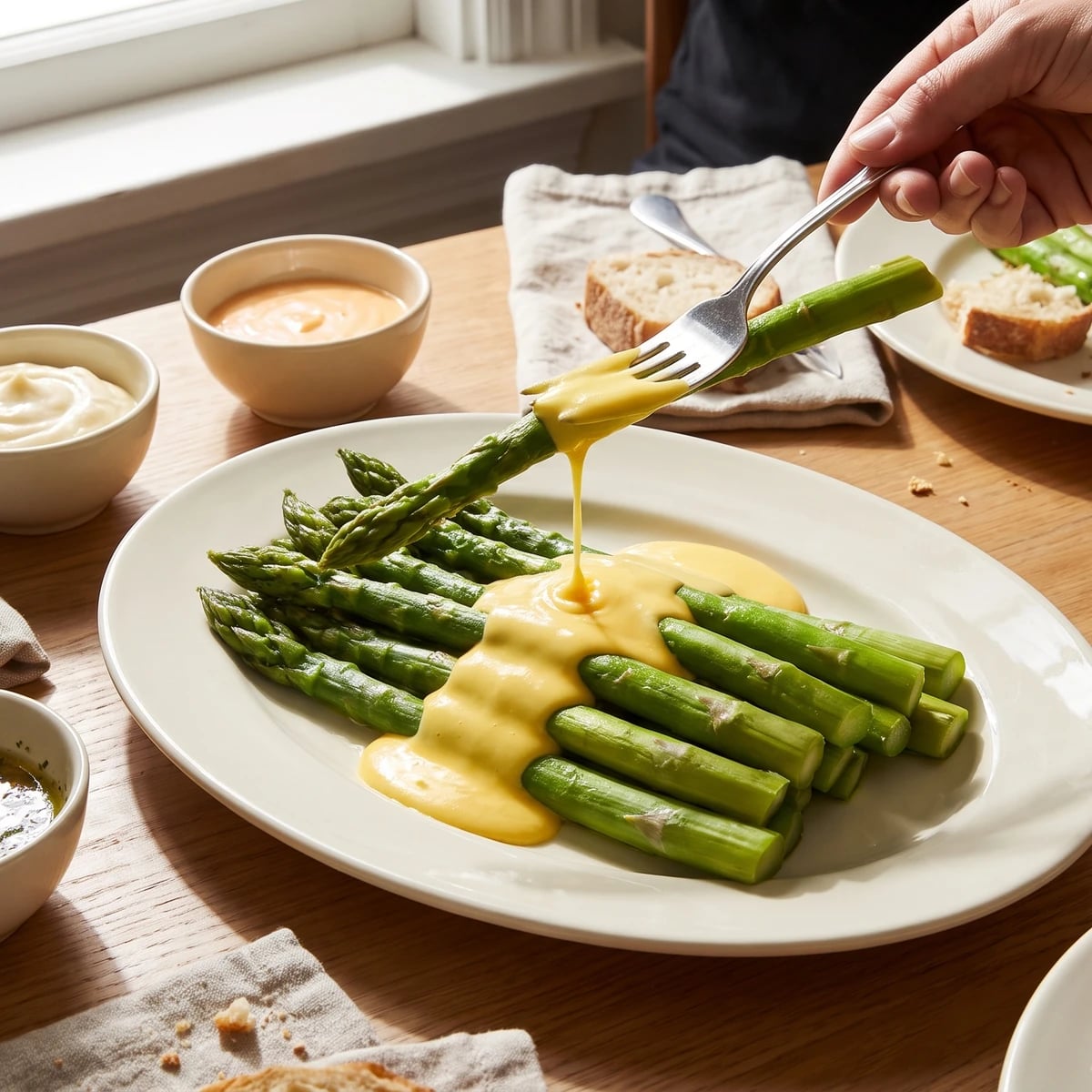
One vegetable, a whole lesson in sauce families: tender asparagus takes butter and warm emulsions when hot, then vinaigrette or cool mayonnaise when cold, each chosen by temperature and texture.
Asperges aux sauces variées (asparagus with various sauces) teach one clear law: the temperature of the spear chooses the family of sauce. Hot asparagus welcomes Sauce au Beurre, Sauce Hollandaise and its Mousseline or Maltaise relations, the occasional Sauce Béarnaise sans herbes (Béarnaise without herbs), or simple beurre fondu. Cold asparagus wants the point of vinaigrette or the cool body of mayonnaise, especially Mayonnaise Chantilly. C'est la même grammaire, temperature first, texture second.
The original entry is a service note from a kitchen that assumed a saucier could send out several finished sauces on command, with a deep asparagus boiler and warm holding baths nearby. A home cook needs none of that parallel motion. The tall boiler and rank of saucepans are brigade scaffolding; a wide sauté pan, one bowl set over warm water, 2 pounds of asparagus, and one chosen sauce give four people the full intent. What changed is scale and simultaneity, not the cooking. One cook, one stove, one evening.
The asparagus must still be cooked until tender enough to bite cleanly, never left raw at the core, and the sauce must meet it at the correct temperature. A thickened warm emulsion can be loosened, and a split one can be rebuilt. The step that decides the plate is simpler: drain and dry every spear completely before the sauce touches it.
At the classical Parisian table and in cuisine bourgeoise, asparagus commonly arrived as its own course, with the sauce chosen according to whether the spears were served hot or cold. Market gardeners at Argenteuil, west of Paris, made thick pale asparagus so celebrated that the town's name became shorthand in the canon for asparagus preparations, but this service of varied sauces was never confined to one region. Its list records the logic of sauce families: butter and warm yolk emulsions for hot spears, vinaigrette or mayonnaise for cold ones, with beaten cream turning mayonnaise into Chantilly.
Quantity
2 pounds (900 g)
woody ends trimmed and stalks peeled as needed
Quantity
3 quarts (2.8 L / 2.8 kg)
Quantity
1½ tablespoons (22 ml / 27 g)
Quantity
¾ cup (180 ml / about 175 g) Sauce au Beurre, Sauce Hollandaise, Sauce Mousseline, Sauce Maltaise, or Sauce Béarnaise sans herbes; or ½ cup (120 ml / 113 g) beurre fondu
finished and kept barely warm
Quantity
½ cup (120 ml / about 115 g) Vinaigrette; or ¾ cup (180 ml / about 175 g) Sauce Mayonnaise or Mayonnaise Chantilly
finished and chilled
Quantity
8 cups (1.9 L / 1.9 kg)
for cold service
| Ingredient | Quantity |
|---|---|
| medium green or white asparaguswoody ends trimmed and stalks peeled as needed | 2 pounds (900 g) |
| water | 3 quarts (2.8 L / 2.8 kg) |
| fine sea salt | 1½ tablespoons (22 ml / 27 g) |
| hot accompaniment, choose one (optional)finished and kept barely warm | ¾ cup (180 ml / about 175 g) Sauce au Beurre, Sauce Hollandaise, Sauce Mousseline, Sauce Maltaise, or Sauce Béarnaise sans herbes; or ½ cup (120 ml / 113 g) beurre fondu |
| cold accompaniment, choose one (optional)finished and chilled | ½ cup (120 ml / about 115 g) Vinaigrette; or ¾ cup (180 ml / about 175 g) Sauce Mayonnaise or Mayonnaise Chantilly |
| ice water (optional)for cold service | 8 cups (1.9 L / 1.9 kg) |
Decide whether the asparagus will be served hot or cold before you fill the pan. For hot service, choose Sauce au Beurre, Sauce Hollandaise, Sauce Mousseline, Sauce Maltaise, Sauce Béarnaise sans herbes, or beurre fondu. For cold service, choose Vinaigrette, Sauce Mayonnaise, or Mayonnaise Chantilly. Prepare one sauce, not the entire list; the original offers a choice, not an examination.
Rinse the asparagus and cut away the dry, fibrous ends. Peel the lower third of medium green spears and the lower two-thirds of thick ones, turning each stalk as you work so it stays round. White asparagus must be peeled from just below the tip almost to the base, because its outer skin remains stringy after cooking. Keep the spears as close in thickness as possible so they finish together.
Set the finished sauce within reach before the asparagus cooks. Hold Sauce au Beurre, Sauce Hollandaise, Sauce Mousseline, Sauce Maltaise, or Sauce Béarnaise sans herbes in a heatproof bowl over warm water, off direct heat; keep beurre fondu fluid over the lowest heat. If a warm emulsion becomes too thick, whisk in 1 teaspoon (5 ml / 5 g) warm water. If an oily ring appears, put 1 teaspoon (5 ml / 5 g) cool water in a clean bowl and whisk the split sauce into it one spoonful at a time. Ça se rattrape. Keep Vinaigrette, Sauce Mayonnaise, and Mayonnaise Chantilly cold until serving.
Bring the water and salt to a full boil in a wide pan. Lower in the asparagus with the tips pointing in one direction, then let the water return to a lively simmer without battering the tips. Cook medium green asparagus for 4 to 7 minutes and white asparagus for 8 to 12 minutes, testing the thickest stalk early with a small knife. It should yield cleanly while retaining enough structure to lift whole. Do not chase raw crunch; classical asparagus is tender. Once it becomes mushy, no sauce can restore it.
For hot service, lift the asparagus directly onto a clean folded towel, spread it in one layer, and blot gently around the tips. Do not rinse it. For cold service, transfer the spears to the ice water just until the cooking stops, about 2 minutes, then drain and leave them between dry towels for at least 5 minutes. If they sat too long in the water, replace the wet towels and chill them uncovered for another 10 minutes. Surface moisture can be removed; a diluted sauce cannot be called back once it reaches the platter.
For hot service, arrange the asparagus on a warmed oval platter with the tips aligned. Pass the chosen sauce separately, or spoon a generous ribbon across the lower stalks so the tips remain visible. The sauce should be glossy and flowing, never fiercely hot. For cold service, arrange the dry spears on a cool platter; spoon Vinaigrette over them just before serving, or pass Sauce Mayonnaise or Mayonnaise Chantilly at the table. Cooking well is not cooking fancy. À table!
1 serving (about 270g)
Culinary guides, cultural storytelling, and the editorial depth that makes cooking meaningful.
Discover Culinary Explorer
Chef Juliette
Artichauts à la Barigoule turns tender artichokes into little braising vessels, packed with mushrooms and fat bacon, wrapped, wine-braised, then dressed with only a spoonful of dark, concentrated sauce.

Chef Juliette
Artichoke hearts, spring peas, and carrot settle into one buttered cocotte, cooking gently until tender before Manied Butter (No. 151) gives their clear vegetable liquor the lightest gloss.

Chef Juliette
Artichauts aux sauces diverses bring one generous lesson to the table: tie, boil, and drain the vegetables properly, then let one well-made sauce turn each leaf and heart into supper.

Chef Juliette
Artichauts à la Provençale turns a tight lid into technique: small artichokes, sweet peas, and lettuce soften in olive oil and their own juices, emerging tender, green, and quietly glossy.