Chef Juliette
Mayonnaise de Volaille
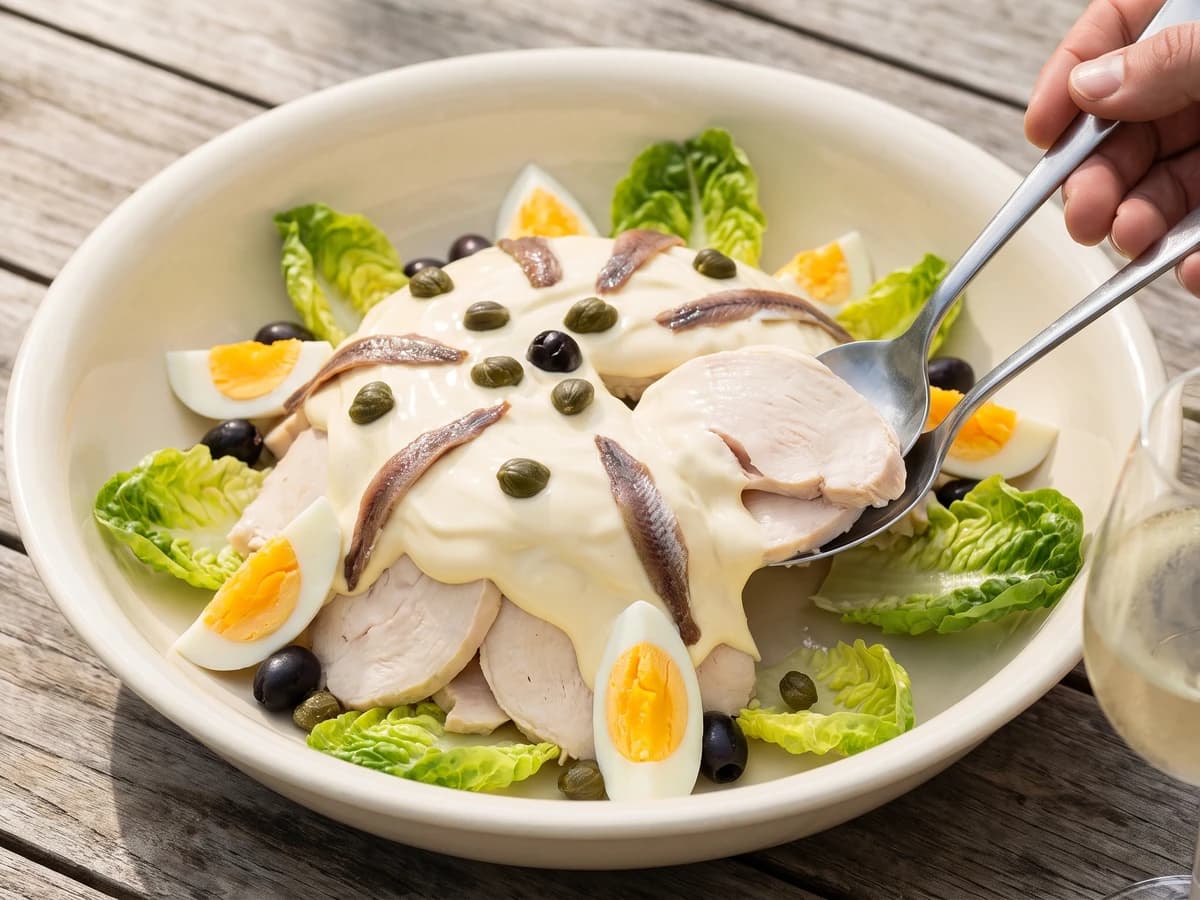
Cold roast chicken, ciseled lettuce, and a shining coat of homemade mayonnaise, arranged with capers, olives, anchovies, eggs, and lettuce hearts, then tossed at the table as the canon intends.
A cooking platform built around craft, culture, and the stories behind what we eat.

Created by Chef Juliette
Based on No. 2007, Salade Francillon, from Le Guide Culinaire (1907) by Auguste Escoffier
Salade Francillon turns one rule into grandeur: let warm potato drink its Chablis, then crown it with celery-poached mussels and black truffle in the original two-to-one-to-one proportion.
Salade Francillon (Parisian potato, mussel, and black-truffle salad) teaches absorption before arrangement. The one true thing is this: Chablis must meet the potato while it is warm. Warm potato drinks; cold potato merely gets wet, and no amount of magnificent truffle can correct that.
The formula assumes Salade Parisienne (No. 2017) and Cooked Marinade for Venison (No. 168) already waiting in the professional mise en place, with spare hands to clean mussels and slice truffles while another cook tends the potatoes. There is no saucier's reduction or salamander to imitate here. The brigade scaffolding is the ready-made mise en place; your equivalent is to prepare those numbered components from their own entries, then finish four servings with one saucepan, one shallow bowl, and the original 2:1:1 proportion measured by volume.
Once the wine is inside the potato, the rest is cool composure: mussels just opened with celery, truffle cut in broad black slices, and both laid in alternating bands over the base. If the potato takes too much wine, drain and rest it; if it cooled too soon, gentle warmth opens it again. Ça se rattrape. Marinate the potato warm. That is the step that matters.
Salade Francillon belongs to Paris and the boulevard theater, where a spoken recipe for potatoes, Chablis, mussels, and truffles escaped the stage and entered the professional repertoire. Its celebrated theatrical relation was called a salade japonaise (Japanese salad), yet the composition is thoroughly Parisian, built from French wine, shellfish, and the grand kitchen's appetite for truffle. The startling point is its proportion, with black truffle occupying a full quarter of the bowl rather than appearing as a token shaving.
Quantity
2 cups after marinating and draining (480 ml / about 400 g) Salade Parisienne (No. 2017)
prepared according to its own entry and kept warm
Quantity
⅓ cup (80 ml / 80 g)
Quantity
about 8 cups shell-on (1.9 L / 1 kg), yielding 1 cup cooked meat (240 ml / about 200 g)
scrubbed and debearded
Quantity
1 large stalk, about ½ cup (120 ml / 50 g)
thinly sliced
Quantity
¼ cup (60 ml / 60 g) Cooked Marinade for Venison (No. 168)
prepared according to its own entry
Quantity
1 cup loosely packed (240 ml / about 120 g)
brushed clean and thinly sliced
| Ingredient | Quantity |
|---|---|
| potato salad à la Parisienneprepared according to its own entry and kept warm | 2 cups after marinating and draining (480 ml / about 400 g) Salade Parisienne (No. 2017) |
| dry Chablis | ⅓ cup (80 ml / 80 g) |
| live musselsscrubbed and debearded | about 8 cups shell-on (1.9 L / 1 kg), yielding 1 cup cooked meat (240 ml / about 200 g) |
| celerythinly sliced | 1 large stalk, about ½ cup (120 ml / 50 g) |
| Cooked Marinade for Venisonprepared according to its own entry | ¼ cup (60 ml / 60 g) Cooked Marinade for Venison (No. 168) |
| mature black trufflebrushed clean and thinly sliced | 1 cup loosely packed (240 ml / about 120 g) |
Reach for the Salade Parisienne (No. 2017) and Cooked Marinade for Venison (No. 168), each prepared according to its own entry; their formulas stay whole rather than being rebuilt inside this salad. Keep the potato portion warm, measure only the marinade needed for the mussels, and discard any mussel with a broken shell or one that remains open when tapped.
Put the warm potato portion of the Salade Parisienne (No. 2017) in a broad bowl. Add the Chablis in three small additions, folding gently after each and waiting a minute before adding more; the potato should become fragrant and moist without sitting in a puddle. If wine remains beneath it after five minutes, drain the excess and spread the potato out briefly. If the potato cooled before the wine reached it, set the bowl over barely warm water and turn it gently until the chill leaves, then continue. Ça se rattrape. Measure exactly 2 cups of the marinated potato for the serving bowl.
Bring the Cooked Marinade for Venison (No. 168) and sliced celery to a brisk simmer in a wide saucepan. Add the mussels, cover, and cook over lively heat for 3 to 5 minutes, shaking the pan once. Lift each mussel out as soon as it opens so the early ones don't toughen while the stubborn ones catch up; give the closed shells one final minute, then discard any that remain shut.
Remove the mussels from their shells, pull away any last threads of beard, and spread the meat on a plate to cool without rinsing away its flavor. Measure 1 cup of mussel meat, matching one part mussels to the two parts marinated potato. Reserve any extra mussels and their strained liquor for another dish.
Slice the black truffle thinly enough to release its perfume but broadly enough that every piece remains visible and distinct under the teeth. Measure 1 loosely packed cup. This full quarter-volume of truffle is not decorative arithmetic; it is the dish, and reducing it to a few polite shavings makes another salad entirely.
Spread the 2 cups of Chablis-marinated potato across the bottom of a shallow serving bowl. Arrange the measured mussels and truffle slices over it in alternating, slightly overlapping bands, keeping both constituents visible rather than tossing them through the base. Let the salad settle for 10 minutes in a cool place so the truffle perfumes the surface, then serve cool but not numb from the refrigerator, with the remaining Chablis. À table!
1 serving (about 210g)
Culinary guides, cultural storytelling, and the editorial depth that makes cooking meaningful.
Discover Culinary ExplorerChef Juliette
Cold roast chicken, ciseled lettuce, and a shining coat of homemade mayonnaise, arranged with capers, olives, anchovies, eggs, and lettuce hearts, then tossed at the table as the canon intends.

Chef Juliette
Cold roast or poached chicken with fine ribbons of lettuce, dressed at the final moment with oil and vinegar: a composed salad whose freshness depends entirely on timing.

Chef Juliette
Five leaves, one living rule: laitue, romaine, chicorée, mâche, or pissenlit must be washed, dried, and dressed only as they go to the table, while every leaf still carries its light vinaigrette.

Chef Juliette
Salade de Betteraves proves that baking, not boiling, is the whole argument: concentrated garnet sweetness, tender baked onion, sharp mustard, and herbs cut into a weeknight salad worth making ahead.