
Chef Juliette
The Seasoning of Salads
Five dressings, one governing lesson: match fat and acid to the salad itself, from tender lettuce under fresh cream to bitter dandelion leaves glossed with hot bacon fat.
A cooking platform built around craft, culture, and the stories behind what we eat.
Created by Chef Juliette
Based on No. 1986, Salads de Betterave (Beetroot Salad), from Le Guide Culinaire (1907) by Auguste Escoffier
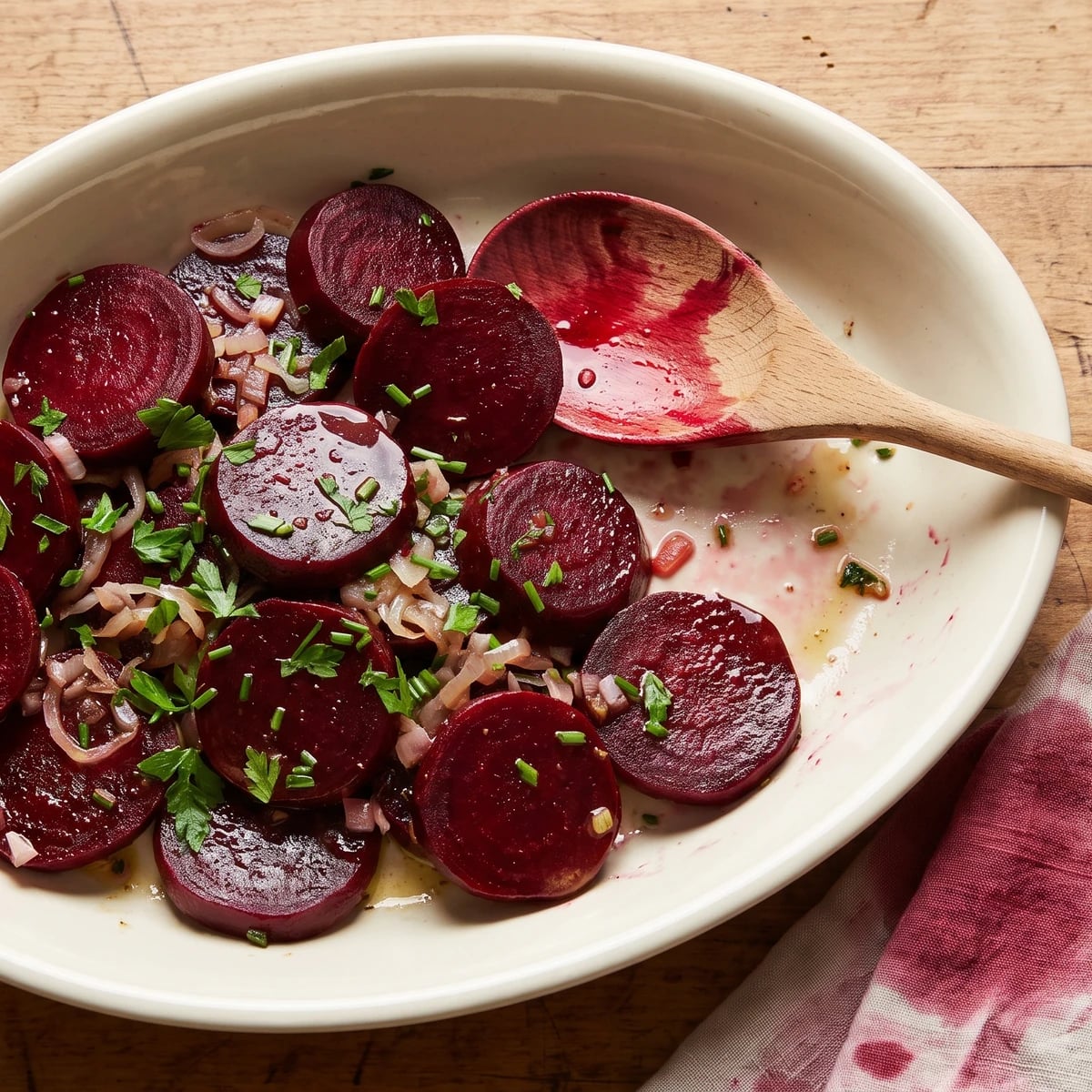
Salade de Betteraves proves that baking, not boiling, is the whole argument: concentrated garnet sweetness, tender baked onion, sharp mustard, and herbs cut into a weeknight salad worth making ahead.
Salade de Betteraves (beetroot salad) teaches a plain but useful truth: beetroot belongs in the oven, not a pot of water. Baking keeps its sweetness inside, deepens its earthy flavor, and leaves the flesh firm enough to cut into julienne, fine matchstick strips, or thin roundels without collapsing.
The original entry assumed a working range where the beetroot could bake while an onion rested in banked cinders, and it gave no quantities because the cold kitchen prepared whatever service required. At home, the cinders become a foil-wrapped, skin-on onion baked beside four portions of beetroot. The ash bed was brigade scaffolding and can go; baking both vegetables without water is the dish and must stay. One cook, one stove, one evening.
The finished salad should be garnet-bright and lightly glossy, with sweet onion disappearing into the sharp dressing and herbs lifting every bite. Before you touch a knife, bake the beetroot whole, with its skin and root intact. That is the step that decides everything afterward.
Salade de betteraves belongs to the French cuisine bourgeoise table, where cooked beetroot served as both a salad in its own right and a colorful accompaniment to compound salads and charcuterie. In the classical garde-manger, the cold kitchen, it was cut into julienne or roundels so it seasoned evenly without becoming a mash. The telling correction is that the canon preferred oven-baked beetroot to boiled: the oven preserved its sweetness, while the hearth's cinders gently softened the onion used to flavor it.
Quantity
4 medium (about 2 lb / 900 g)
scrubbed, leaves trimmed while roots remain intact
Quantity
1 medium (about 5 oz / 150 g)
unpeeled
Quantity
2 tablespoons (30 ml / 30 g)
Quantity
2 teaspoons (10 ml / 10 g)
omit for the oil-dressed version
Quantity
4 tablespoons (60 ml / 55 g)
Quantity
¾ teaspoon (3.75 ml / 4 g)
divided
Quantity
¼ teaspoon (1.25 ml / 0.5 g)
Quantity
3 tablespoons loosely packed (45 ml / 8 g)
finely chopped
Quantity
1 teaspoon (5 ml / 5 g)
only if needed to rescue the dressing
| Ingredient | Quantity |
|---|---|
| medium red beetrootsscrubbed, leaves trimmed while roots remain intact | 4 medium (about 2 lb / 900 g) |
| medium yellow onionunpeeled | 1 medium (about 5 oz / 150 g) |
| red wine vinegar | 2 tablespoons (30 ml / 30 g) |
| Dijon mustard (optional)omit for the oil-dressed version | 2 teaspoons (10 ml / 10 g) |
| sunflower or grapeseed oil | 4 tablespoons (60 ml / 55 g) |
| fine sea saltdivided | ¾ teaspoon (3.75 ml / 4 g) |
| freshly ground black pepper | ¼ teaspoon (1.25 ml / 0.5 g) |
| mixed flat-leaf parsley and chivesfinely chopped | 3 tablespoons loosely packed (45 ml / 8 g) |
| cool water (optional)only if needed to rescue the dressing | 1 teaspoon (5 ml / 5 g) |
Heat the oven to 400°F (200°C). Leave the beetroot skins and roots intact so their juices remain inside, then wrap each beetroot loosely in foil and set them on a rimmed sheet pan. Wrap the unpeeled onion separately and place it beside them. Bake the onion until completely tender when pressed, 45 to 55 minutes, and the beetroot until a thin skewer reaches the center with almost no resistance, 60 to 80 minutes depending on size. Do not accept a firm center; if the skewer catches, rewrap the beetroot and give it another 10 minutes. Ça se rattrape.
Open the parcels carefully and let the vegetables cool until they can be handled, about 15 minutes. Rub the beetroot skins away with a folded kitchen towel, using a small knife only on stubborn patches. Unwrap the onion, discard its papery skin and any dry outer layer, then chop the soft flesh very finely. Keep every drop of onion juice; it belongs in the salad.
Choose one shape. For roundels, slice the beetroot crosswise about ⅛ inch (3 mm) thick. For julienne, cut those slices into neat strips about ⅛ inch (3 mm) wide. Even cutting is not decoration here: pieces of one thickness take the dressing at the same rate and remain distinct under the fork.
Whisk the vinegar, Dijon mustard, ½ teaspoon of the salt, and the pepper in a large nonreactive bowl. Add the oil in a thin stream while whisking until the vinaigrette moutardée (mustard vinaigrette) looks lightly creamy. For the source's oil-dressed version, omit the mustard and whisk the vinegar and oil together; the dressing will remain loose, which is exactly right. If the mustard dressing separates stubbornly, whisk the cool water in a clean bowl and slowly beat the separated dressing into it. Ça se rattrape.
Add the warm beetroot and finely chopped baked onion to the bowl. Fold gently with two large spoons, using only three-quarters of the dressing at first, then leave the salad for 20 minutes. Warm beetroot drinks in seasoning; flooding it at once only leaves a red puddle underneath. If it tastes dry after resting, add the reserved dressing one spoonful at a time.
Fold in the parsley and chives once the beetroot is cool enough that the herbs stay bright. Taste and add the remaining salt only if needed, followed by another touch of vinegar if the sweetness has softened the salad's edge. Serve cool or at room temperature, never numb from the refrigerator. À table!
1 serving (about 240g)
Culinary guides, cultural storytelling, and the editorial depth that makes cooking meaningful.
Discover Culinary Explorer
Chef Juliette
Five dressings, one governing lesson: match fat and acid to the salad itself, from tender lettuce under fresh cream to bitter dandelion leaves glossed with hot bacon fat.

Chef Juliette
Five leaves, one living rule: laitue, romaine, chicorée, mâche, or pissenlit must be washed, dried, and dressed only as they go to the table, while every leaf still carries its light vinaigrette.

Chef Juliette
Salade de Céleri turns pale stalks into crisp curling fringes, then coats them with mustard and cream. The lesson is absolute: drain the celery hard, because water steals the sauce.

Chef Juliette
Céleri-rave becomes supple without losing its bite when a fine julienne meets mustard-rich mayonnaise. The knife work is the dish, and a short rest finishes what the dressing begins.