Chef Juliette
Mayonnaise de Volaille
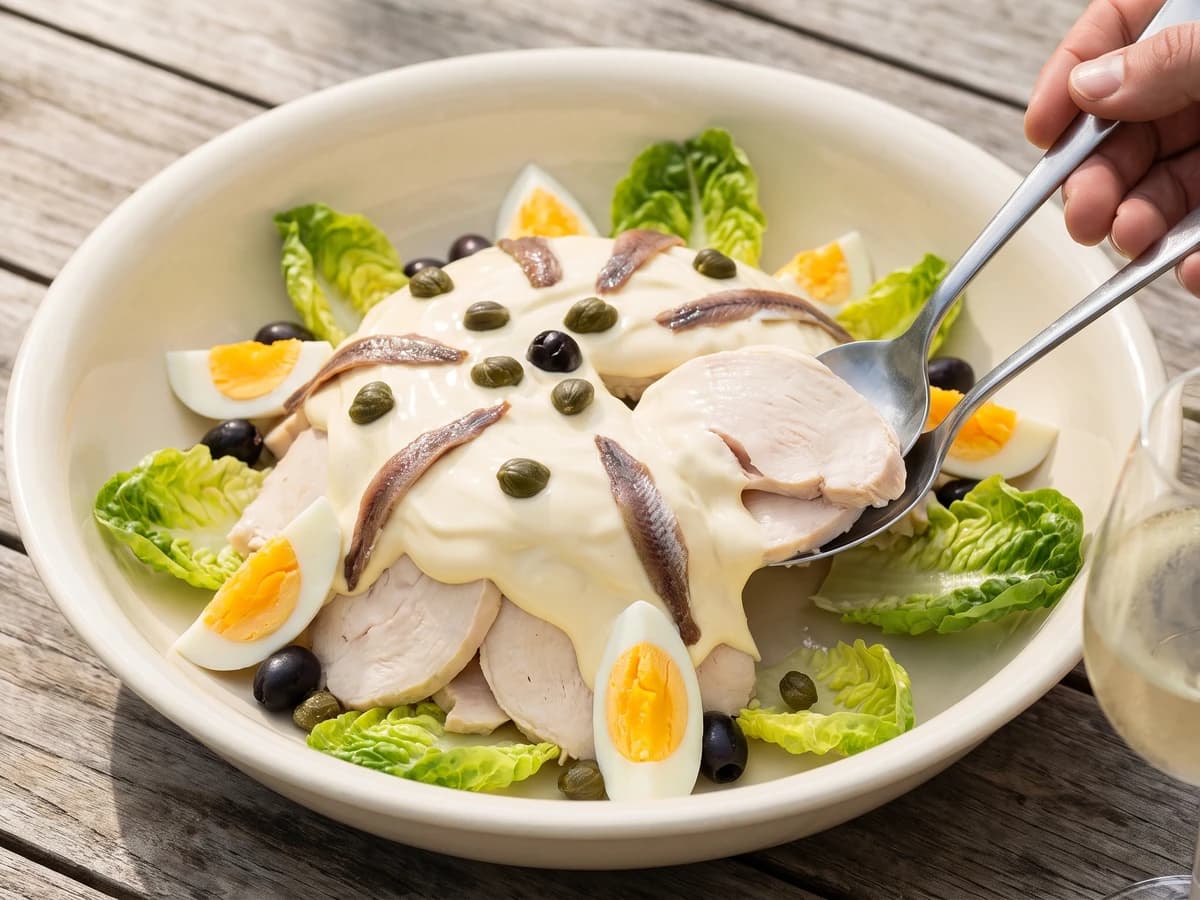
Cold roast chicken, ciseled lettuce, and a shining coat of homemade mayonnaise, arranged with capers, olives, anchovies, eggs, and lettuce hearts, then tossed at the table as the canon intends.
A cooking platform built around craft, culture, and the stories behind what we eat.
Created by Chef Juliette
Based on No. 1713, Chicken Salad, from Le Guide Culinaire (1907) by Auguste Escoffier
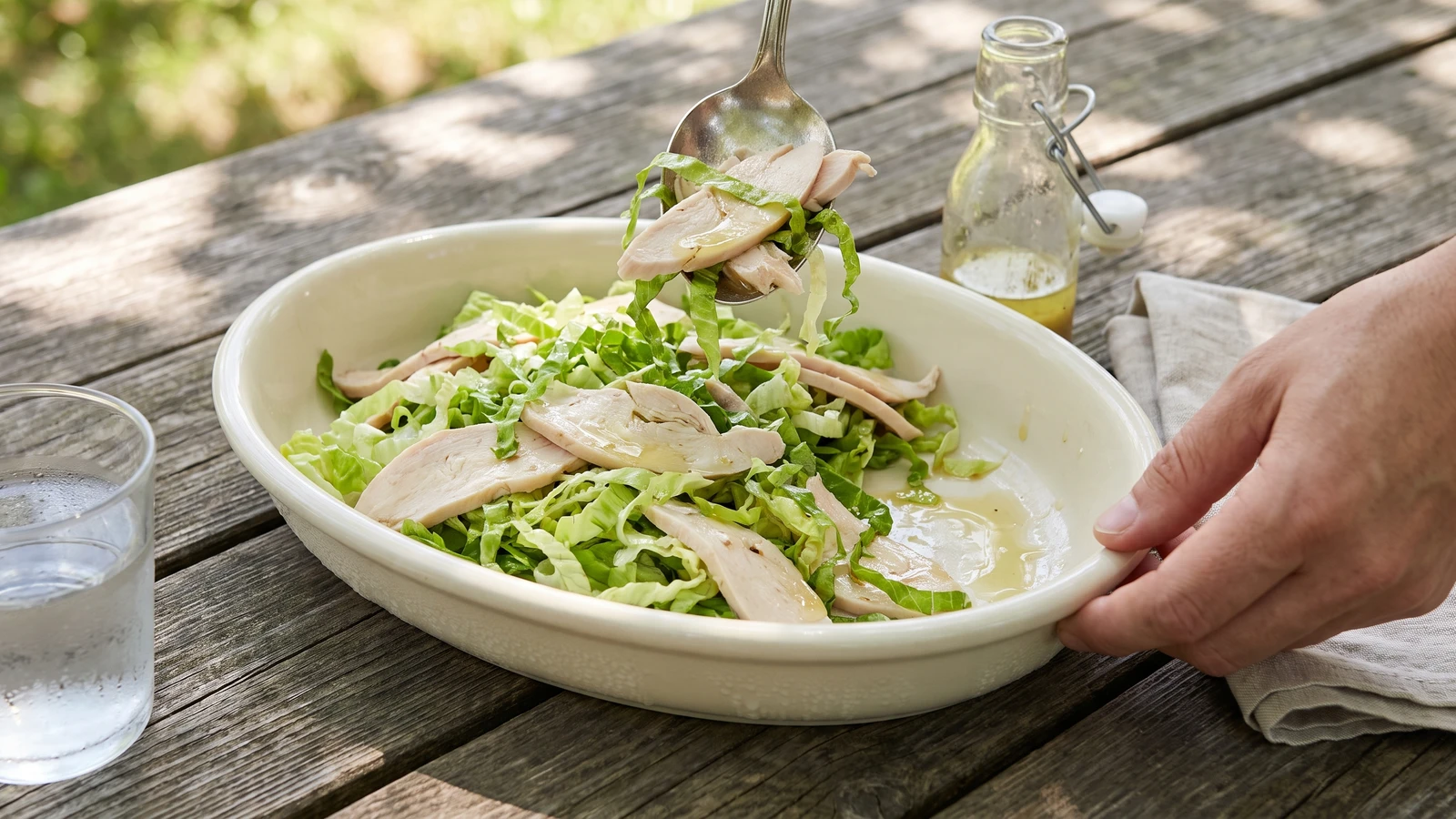
Cold roast or poached chicken with fine ribbons of lettuce, dressed at the final moment with oil and vinegar: a composed salad whose freshness depends entirely on timing.
Salade de volaille (chicken salad) teaches the discipline of the last minute. Before you touch a pan, know the one true thing: the assaisonnement ordinaire (plain oil-and-vinegar seasoning) goes on only when everyone is ready to eat. Dress it early and the ciselée lettuce softens while the cold chicken sheds moisture; dress it at the last breath and each ribbon stays crisp around the tender meat.
The old formula assumed a garde-manger, the brigade's cold station, holding cooked fowl and washed lettuce ready for service. At home, yesterday's roast chicken or chicken gently poached ahead, a salad spinner, and one wide bowl do the same work. The only modernization is to read boiled fowl as gently poached chicken, because a young market bird turns firm and stringy under a hard boil. The brigade's holding setup was scaffolding and can go. Skinless cold fowl, ciselée lettuce, and last-minute seasoning are the dish and must stay.
This is deliberately not the mayonnaise-bound version beside it in the classical repertoire. Its foundation is a temporary emulsion, bright enough to wake the cold meat without concealing it. One cook, one stove, one evening, though tonight the stove has already earned its rest. Dry the lettuce completely, then wait until the final moment to toss. That timing decides everything.
Salade de volaille belongs to the Parisian cuisine bourgeoise and the classical garde-manger, where cold roast or poached fowl was recut for luncheon rather than treated as a lesser leftover. Classical collections place two versions side by side: one bound with mayonnaise, and this brighter composed salad dressed with ordinary oil-and-vinegar seasoning only at service. It traveled naturally from household dining rooms to café buffets and picnic baskets, but chicken, ciselée lettuce, and dressing were always kept apart until the final toss.
Quantity
about 3 cups (710 ml / 450 g)
skin and bones removed, sliced into bite-size pieces
Quantity
1 small head, about 6 loosely packed cups (1.4 L / 180 g)
washed, thoroughly dried, and cut ciselée
Quantity
3 tablespoons (45 ml / 41 g)
Quantity
1 tablespoon (15 ml / 15 g)
Quantity
1/2 teaspoon (2.5 ml / 3 g)
Quantity
1/4 teaspoon (1.25 ml / 0.5 g)
| Ingredient | Quantity |
|---|---|
| cold roast or gently poached chicken meatskin and bones removed, sliced into bite-size pieces | about 3 cups (710 ml / 450 g) |
| butter lettucewashed, thoroughly dried, and cut ciselée | 1 small head, about 6 loosely packed cups (1.4 L / 180 g) |
| mild olive oil or neutral salad oil | 3 tablespoons (45 ml / 41 g) |
| wine vinegar | 1 tablespoon (15 ml / 15 g) |
| fine salt | 1/2 teaspoon (2.5 ml / 3 g) |
| freshly ground black pepper | 1/4 teaspoon (1.25 ml / 0.5 g) |
Keep the cooked chicken cold while you remove every scrap of skin, bone, cartilage, and excess fat. Cut the meat across the grain into neat pieces about 1/4 inch (6 mm) thick, large enough to remain juicy but small enough to meet the lettuce in every serving. Pat any damp surfaces dry. Moisture left on the chicken dilutes the seasoning before it can coat the meat.
Separate the lettuce leaves, wash them in cold water, and spin them until thoroughly dry. Stack a few leaves at a time, roll them loosely, and cut crosswise into fine ribbons. Work with a sharp knife and a light hand; crushed lettuce darkens and softens. Reserve one loose handful of the driest ribbons, then place the remainder in a wide salad bowl with the chicken.
Put the wine vinegar, salt, and pepper in a small bowl and whisk until the salt dissolves. Add the oil in a thin stream while whisking until the assaisonnement looks lightly thickened and unified. Without mustard it will separate as it stands, which is proper for this plain seasoning. If it divides before serving, whisk again for a few seconds. Ça se rattrape.
Set the table before dressing the salad. Whisk the assaisonnement once more, pour about three-quarters of it around the inner wall of the bowl, and lift the chicken and lettuce through it with two large spoons. Toss only until every surface carries a fine sheen, then taste one piece of chicken together with some lettuce. Add the remaining seasoning only if the salad needs it. If it becomes too wet, fold in the reserved dry lettuce at once; ça se rattrape, but only if you act before the leaves soften.
Transfer the salad loosely to a shallow serving dish without pressing it into a compact mound. Bring it straight to the table while the lettuce remains crisp and the chicken is cool. For a picnic, carry all three components chilled and separate, then mix them only after the plates are out. Cooking well is not cooking fancy. À table!
1 serving (about 172g)
Culinary guides, cultural storytelling, and the editorial depth that makes cooking meaningful.
Discover Culinary ExplorerChef Juliette
Cold roast chicken, ciseled lettuce, and a shining coat of homemade mayonnaise, arranged with capers, olives, anchovies, eggs, and lettuce hearts, then tossed at the table as the canon intends.

Chef Juliette
Five leaves, one living rule: laitue, romaine, chicorée, mâche, or pissenlit must be washed, dried, and dressed only as they go to the table, while every leaf still carries its light vinaigrette.

Chef Juliette
Salade de Betteraves proves that baking, not boiling, is the whole argument: concentrated garnet sweetness, tender baked onion, sharp mustard, and herbs cut into a weeknight salad worth making ahead.

Chef Juliette
Salade de Céleri turns pale stalks into crisp curling fringes, then coats them with mustard and cream. The lesson is absolute: drain the celery hard, because water steals the sauce.