Chef Juliette
Mayonnaise de Volaille
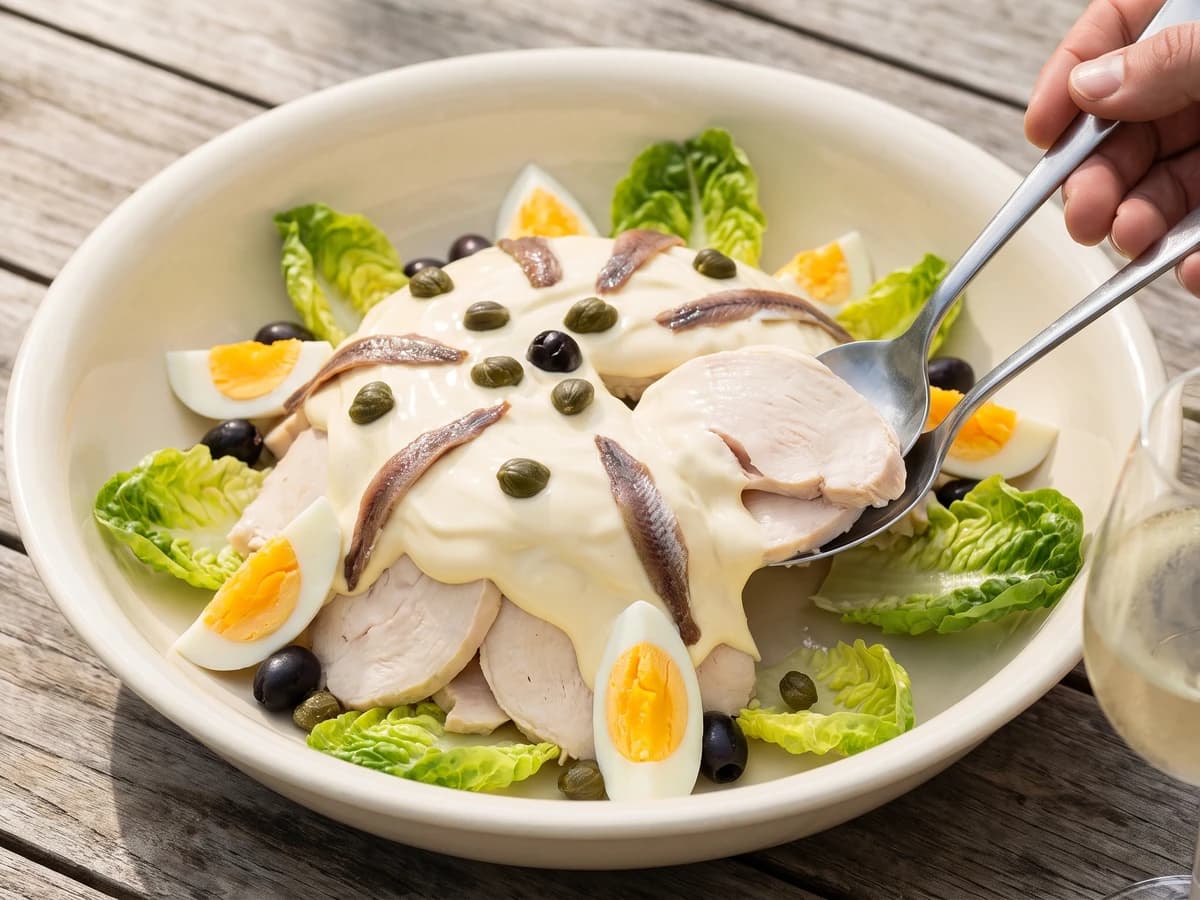
Cold roast chicken, ciseled lettuce, and a shining coat of homemade mayonnaise, arranged with capers, olives, anchovies, eggs, and lettuce hearts, then tossed at the table as the canon intends.
A cooking platform built around craft, culture, and the stories behind what we eat.

Created by Chef Juliette
Based on No. 2017, Salade Parisienne, from Le Guide Culinaire (1907) by Auguste Escoffier
Langouste and truffle gleam through a clear aspic Charlotte, enclosing a bright vegetable salad bound with aspic-set mayonnaise. The triumph is temperature: thin coats, a deep chill, then one clean turn.
Salade Parisienne (Paris-style moulded langouste and vegetable salad) teaches the discipline of cold aspic: temperature is structure. Before you touch a pan, know this one thing. The jelly must be cool enough to cling yet fluid enough to seal; warm jelly slides away, while half-set jelly catches bubbles and ridges.
The entry assumed a garde-manger working over broken ice, a saucier handing over very clear fish jelly, and langouste remains from a larger service. At home, an ice-water bowl replaces the chilled bench, a 1-quart Charlotte mould replaces brigade scale, prepared fish aspic replaces a stockpot built for one garnish, and two cooked tails replace service trimmings. Another Method of Preparing Aspics de Filets de Soles (No. 916) supplies only the mould-clothing operation; its sole paupiettes remain in their own entry. Salade de Légumes (No. 2011) also arrives finished, exactly as the book intends. The separate stockpot and brigade quantities are scaffolding. The clear coat, the quarter-volume of diced shellfish, the mayonnaise collée (mayonnaise set with aspic), and the full cold set must stay.
When it is right, the Charlotte turns out glass-clear and firm, with coral langouste and black truffle showing through its walls and a bright, creamy vegetable salad waiting inside. One cook, one stove, one evening, followed by patience in the refrigerator. The step that decides it is clothing the mould: make the first coat thin, even, and fully set before the decoration touches it.
Salade Parisienne belongs to the formal cold-buffet repertoire of Parisian grand kitchens, where aspic served as both seasoning and architecture for shellfish, truffle, and dressed vegetables. The name can mislead: this is not the familiar ham, cheese, mushroom, and egg salad now sold under the same name, but a Charlotte built around Salade de Légumes (No. 2011), with Another Method of Preparing Aspics de Filets de Soles (No. 916) supplying the professional vocabulary of clothing the mould. Passed from the garde-manger to formal home tables, it kept its essential test unchanged, a clear coat and a clean turn that reveal every careful layer.
Quantity
1 application from Another Method of Preparing Aspics de Filets de Soles (No. 916)
for the Charlotte mould
Quantity
2½ cups (600 ml / 425 g) Salade de Légumes (No. 2011)
freshly prepared, well drained, and cooled completely
Quantity
1½ cups (360 ml / 360 g)
melted and cooled until fluid
Quantity
2 large tails, about 10 ounces (285 g) meat
cut into 16 thin collops, then dice ⅝ cup (150 ml / 100 g) of the remainder
Quantity
1 small truffle, about ¾ ounce (20 g)
sliced paper-thin and cut into small lozenges
Quantity
1
Quantity
2 teaspoons (10 ml / 10 g)
Quantity
¼ teaspoon (1.25 ml / 1.5 g)
Quantity
1 pinch
Quantity
½ cup (120 ml / 110 g)
| Ingredient | Quantity |
|---|---|
| mould-clothing applicationfor the Charlotte mould | 1 application from Another Method of Preparing Aspics de Filets de Soles (No. 916) |
| Salade de Légumesfreshly prepared, well drained, and cooled completely | 2½ cups (600 ml / 425 g) Salade de Légumes (No. 2011) |
| very clear fish aspic jellymelted and cooled until fluid | 1½ cups (360 ml / 360 g) |
| cooked spiny-lobster tail meatcut into 16 thin collops, then dice ⅝ cup (150 ml / 100 g) of the remainder | 2 large tails, about 10 ounces (285 g) meat |
| black trufflesliced paper-thin and cut into small lozenges | 1 small truffle, about ¾ ounce (20 g) |
| pasteurized large egg yolk | 1 |
| white wine vinegar | 2 teaspoons (10 ml / 10 g) |
| fine salt | ¼ teaspoon (1.25 ml / 1.5 g) |
| finely ground white pepper | 1 pinch |
| neutral sunflower or grapeseed oil | ½ cup (120 ml / 110 g) |
Set a smooth 1-quart (1 L) Charlotte mould in a bowl of ice water, keeping the water outside the mould. Hold the fluid aspic jelly in a second bowl nearby. Arrange the langouste collops and truffle lozenges on a cold plate, then measure exactly ⅝ cup (150 ml / 100 g) of diced langouste. Spread the freshly prepared Salade de Légumes (No. 2011) in a shallow dish and chill it only until no warmth remains; its own entry calls for freshly cooked vegetables, while this mould requires them cool enough not to melt the mayonnaise collée.
Use the mould-clothing operation from Another Method of Preparing Aspics de Filets de Soles (No. 916). Pour about ¼ cup (60 ml / 60 g) of the cool, fluid aspic jelly into the chilled Charlotte mould, then rotate and tilt it over the ice water until every part of the bottom and sides wears a thin, even film. Pour the excess jelly back into its bowl and chill the mould until the coating is firm. If the jelly runs straight off, the mould or jelly is too warm; drain it, chill both for several minutes, and begin again. If the jelly catches in ridges, warm its bowl briefly in lukewarm water and stir until fluid.
Arrange the langouste collops against the bottom and sides of the coated mould, placing a truffle lozenge neatly upon each. Fix every piece with a few drops of aspic jelly and chill until held fast, then spoon over another very thin veil of jelly to seal the decoration. Do not flood the mould. If a collop begins to float, drain away the loose jelly, chill the decoration until firm, and continue a teaspoon at a time.
Whisk the pasteurized yolk with the vinegar, salt, and white pepper until smooth. Add the oil drop by drop until the emulsion takes, then in a slender thread, whisking without pause until the mayonnaise stands in soft peaks. If it splits, stop. Ça se rattrape: place a teaspoon of cold water in a clean bowl and whisk in the broken mayonnaise one spoonful at a time. Measure 2 tablespoons (30 ml / 30 g) of cool but still liquid aspic jelly and whisk it gradually into the finished mayonnaise. This is the mayonnaise collée that will hold the filling without making it heavy.
Place the 2½ cups (600 ml / 425 g) Salade de Légumes (No. 2011) in a chilled bowl and fold in the measured ⅝ cup (150 ml / 100 g) of diced langouste, exactly one quarter of the vegetable salad by volume. Fold in three quarters of the mayonnaise collée, then add only enough of the remainder for the mixture to hold together when lifted on a spoon. It should cohere, not swim. If liquid collects beneath it, drain the filling in a sieve for two minutes, chill it again, and finish binding it with the reserved mayonnaise.
Spoon the filling into the decorated mould in three additions. Press each layer gently against the sides with the back of a spoon so no air pockets remain, taking care not to disturb the langouste lining or crush the vegetables. Tap the mould once or twice against a folded towel, fill it to the rim, and level the top. Gentle pressure, not force. The vegetables should still look like themselves when the Charlotte is cut.
Cover the mould without letting the cover touch the filling and refrigerate at 4°C (40°F) or colder for at least 6 hours, preferably overnight. The walls and centre must feel equally firm before unmoulding; a set exterior can hide a soft middle. If the centre still yields near serving time, leave it in the mould and give it another hour. Freezing makes the jelly weep when it thaws, so patience is the only proper finish.
Spread a clean, lightly dampened white linen napkin over a chilled oval platter. Dip the mould up to its rim in warm water for 3 to 5 seconds, dry the outside, invert it squarely onto the napkin, and lift straight upward. If it refuses to release, wrap the sides in a warm towel for another 5 seconds and try again; if the jelly begins to soften, return the mould to the refrigerator for 15 minutes before repeating. Bring the Salade Parisienne to the table cold and cut it into generous wedges. À table!
1 serving (about 305g)
Culinary guides, cultural storytelling, and the editorial depth that makes cooking meaningful.
Discover Culinary ExplorerChef Juliette
Cold roast chicken, ciseled lettuce, and a shining coat of homemade mayonnaise, arranged with capers, olives, anchovies, eggs, and lettuce hearts, then tossed at the table as the canon intends.

Chef Juliette
Cold roast or poached chicken with fine ribbons of lettuce, dressed at the final moment with oil and vinegar: a composed salad whose freshness depends entirely on timing.

Chef Juliette
Five leaves, one living rule: laitue, romaine, chicorée, mâche, or pissenlit must be washed, dried, and dressed only as they go to the table, while every leaf still carries its light vinaigrette.

Chef Juliette
Salade de Betteraves proves that baking, not boiling, is the whole argument: concentrated garnet sweetness, tender baked onion, sharp mustard, and herbs cut into a weeknight salad worth making ahead.