Chef Juliette
Mayonnaise de Volaille
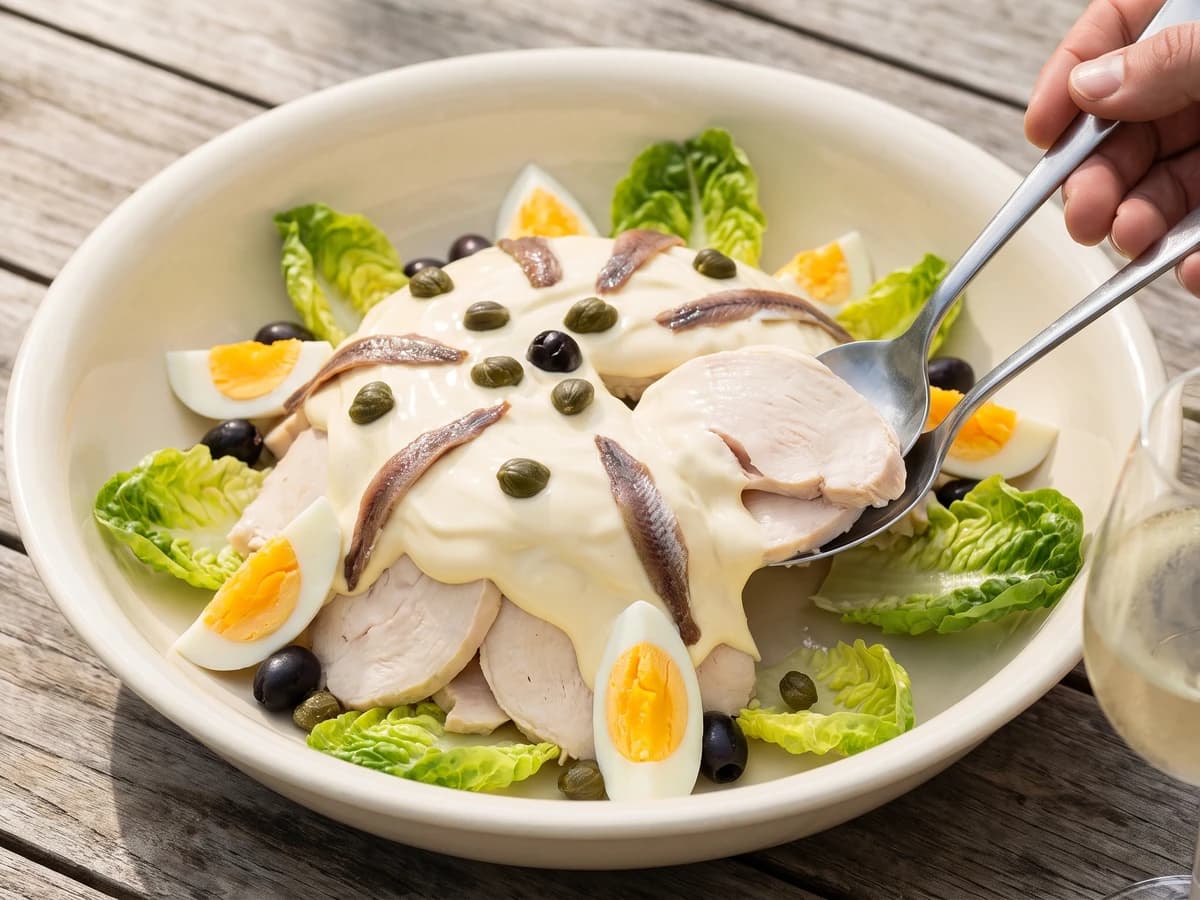
Cold roast chicken, ciseled lettuce, and a shining coat of homemade mayonnaise, arranged with capers, olives, anchovies, eggs, and lettuce hearts, then tossed at the table as the canon intends.
A cooking platform built around craft, culture, and the stories behind what we eat.
Created by Chef Juliette
Based on No. 2011, Salade de Légumes, from Le Guide Culinaire (1907) by Auguste Escoffier
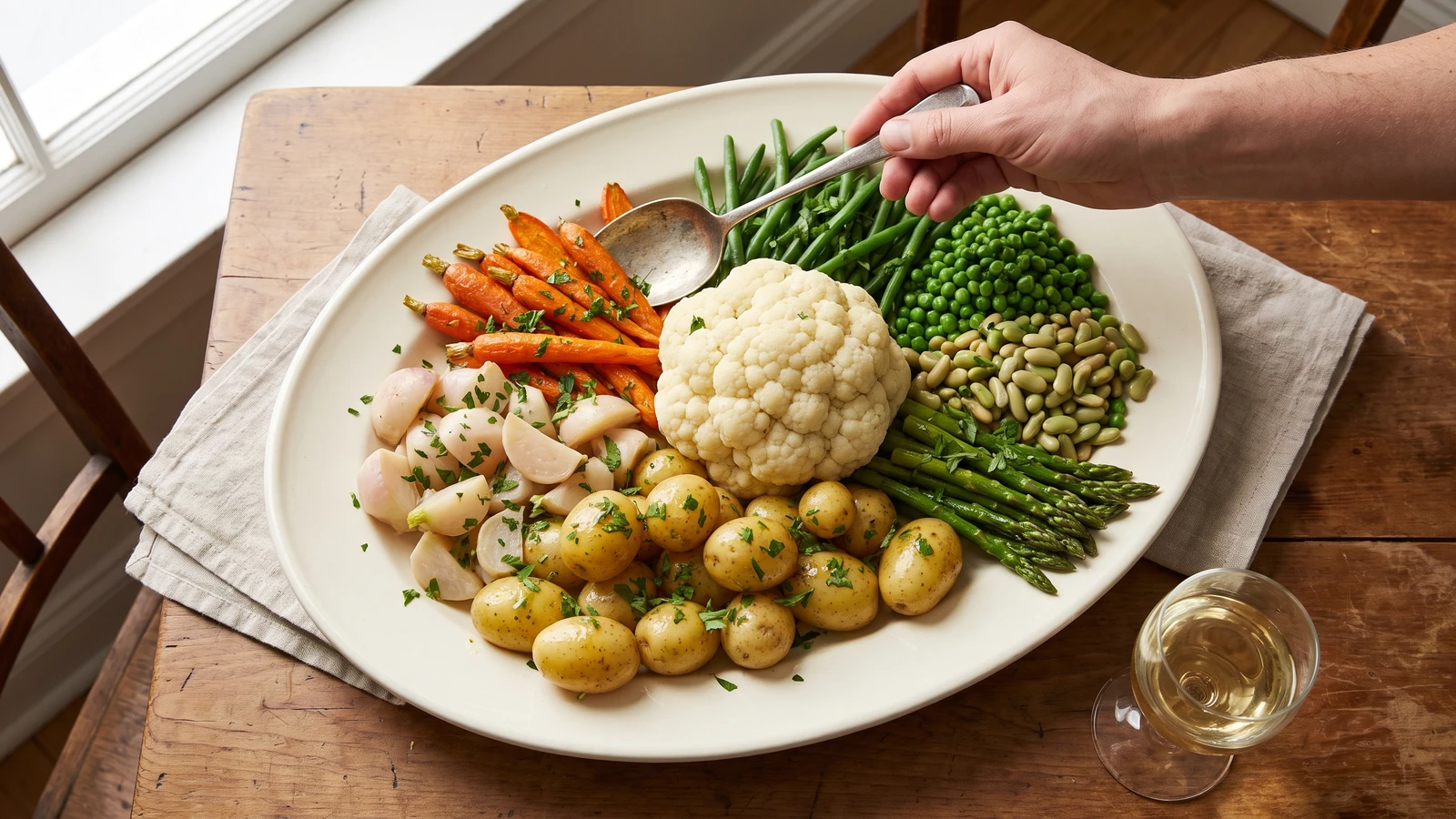
Seven vegetables, cooked separately and gathered warm around a cauliflower crown, take parsley, chervil, oil, and vinegar into every surface. The discipline is timing, the pleasure is abundance.
Salade de légumes (composed vegetable salad) teaches one clean lesson: vegetables take their seasoning best while freshly cooked and warm. Oil and vinegar cling to their dry, tender surfaces, parsley and chervil wake in the warmth, and each vegetable still tastes of itself. Let everything go cold and tired first, and the dressing merely sits on top.
The original entry assumed a grooved spoon-cutter and enough brigade hands to bring seven cooked vegetables to the platter together. At home, a small melon baller or neat 1.5 cm dice gives the honest shape, while two saucepans and a staggered cooking order handle the timing. The fluting is brigade scaffolding and can go; equal carrot and turnip quantities, distinct heaps, a central cauliflower crown, and warm seasoning are the dish itself. One cook, one stove, one evening.
The finished platter should look abundant rather than fussy, with every vegetable holding its colour and identity beneath a light sheen of vinaigrette. Have the dressing and warm platter waiting before the first vegetable leaves the water. That readiness is the step that decides the salad.
Salade de légumes belongs to the classical Parisian dining room and the cuisine bourgeoise table, where a salad could be composed carefully on a platter rather than tossed in a bowl. Its distinct heaps and decorative cuts traveled from grand-kitchen service into household cookery, but the governing idea is practical, not ornamental: salade describes vegetables seasoned with oil and vinegar, not necessarily vegetables served raw or cold. The cauliflower crown marks the dish's formal parentage, while the instruction to use freshly cooked, uncooled vegetables reveals its real appetite.
Quantity
½ cup (120 ml / 75 g)
shaped with a small melon baller or cut into ½-inch (1.5 cm) dice
Quantity
½ cup (120 ml / 75 g)
shaped with a small melon baller or cut into ½-inch (1.5 cm) dice
Quantity
¾ cup (180 ml / 120 g)
cut into ½-inch (1.5 cm) dice
Quantity
¾ cup (180 ml / 90 g)
cut diagonally into lozenges
Quantity
½ cup (120 ml / 75 g)
Quantity
½ cup (120 ml / 90 g)
drained
Quantity
¾ cup (180 ml / 100 g)
cut into 2-inch (5 cm) lengths
Quantity
1 crown (about 2 cups / 200 g)
leaves removed and stem trimmed flat
Quantity
6 tablespoons (90 ml / 82 g)
Quantity
2 tablespoons (30 ml / 30 g)
Quantity
2 tablespoons (30 ml / 8 g)
finely chopped
Quantity
2 tablespoons (30 ml / 5 g)
finely chopped
Quantity
2 tablespoons (30 ml / 36 g)
divided
| Ingredient | Quantity |
|---|---|
| carrotsshaped with a small melon baller or cut into ½-inch (1.5 cm) dice | ½ cup (120 ml / 75 g) |
| turnipsshaped with a small melon baller or cut into ½-inch (1.5 cm) dice | ½ cup (120 ml / 75 g) |
| waxy potatocut into ½-inch (1.5 cm) dice | ¾ cup (180 ml / 120 g) |
| slender French beanscut diagonally into lozenges | ¾ cup (180 ml / 90 g) |
| fresh or frozen peas | ½ cup (120 ml / 75 g) |
| small cooked flageoletsdrained | ½ cup (120 ml / 90 g) |
| asparagus tipscut into 2-inch (5 cm) lengths | ¾ cup (180 ml / 100 g) |
| compact cauliflower crownleaves removed and stem trimmed flat | 1 crown (about 2 cups / 200 g) |
| mild olive oil | 6 tablespoons (90 ml / 82 g) |
| white wine vinegar | 2 tablespoons (30 ml / 30 g) |
| flat-leaf parsleyfinely chopped | 2 tablespoons (30 ml / 8 g) |
| chervilfinely chopped | 2 tablespoons (30 ml / 5 g) |
| fine sea saltdivided | 2 tablespoons (30 ml / 36 g) |
Prepare every vegetable before heating the water, keeping each kind in its own bowl. Use a small melon baller for the carrots and turnips if one is already in your drawer; otherwise cut both into neat ½-inch (1.5 cm) dice. Their quantities and size must remain equal. Cut the potatoes to match, slice the French beans on a long diagonal into lozenges, trim the asparagus tips, and leave the cauliflower as one compact crown. Fill the serving platter with hot tap water so it warms while you work, then empty and dry it thoroughly before arranging the salad.
Reserve ¼ teaspoon of the salt for the dressing. Whisk it into the white wine vinegar until dissolved, then whisk in the oil gradually to make a loose vinaigrette, the oil-and-vinegar dressing. Set it beside the warm platter with a spoon and the chopped herbs. The vinaigrette will separate while it waits, which is its nature; whisk it briefly each time you use it.
Bring one large and one medium saucepan of water to a brisk boil, dividing the remaining salt between them. Set a spider or slotted spoon beside the stove. The two pots replace the brigade's several pans and extra hands: they let the vegetables finish within minutes of one another without mixing their shapes or flavours.
Lower the cauliflower into the large pot and the carrots into the medium pot at the same time. Simmer the carrots for 4 to 5 minutes, until a knife enters with slight resistance; lift them out, let the water sheet away for 30 seconds, and form the first heap on the platter. Add the turnips to that pot and cook for 3 to 5 minutes. After 8 to 10 minutes, lift the cauliflower when its thick stem is tender, drain it crown-side down, and stand it in the middle of the platter. Add the potatoes to the large pot for 5 to 7 minutes. Continue in the medium pot with the French beans for 3 to 4 minutes, the asparagus for 2 to 3 minutes, and the peas for 1 to 2 minutes. Warm the flageolets in the large pot for the final 1 to 2 minutes. Drain every vegetable well and place it in its own heap as soon as it is ready.
Arrange the carrots, turnips, potatoes, French beans, peas, flageolets, and asparagus as seven distinct heaps around the cauliflower. Whisk the vinaigrette and spoon it over each heap while the vegetables are still warm, giving the cauliflower its share as well. Scatter the parsley and chervil evenly over the platter. If dressing gathers beneath the vegetables, tilt the platter slightly and spoon it back over them; wet vegetables dilute vinaigrette, but careful draining keeps the seasoning bright.
Let the salad stand for 5 to 10 minutes so the warm vegetables take in the oil, vinegar, and herbs. Serve warm or at room temperature, with a broad spoon so each guest can take from several heaps without dismantling the cauliflower crown. For a potluck, carry it loosely covered and serve within 2 hours; for a longer journey, refrigerate it and let it lose its deep chill for 30 minutes before serving. À table!
1 serving (about 240g)
Culinary guides, cultural storytelling, and the editorial depth that makes cooking meaningful.
Discover Culinary ExplorerChef Juliette
Cold roast chicken, ciseled lettuce, and a shining coat of homemade mayonnaise, arranged with capers, olives, anchovies, eggs, and lettuce hearts, then tossed at the table as the canon intends.

Chef Juliette
Cold roast or poached chicken with fine ribbons of lettuce, dressed at the final moment with oil and vinegar: a composed salad whose freshness depends entirely on timing.

Chef Juliette
Five leaves, one living rule: laitue, romaine, chicorée, mâche, or pissenlit must be washed, dried, and dressed only as they go to the table, while every leaf still carries its light vinaigrette.

Chef Juliette
Salade de Betteraves proves that baking, not boiling, is the whole argument: concentrated garnet sweetness, tender baked onion, sharp mustard, and herbs cut into a weeknight salad worth making ahead.