
Chef Juliette
Smelt (Éperlans)
Tiny éperlans, lightly floured and fried until their tails stand crisp, arrive in a generous heap on a napkin with fried parsley and grooved lemon, a weeknight lesson in heat and restraint.
A cooking platform built around craft, culture, and the stories behind what we eat.
Created by Chef Juliette
Based on No. 197, Forcemeat for Galantines, Pies and Terrines, from Le Guide Culinaire (1907) by Auguste Escoffier
Veal, pork, and unsmoked fatback become a fine, resilient farce through cold, pounding, and sieving, ready to bind a terrine, line a pie, or give a galantine its clean, generous slice.
Farce fine pour galantines, pâtés et terrines, the fine forcemeat for galantines, pies, and terrines, teaches the first law of charcuterie: cold is not a precaution here, cold is the bind. Before the meat meets the blade, know this one true thing. If the fat stays firm enough to emulsify with the lean meat, the farce will cook into a smooth, succulent slice; if it melts and smears, no amount of pounding can restore that exact texture.
The original recipe assumed mortars, strong arms, a tamis, several hands to pound four pounds of meat before it warmed, and a stockpot of matching fumet never off the fire. At home, a food processor replaces the mortar, a chilled fine sieve replaces the tamis, and this one-third batch gives about 700 grams, enough for one small terrine or galantine. Chopping three meats separately was brigade scaffolding and can go. The 1:1:2 proportion of veal, pork, and fresh fatback, the cold emulsion, and the final sieving are the dish itself, so they stay. One cook, one stove, one evening.
The finished farce should be pale rose, cohesive, and satin-matte, holding the ridge of a spoon without feeling stiff. Chill every part before you begin, including the egg and burnt brandy. The first grinding decides everything: stop while the paste is cold, sticky, and matte.
Farce fine belongs to the charcutier's workroom across France and to the Parisian garde-manger tradition of galantines, raised pies, and elaborate cold pieces, rather than to one province. From those workrooms it traveled to bourgeois holiday tables inside pâtés and terrines, where the same smooth bind held meats, game, and garnishes in clean slices. The surprising proportion is deliberate: fatback makes up half the meat weight because it supplies moisture and structure, not because it is merely inexpensive padding.
Quantity
⅔ cup loosely packed (160 ml / 151 g)
all sinew removed and cut into ¾-inch cubes
Quantity
⅔ cup loosely packed (160 ml / 151 g)
all silverskin removed and cut into ¾-inch cubes
Quantity
1½ cups loosely packed (360 ml / 302 g)
rind removed and cut into ¾-inch cubes
Quantity
1½ tablespoons (22 ml / 28 g)
Quantity
1
thoroughly chilled
Quantity
1 tablespoon (15 ml / 14 g)
heated, ignited, and cooled
Quantity
2 to 4 tablespoons (30 to 60 ml / 30 to 60 g)
thoroughly chilled
Quantity
⅝ to ¾ cup (150 to 180 ml / 140 to 175 g) Gratin Forcemeat for Ordinary Hot, Raised Pies (No. 202)
finished, chilled, and matched to the game
| Ingredient | Quantity |
|---|---|
| lean veal fillet or veal top roundall sinew removed and cut into ¾-inch cubes | ⅔ cup loosely packed (160 ml / 151 g) |
| pork tenderloinall silverskin removed and cut into ¾-inch cubes | ⅔ cup loosely packed (160 ml / 151 g) |
| fresh fat bacon, meaning unsmoked pork fatbackrind removed and cut into ¾-inch cubes | 1½ cups loosely packed (360 ml / 302 g) |
| classical spiced salt | 1½ tablespoons (22 ml / 28 g) |
| large eggthoroughly chilled | 1 |
| brandyheated, ignited, and cooled | 1 tablespoon (15 ml / 14 g) |
| matching fumet, a concentrated meat or game essencethoroughly chilled | 2 to 4 tablespoons (30 to 60 ml / 30 to 60 g) |
| Gratin Forcemeat for Ordinary Hot, Raised Pies (optional)finished, chilled, and matched to the game | ⅝ to ¾ cup (150 to 180 ml / 140 to 175 g) Gratin Forcemeat for Ordinary Hot, Raised Pies (No. 202) |
Chill the food processor bowl, blade, sieve, spatula, and mixing bowl for at least 30 minutes. Spread the cubed veal, pork, and fatback on a metal tray and place them in the freezer for 20 to 30 minutes, until the edges feel firm but the centers remain pliable. Keep the egg cold as well. The meat should stay below 50°F (10°C) throughout the grinding; warmer than that, the fat begins to smear instead of binding.
Put the brandy in the smallest saucepan you own and warm it over low heat just until aromatic. Remove the pan completely from the burner and move the bottle away, then ignite the brandy with a long match. Let the flame die on its own, or cover the pan with a lid to extinguish it, then chill the burnt brandy completely. If such a small amount will not catch, simmer it gently for 30 seconds instead. The intention is to soften the raw alcohol, not scorch the brandy.
Combine the chilled veal, pork, fatback, and spiced salt, keeping the source's exact 1:1:2 meat ratio. Process one-third at a time with short pulses until each batch becomes an even, fine mince. Scrape it onto a chilled tray set over ice while you grind the remainder. If the fat begins coating the bowl or the mince feels soft, stop immediately and chill everything for 15 minutes. Don't try to outrun warm fat with a faster blade.
Return all the mince to the cold processor. Run the machine in short bursts until the mixture becomes fine, sticky, and cohesive, then add the chilled egg in three additions, letting each disappear before adding the next. Pour in the cooled burnt brandy in a thin thread and process only until absorbed. The farce should climb the blade slightly and look satin-matte. If oily beads appear, stop. Ça se rattrape: spread the mixture thinly on the chilled tray, chill it for 15 minutes, then pulse it briefly with 1 tablespoon of the measured cold fumet. If liquid fat has already collected in a puddle, reserve the mixture for a coarse pie filling rather than a sliced galantine.
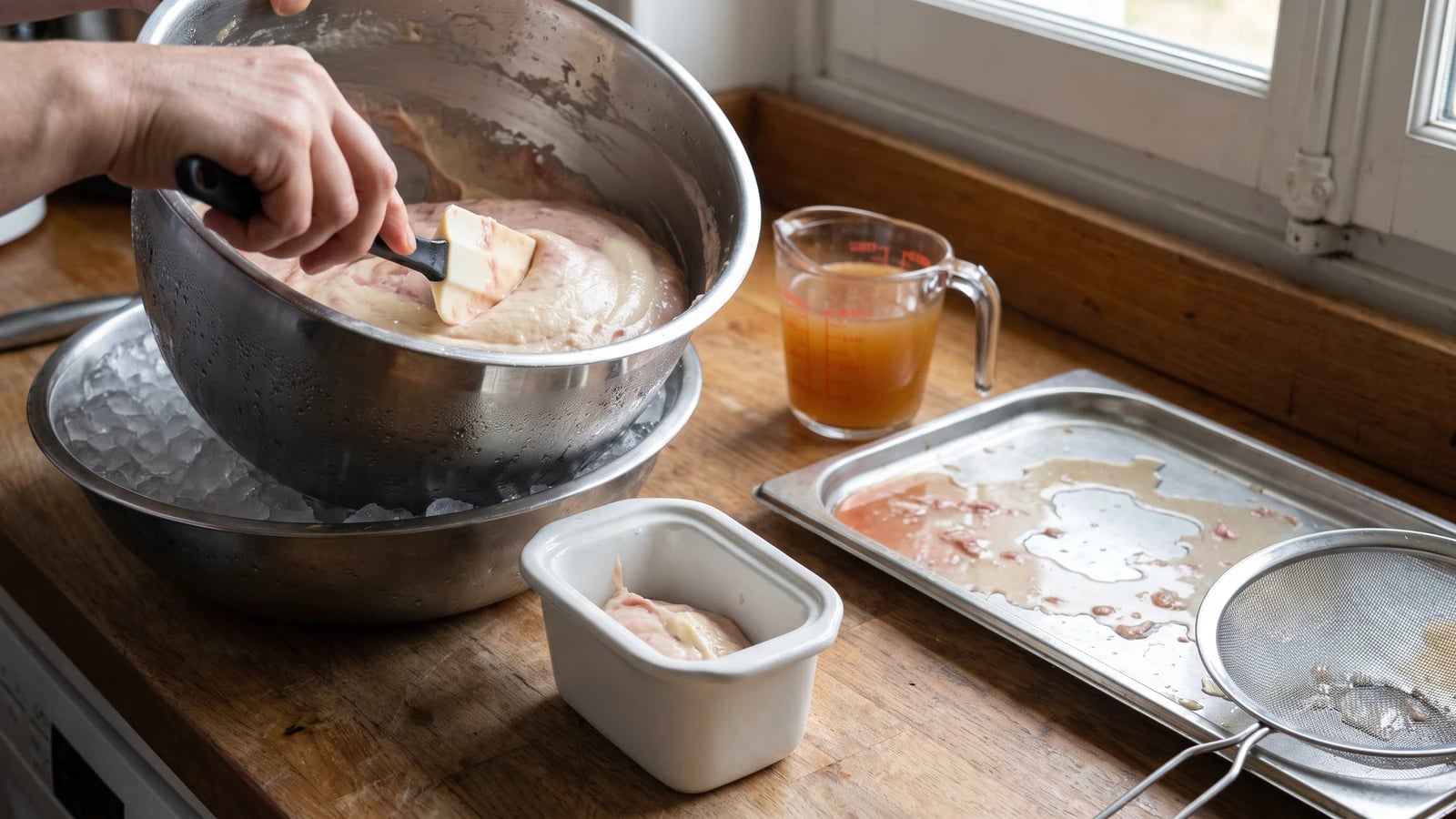
Set the chilled sieve over the cold mixing bowl and press the farce through with a firm flexible scraper, working in small portions. Scrape the underside of the sieve into the bowl and discard any sinew left behind. Keep the receiving bowl over ice as you work. This pass gives the farce its close, even texture and catches what the processor cannot; don't omit it when the final dish must slice cleanly.
Fry a tablespoon of farce in a small dry skillet over moderate heat until its center reaches 160°F (71°C), then let it stand for a minute before tasting. Do not taste the mixture raw. The test should cut neatly without crumbling or releasing a wide halo of fat. If it crumbles but remains matte, chill the farce and process it for another 10 seconds; if it leaks fat, use the chilling rescue from the previous step. The source's spiced-salt proportion is assertive, so taste before adding any further seasoning.
Transfer the sieved farce to a chilled basin, press reusable wrap directly against its surface, and refrigerate it for at least 1 hour. This short rest firms the fat and lets the salt complete the bind. Keep it at or below 40°F (4°C).
For a game terrine, raised pie, or galantine, weigh the rested base before adding fumet. Fold in one-fifth to one-quarter of that weight in finished, thoroughly chilled Gratin Forcemeat for Ordinary Hot, Raised Pies (No. 202), using the game meat appropriate to the final dish. For this full batch, that is about 140 to 175 grams. Fold just until no streaks remain; beating would warm the mixture and weaken its texture.
Immediately before packing the farce into its terrine, pie, or galantine, beat in the cold matching fumet 1 tablespoon at a time. Use only enough to make the farce supple while it still holds a clear ridge from the spoon, usually 2 to 4 tablespoons. Veal fumet suits a meat preparation; game fumet belongs with game. If the mixture becomes loose, stop adding liquid and chill it for 20 minutes. Ça se rattrape. Don't reach for flour or breadcrumbs, which would change the preparation.
Use the finished farce at once, or keep it tightly covered in the refrigerator for no more than 24 hours. This is a raw foundation, not a finished appetizer. Pack and cook it according to the enclosing terrine, pâté, or galantine recipe, taking the center to at least 160°F (71°C), then chill promptly if the final preparation will be served cold.
1 serving (about 105g)
Culinary guides, cultural storytelling, and the editorial depth that makes cooking meaningful.
Discover Culinary ExplorerChef Juliette
Tiny éperlans, lightly floured and fried until their tails stand crisp, arrive in a generous heap on a napkin with fried parsley and grooved lemon, a weeknight lesson in heat and restraint.

Chef Juliette
Brandade de Morue turns salt cod, warm olive oil, and milk into a pale, silky emulsion: keep everything warm and add the oil slowly, then crown the generous dome with butter-fried bread.

Chef Juliette
Salt cod worked warm with cream, one patient spoonful at a time, until the rough flakes become a glossy Nîmes paste, domed generously and ringed with butter-fried croutons for the table.

Chef Juliette
Wine-poached char packed in its earthenware crock beneath butter gold: a make-ahead first course that turns careful cooling, thorough boning, and one unbroken seal into quiet abundance.