
Chef Juliette
John Dory (St. Pierre)
John Dory has the delicacy of sole and the firmness of turbot. A light flouring, a quick butter sauté, and nut-brown beurre noisette show exactly why looks never mattered.
A cooking platform built around craft, culture, and the stories behind what we eat.
Created by Chef Juliette
Based on No. 1714, Pâté de Poulet, from Le Guide Culinaire (1907) by Auguste Escoffier
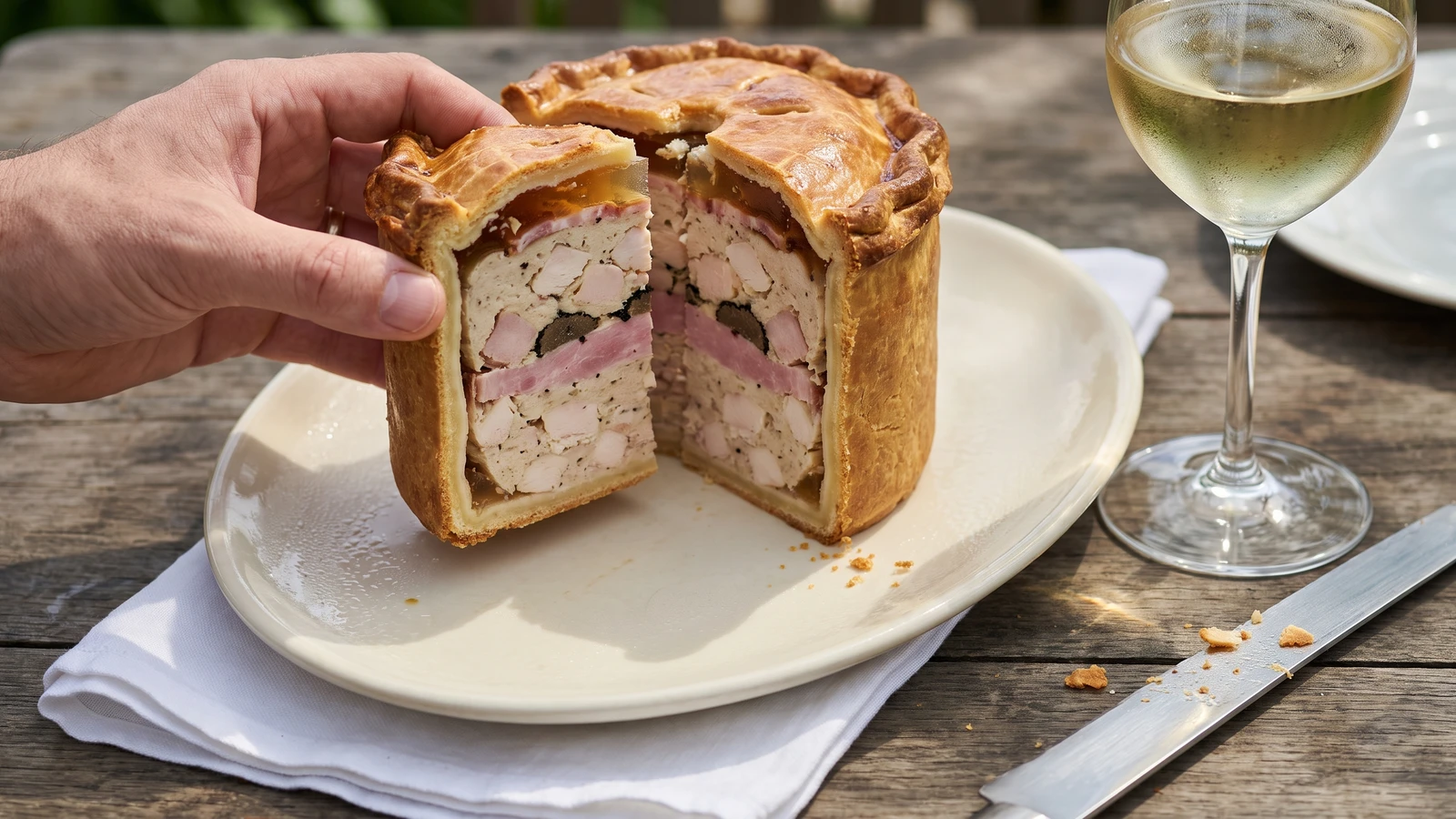
A raised Pâté de Poulet built in deliberate layers: silky forcemeat, brandied suprême collops, ham, bacon, and black truffle under a burnished crust, then filled with chicken jelly and rested until every slice stands clean.
Pâté de Poulet (raised chicken pie) teaches the architecture of pâté en croûte. The pastry is the mould, the smooth forcemeat is the mortar, and the brandied suprêmes, ham, bacon, and truffle form deliberate layers inside. The one true thing to understand before touching a pan is this: the forcemeat must remain refrigerator-cold. Let the fat soften while you process it and the filling becomes greasy and coarse instead of close and silky.
The original assumed a brigade with hands to bone the bird, chop, pound, and sieve the forcemeat, plus a chicken jelly drawn from stock never off the fire. Your kitchen has no saucier on staff, and it needs none. A chilled food processor followed by one honest pass through a sieve replaces the repeated pounding, concentrated chicken stock reinforced with a little gelatin replaces the permanent stockpot, and a deep springform replaces the raised-pie mould. No salamander belongs here; the oven gilds the crust. One cook, one stove, one evening, followed by the necessary cold rest.
The brigade's repeated chopping and pounding were scaffolding, so they may go. The book's meat-to-fat ratio, exact layering, firm crust, jelly filling, and full day of rest are the dish itself, so they stay. Chill the meats, fat, bowl, and blade before you begin; that cold forcemeat is the step that decides everything.
Pâté de poulet belongs to the grand French cold table, where the charcutier's raised pâté en croûte passed into Parisian household and buffet service with truffle, tongue or ham, and clear jelly layered inside. Lyon is especially devoted to pâté en croûte, but this garnished chicken version is part of the national classical repertoire rather than a specifically Lyonnais dish. The crust is not decorative packaging: it is the mould that cooks the filling and the chamber that receives the jelly before the pie rests cold.
Quantity
1 batch (about 575 g) Dressing Paste (Pâte à Pâté) (No. 2359)
thoroughly rested and chilled
Quantity
2 (about 12 oz / 340 g)
each cut into 3 thick collops
Quantity
3½ oz (100 g)
cut into small cubes
Quantity
1¾ oz (50 g)
cut into small cubes
Quantity
1¾ oz (50 g)
cut into small cubes
Quantity
7 oz (200 g)
cut into small cubes
Quantity
¼ cup (60 ml / 55 g)
Quantity
1¼ teaspoons (6.25 ml / 7.5 g)
divided
Quantity
½ teaspoon (2.5 ml / 1 g)
divided
Quantity
⅛ teaspoon (0.6 ml / 0.25 g)
divided
Quantity
2 small (about ⅓ cup / 60 g)
peeled if necessary and thickly sliced
Quantity
1 teaspoon (5 ml / 5 g)
do not substitute truffle oil
Quantity
1½ teaspoons (7.5 ml / 8 g)
Quantity
12 thin slices (about 4¼ oz / 120 g)
Quantity
4 thick slices (about 3½ oz / 100 g)
Quantity
1
Quantity
2 tablespoons (30 ml / 30 g)
for sealing the pastry
Quantity
1
beaten for gilding
Quantity
2 tablespoons (30 ml / 16 g)
for rolling
Quantity
2 cups (475 ml / 475 g)
Quantity
2 teaspoons (10 ml / 6 g)
Quantity
¼ teaspoon (1.25 ml / 1.5 g)
Quantity
0 cups (0 ml / 0 g) Cooked Marinade for Venison (No. 168)
Quantity
0 cups (0 ml / 0 g) Gratin Forcemeat for Ordinary Hot, Raised Pies (No. 202)
| Ingredient | Quantity |
|---|---|
| Dressing Paste (Pâte à Pâté)thoroughly rested and chilled | 1 batch (about 575 g) Dressing Paste (Pâte à Pâté) (No. 2359) |
| boneless, skinless chicken breast suprêmeseach cut into 3 thick collops | 2 (about 12 oz / 340 g) |
| boneless chicken thigh meatcut into small cubes | 3½ oz (100 g) |
| lean porkcut into small cubes | 1¾ oz (50 g) |
| lean vealcut into small cubes | 1¾ oz (50 g) |
| fresh pork fatbackcut into small cubes | 7 oz (200 g) |
| brandy | ¼ cup (60 ml / 55 g) |
| fine saltdivided | 1¼ teaspoons (6.25 ml / 7.5 g) |
| freshly ground black pepperdivided | ½ teaspoon (2.5 ml / 1 g) |
| freshly grated nutmegdivided | ⅛ teaspoon (0.6 ml / 0.25 g) |
| black truffles, fresh or whole preservedpeeled if necessary and thickly sliced | 2 small (about ⅓ cup / 60 g) |
| truffle essence or truffle juicedo not substitute truffle oil | 1 teaspoon (5 ml / 5 g) |
| beaten raw egg | 1½ teaspoons (7.5 ml / 8 g) |
| unsmoked larding bacon | 12 thin slices (about 4¼ oz / 120 g) |
| cooked ham, preferably jambon de Paris | 4 thick slices (about 3½ oz / 100 g) |
| bay leaf | 1 |
| cold waterfor sealing the pastry | 2 tablespoons (30 ml / 30 g) |
| large eggbeaten for gilding | 1 |
| plain flourfor rolling | 2 tablespoons (30 ml / 16 g) |
| strong unsalted chicken stock | 2 cups (475 ml / 475 g) |
| powdered gelatin | 2 teaspoons (10 ml / 6 g) |
| fine salt for the jelly (optional) | ¼ teaspoon (1.25 ml / 1.5 g) |
| Cooked Marinade for Venison, source reference only (optional) | 0 cups (0 ml / 0 g) Cooked Marinade for Venison (No. 168) |
| Gratin Forcemeat for Ordinary Hot, Raised Pies, source reference only (optional) | 0 cups (0 ml / 0 g) Gratin Forcemeat for Ordinary Hot, Raised Pies (No. 202) |
Set the food processor bowl and blade in the refrigerator. Spread the cubed chicken thigh, pork, veal, and fatback on a tray and chill them in the freezer for 20 minutes, until very firm at the edges but not frozen solid. Keep the Dressing Paste (Pâte à Pâté) (No. 2359) refrigerated. Cold is structural here: the fat must be cut into the meats, not smeared around a warm bowl.
Put the six suprême collops, the thick pieces cut from the breast fillets, in a shallow glass or ceramic dish. Add the brandy, ⅓ teaspoon of the measured salt, half the pepper, half the nutmeg, and the sliced truffles. Turn everything gently, cover, and refrigerate for 30 minutes. Drain well, reserving every drop of the marinade and keeping the truffles separate. Do not substitute the Cooked Marinade for Venison (No. 168): the chicken entry prescribes this short brandy marinade, while the numbered preparation belongs to the source's wider pâté references.
Process the chilled chicken thigh, pork, veal, and fatback in two small batches, pulsing first and then running the machine just until each batch becomes a very smooth, cohesive paste. The weights preserve the book's proportion exactly: 100 g chicken, 50 g pork, 50 g veal, and 200 g fatback, so the fat equals all the lean meats together. Scrape each batch into a bowl set over ice. If the fat begins to look shiny or greasy, stop immediately and chill everything for 15 minutes before continuing. Ça se rattrape. Warm forcemeat separates; cold forcemeat binds.
Push the forcemeat through a medium-mesh sieve with a firm scraper, discarding any sinew left behind. Beat in the reserved brandy marinade, truffle essence or juice, beaten raw egg, and the remaining salt, pepper, and nutmeg until the paste turns tacky and holds a soft peak. Fry a teaspoonful until fully cooked and taste it cold enough not to burn you; correct the seasoning now. If the forcemeat loosens after the marinade, refrigerate it for 20 minutes rather than adding crumbs. Do not add Gratin Forcemeat for Ordinary Hot, Raised Pies (No. 202): the source reserves that preparation for its game-pie variation, not Pâté de Poulet.
Set a rack in the lower third of the oven and heat it to 350°F (180°C). Dust the work surface lightly with flour. Roll about two-thirds of the chilled Dressing Paste (Pâte à Pâté) (No. 2359) into a circle roughly 14 inches (35 cm) across and 3⁄16 inch (5 mm) thick. Ease it into the deep mould without stretching, pressing it firmly into the base and sides while leaving a fine crest about ¾ inch (2 cm) above the rim. If the pastry tears, patch it with a thin scrap and press the edges together with cold water. A raised pie needs a sealed vessel, not unblemished vanity.
Use about one-third of the forcemeat to line the pastry base and sides in an even layer. Cover the bottom with thin larding bacon, half the ham, and another layer of bacon. Add a thin layer of forcemeat, half the truffle slices, another layer of forcemeat, and all six drained chicken collops. Continue with forcemeat, the remaining truffles, another thin layer of forcemeat, then the remaining ham enclosed between two layers of bacon. Cover with all remaining forcemeat, pressing firmly after every addition to remove air pockets. Finish with a final layer of bacon and the bay leaf. Keep the layers level and tight; loose packing leaves cavities that no amount of jelly can make handsome.
Roll most of the remaining pastry 3⁄16 inch (5 mm) thick for the lid. Brush the raised crest with cold water, lay on the lid, and press the two pieces together firmly. Trim, turn, and pinch the crest into an even seal. Cut a ¾-inch (2 cm) opening in the centre and insert a short collar of folded foil to keep the chimney open. Cut simple leaves from the final scraps and arrange them around the chimney. Gild the lid and crest, meaning brush them evenly with beaten egg, taking care not to flood the pinched edge.
Set the mould on a rimmed baking sheet and bake for 75 to 90 minutes, turning it once, until the pastry is deeply golden and an instant-read thermometer passed through the chimney into the centre registers 165°F (74°C). If the crest colours before the centre is ready, shield it loosely with foil and keep baking. Clear any set juices from the chimney with a thin skewer as soon as the pie leaves the oven, then leave the pie in its mould to cool for 45 to 60 minutes. It should be warm rather than blazing hot when the jelly goes in.
While the pie half-cools, put 2 tablespoons of the cold chicken stock in a small bowl and sprinkle the gelatin evenly over it. Leave it for 5 minutes. Bring the remaining stock to a lively simmer and reduce it to about 1¼ cups (300 ml), concentrating the flavour that a classical kitchen drew from its permanent stockpot. Remove from the heat, stir in the softened gelatin until fully dissolved, and taste before adding the optional salt. Let the chicken jelly cool until lukewarm but still completely liquid.
Pour the lukewarm chicken jelly through the chimney a little at a time, pausing after each addition so it can settle around the filling. Continue until the cavity remains full at the opening; the exact amount depends on how tightly the pie was packed. If jelly begins leaking from a small crack, stop and refrigerate the pie for 15 minutes so the first addition seals the escape, then resume slowly. Chill the filled pie in its mould until completely cold, cover it, and rest it for at least 24 hours. The jelly must set and the filling must settle before the crust can hold a clean slice.
Release the mould while the pâté is very cold. If the sides cling, warm a thin knife under hot water, dry it, and pass it carefully around the edge without sawing into the crust. Set the Pâté de Poulet on a folded napkin over a plain platter and cut generous wedges with a long, sharp knife, wiping the blade between cuts so the truffle, ham, collops, and amber jelly remain distinct. Serve very cold. À table!
1 serving (about 500g)
Culinary guides, cultural storytelling, and the editorial depth that makes cooking meaningful.
Discover Culinary ExplorerChef Juliette
John Dory has the delicacy of sole and the firmness of turbot. A light flouring, a quick butter sauté, and nut-brown beurre noisette show exactly why looks never mattered.

Chef Juliette
Fresh haddock proves its delicacy in the meunière pan: a fine flour crust, moist pearly flakes, and beurre noisette sharpened with lemon and parsley, ready from one skillet in half an hour.

Chef Juliette
Éperlans à l’Anglaise turns small fish into a lesson in disciplined coating: boned smelts under a close, crisp crumb, pan-fried in clarified butter and finished with bright, half-melted maître d’hôtel butter.

Chef Juliette
Tiny smelts, shallot, mushrooms, white wine, gratin sauce, and fine bread raspings meet a fierce oven, where the fish must turn tender in the same breath the buttered crust bronzes.