
Chef Juliette
Abatis aux Navets
Glazed turnips, pearl onions, and tender poultry giblets settle into a pale, glossy sauce, with crisp-edged salt pork lending depth: a thrifty braise whose whole success rests on cooking the flour first.
A cooking platform built around craft, culture, and the stories behind what we eat.
Created by Chef Juliette
Based on No. 1676, Sylphides de Volaille, from Le Guide Culinaire (1907) by Auguste Escoffier
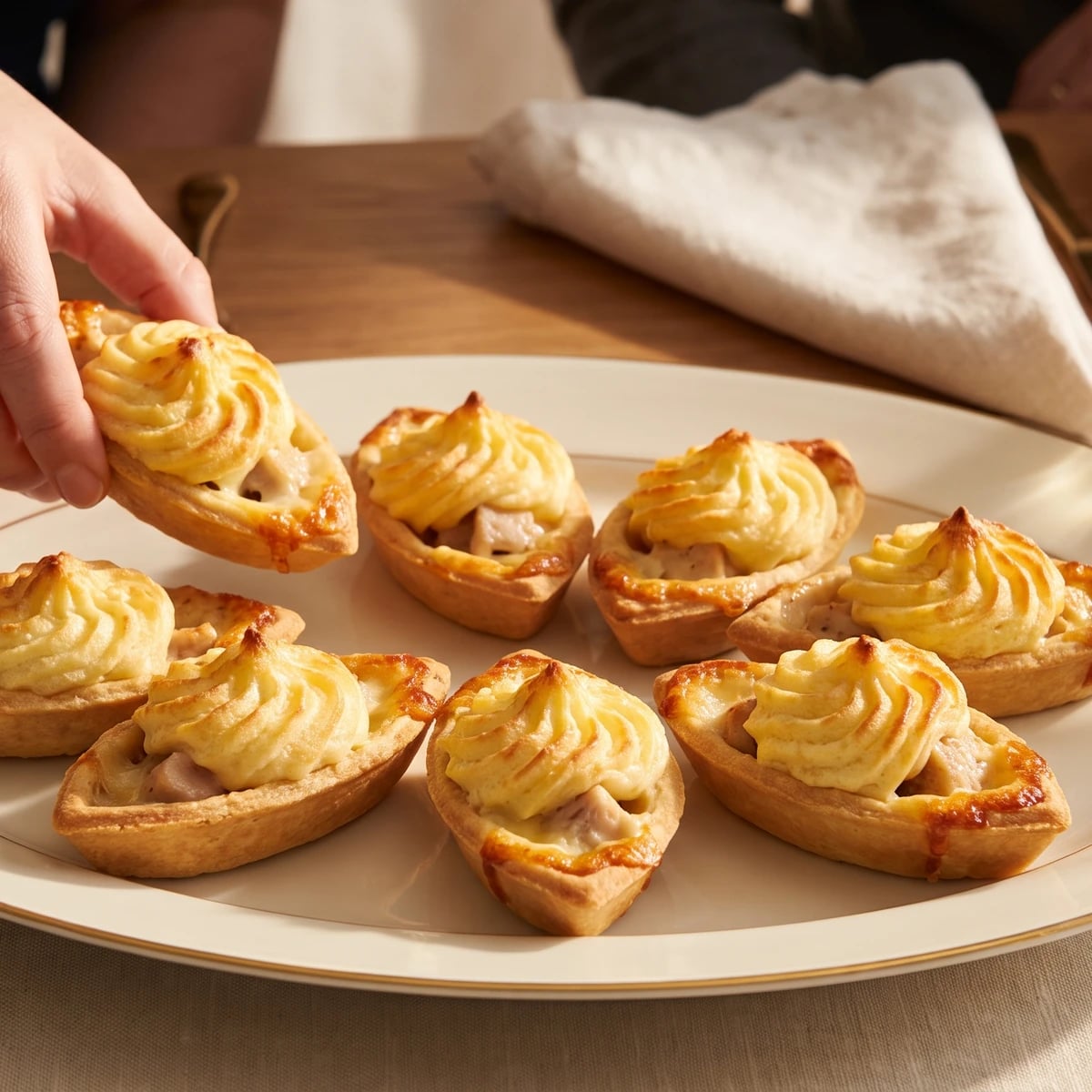
Sylphides de Volaille pair poached chicken mousselines with Mornay, tender collops, and piped Soufflé au Parmesan, baked in crisp barquettes until the crowns rise and bronze, then carried straight to the table.
Sylphides de Volaille (airy chicken bites in pastry boats) teach one strict truth: temperature decides the dish. The chicken forcemeat must stay cold enough to take its cream without splitting, while the finished Parmesan crowns must go from the oven to the table before they lose their lift. Cold in the making, immediate in the serving. C’est la même grammaire.
The original kitchen assumed a saucier on staff for the Mornay, stock never off the fire, Barquettes and Soufflé au Parmesan arriving from separate stations, and fierce top heat close at hand. At home, a food processor replaces the mortar, a fine-mesh sieve replaces the tamis, a wide sauté pan becomes the poaching kettle, and a thoroughly heated conventional oven does the work often assigned to a salamander. The linked preparations keep their own formulas and ratios; what changes is the quantity and the equipment. One cook, one stove, one evening.
Brigade scheduling is scaffolding and can go. The layering cannot: Mornay beneath the mousseline, a tender collop above it, then a piped coat of stiff Parmesan soufflé baked at the last possible moment. Before you touch a pan, chill the processor blade, bowl, chicken, and cream. That cold emulsion is the step that matters most.
Sylphides de Volaille belong to the Parisian grand-kitchen repertoire, where pastry, sauce, poultry, and soufflé work from several stations met in one composed entrée. The name suggests an airy spirit rather than a French region, and the lightness comes from technique, specifically the mousseline and risen Parmesan crown, not from sparseness. The dish passed into bourgeois celebration cooking by turning each station preparation into orderly make-ahead work followed by one swift final assembly.
Quantity
5½ ounces (160 g)
very cold and cut into 1-inch (2.5 cm) pieces
Quantity
¾ teaspoon (3.75 ml / 4 g)
Quantity
⅛ teaspoon (0.6 ml / 0.3 g)
Quantity
1 large (2 tablespoons / 30 ml / 30 g)
very cold
Quantity
½ cup plus up to 1 tablespoon (120 to 135 ml / 120 to 135 g)
very cold, with the extra tablespoon held separately for rescue
Quantity
3 ounces (85 g)
cut into 8 collops about ⅛ inch (3 mm) thick
Quantity
3 cups (720 ml / 720 g)
keep ¼ cup cold
Quantity
½ cup (120 ml / 130 g)
warm but not hot
Quantity
8 small baked shells (about 5 ounces / 140 g total) from Barquettes (No. 314)
about 3½ inches (9 cm) long
Quantity
1 cup (240 ml / 220 g) Soufflé au Parmesan (No. 2295a)
somewhat stiff and prepared immediately before piping
| Ingredient | Quantity |
|---|---|
| boneless, skinless chicken breast for the mousselinesvery cold and cut into 1-inch (2.5 cm) pieces | 5½ ounces (160 g) |
| fine salt | ¾ teaspoon (3.75 ml / 4 g) |
| ground white pepper | ⅛ teaspoon (0.6 ml / 0.3 g) |
| large egg whitevery cold | 1 large (2 tablespoons / 30 ml / 30 g) |
| heavy creamvery cold, with the extra tablespoon held separately for rescue | ½ cup plus up to 1 tablespoon (120 to 135 ml / 120 to 135 g) |
| boneless, skinless chicken breast for the collopscut into 8 collops about ⅛ inch (3 mm) thick | 3 ounces (85 g) |
| good unsalted chicken stockkeep ¼ cup cold | 3 cups (720 ml / 720 g) |
| prepared Mornay saucewarm but not hot | ½ cup (120 ml / 130 g) |
| Barquettesabout 3½ inches (9 cm) long | 8 small baked shells (about 5 ounces / 140 g total) from Barquettes (No. 314) |
| Soufflé au Parmesansomewhat stiff and prepared immediately before piping | 1 cup (240 ml / 220 g) Soufflé au Parmesan (No. 2295a) |
Chill the food-processor bowl and blade for 15 minutes. Add the cold chicken, salt, and white pepper, then pulse until the meat becomes a smooth, tacky paste. Add the egg white and process only until absorbed. With the machine running, pour in the required ½ cup (120 ml) of cream in four additions, stopping to scrape the bowl between them. Keep the forcemeat below 50°F (10°C), then press it through a fine-mesh sieve, cover its surface, and chill for 20 minutes. If it turns grainy, shiny, or oily, stop immediately: the emulsion has become warm. Set the bowl over ice for 10 minutes, then pulse in the reserved cold cream a teaspoon at a time until the paste returns to a satin finish. Ça se rattrape.
Pour all but the reserved cold stock into a wide sauté pan and bring it to 170 to 175°F (77 to 80°C), where the surface barely quivers. Poach a teaspoon of forcemeat for 2 minutes and taste it. It should be tender, cohesive, and properly seasoned. If it feels tight or bouncy, work in the reserved cold cream one teaspoon at a time and test again; if it frays, chill the paste for another 10 minutes before shaping.
Slip the chicken collops into the barely trembling stock and poach for 2 to 3 minutes, until opaque and at least 165°F (74°C) at the centre. Lift them out and drain well. Using two spoons dipped in cold water, shape the chilled forcemeat into 8 slim oval mousselines small enough to sit inside the barquettes. Lower them into the stock and poach gently for 7 to 9 minutes, turning once, until lightly springy and 165°F (74°C) inside. Never let the stock boil. If it does, pull the pan off the heat and add a little reserved cold stock; once the surface settles, continue over lower heat. Drain the mousselines on a clean towel and blot them carefully so they cannot water the Mornay.
Set a rack in the upper third of the oven and heat it to 425°F (220°C). Arrange the Barquettes (No. 314) on a parchment-lined sheet pan. If the shells have softened in storage, bake them empty for 4 minutes and let them settle for 2 minutes before filling. Warm the Mornay gently until it falls from a spoon in a thick ribbon. If it has tightened, loosen it with a teaspoon of poaching stock; if it runs freely, reduce it briefly until it stays where it is spooned.
Spoon about 1 tablespoon of Mornay into the bottom of each barquette. Set one poached mousseline over the sauce, then place one drained chicken collop on top. Fit a piping bag with a ½-inch (12 mm) plain tube and fill it with the somewhat stiff Soufflé au Parmesan (No. 2295a). Pipe from the base upward in close, even coils, covering each stack completely and finishing with a modest peak. If the piping slumps, set the filled bag in the cold for 3 minutes, then continue without stirring the mixture; stirring would knock out the air the crown needs.
Bake the sylphides for 9 to 11 minutes without opening the oven during the first 7. They are ready when the Parmesan crowns have risen, their ridges are butter-gold, and the tips have taken a deeper bronze. Rotate the pan only after the crowns are set if the colour is uneven. Transfer them immediately to a warm platter and carry them straight to the table. A soufflé waits for nobody. À table!
1 serving (about 205g)
Culinary guides, cultural storytelling, and the editorial depth that makes cooking meaningful.
Discover Culinary Explorer
Chef Juliette
Glazed turnips, pearl onions, and tender poultry giblets settle into a pale, glossy sauce, with crisp-edged salt pork lending depth: a thrifty braise whose whole success rests on cooking the flour first.

Chef Juliette
Pâté d’abatis turns modest poultry giblets into a generous supper: browned in butter, bound with a light consommé sauce, cooled completely, then sealed beneath puff pastry that rises crisp and gilded.

Chef Juliette
Four boned chicken legs become compact ballotines, packed with good sausage meat, sewn into their own skin, browned deeply, and braised until the filling stays juicy and the pan sauce gleams.

Chef Juliette
Boudins de Volaille à la Richelieu turn a cold chicken mousseline around truffled salpicon, then poach, crumb, and bronze it in clarified butter, with glossy Périgueux sauce served separately.