
Chef Juliette
Smelt (Éperlans)
Tiny éperlans, lightly floured and fried until their tails stand crisp, arrive in a generous heap on a napkin with fried parsley and grooved lemon, a weeknight lesson in heat and restraint.
A cooking platform built around craft, culture, and the stories behind what we eat.
Created by Chef Juliette
Based on No. 1669, Fritôt ou Marinade de Volaille, from Le Guide Culinaire (1907) by Auguste Escoffier
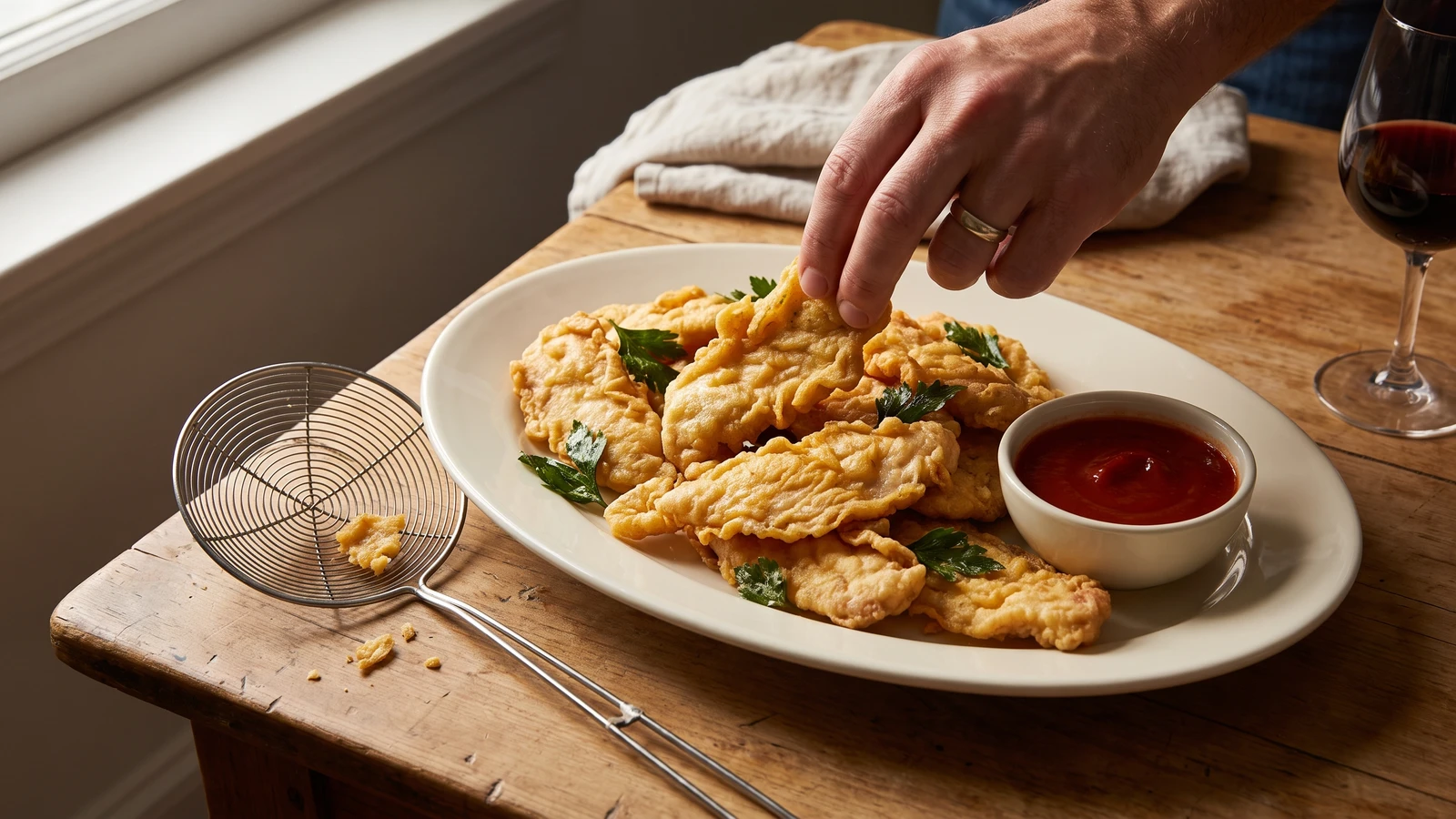
Fritôt turns modest cooked chicken into a proper hot first course: lemon and herbs within, a fine golden shell outside, and tomato sauce waiting beside it for dipping.
Fritôt ou Marinade de Volaille (lightly battered fried chicken) teaches one clean lesson: because the poultry is already cooked, you are frying the batter, not cooking the meat. The coating must be thin, the fat decisively hot, and the stay in the pan brief. Done properly, the chicken tastes of lemon and fines herbes beneath a crisp, gilded veil.
The original assumed cooked poultry waiting after service, a dedicated frying station, a saucier with tomato sauce ready, and a linen napkin for draining and presentation. Your home equivalent is leftover poached or roast chicken, one deep saucepan, a thermometer, a wire rack, and a small bowl of warm tomato sauce. The five-quart production behind the Cooked Marinade for Venison (No. 168) is brigade scaffolding, so this four-person translation reaches for one teaspoon from a finished batch. The quarter-hour marinade, airy batter, and properly hot fat are the dish itself. One cook, one stove, one evening.
Poached chicken is preferable because its open texture drinks the oil, lemon, and herbs more readily; roast chicken still makes a handsome fritôt, though its firmer surface takes less seasoning. Fifteen minutes is enough. Before the first slice meets the pan, bring the fat fully to temperature.
Fritôt belongs to national French classical service, codified in Parisian grand kitchens and welcomed at bourgeois tables as a hot hors-d’œuvre made from cooked poultry. Across generations, fritôt and marinade de volaille became names for the same preparation, although the older working distinction gave cooked bird to the fritôt and raw, pre-marinated pieces to the marinade. The fried parsley, serving napkin, and separate tomato sauce reflect formal service, but the thrifty heart of the dish remains entirely domestic.
Quantity
About 3 cups (710 ml / 400 g)
preferably poached, chilled and cut across the grain into 1 cm slices
Quantity
1 tablespoon (15 ml / 14 g)
Quantity
1 tablespoon (15 ml / 15 g)
Quantity
2 tablespoons (30 ml / 8 g)
parsley, chives, chervil, and tarragon, finely chopped
Quantity
1 teaspoon (5 ml / 5 g) Cooked Marinade for Venison (No. 168)
taken from a finished batch
Quantity
¾ cup (180 ml / 90 g)
Quantity
½ cup (120 ml / 120 g), plus a little more if needed
Quantity
1
Quantity
¾ teaspoon (3.75 ml / 4.5 g)
divided
Quantity
6 cups (1.4 L / 1.3 kg), or enough for a depth of 7.5 cm
for frying
Quantity
About ½ cup loosely packed (120 ml / 15 g)
washed and completely dried
Quantity
1 cup (240 ml / 250 g)
warmed
| Ingredient | Quantity |
|---|---|
| cooked chickenpreferably poached, chilled and cut across the grain into 1 cm slices | About 3 cups (710 ml / 400 g) |
| mild olive oil | 1 tablespoon (15 ml / 14 g) |
| fresh lemon juice | 1 tablespoon (15 ml / 15 g) |
| fines herbesparsley, chives, chervil, and tarragon, finely chopped | 2 tablespoons (30 ml / 8 g) |
| Cooked Marinade for Venison (No. 168)taken from a finished batch | 1 teaspoon (5 ml / 5 g) Cooked Marinade for Venison (No. 168) |
| plain flour | ¾ cup (180 ml / 90 g) |
| ice-cold sparkling water | ½ cup (120 ml / 120 g), plus a little more if needed |
| large egg white | 1 |
| fine saltdivided | ¾ teaspoon (3.75 ml / 4.5 g) |
| refined peanut or sunflower oilfor frying | 6 cups (1.4 L / 1.3 kg), or enough for a depth of 7.5 cm |
| flat-leaf parsley sprigswashed and completely dried | About ½ cup loosely packed (120 ml / 15 g) |
| smooth tomato saucewarmed | 1 cup (240 ml / 250 g) |
Arrange the chicken slices in a shallow bowl. Add the olive oil, lemon juice, fines herbes, and the finished Cooked Marinade for Venison (No. 168), turning gently so every surface is lightly dressed. Cover and leave for exactly 15 minutes. Poached meat absorbs this seasoning more readily than roast meat, but neither benefits from a long soak; too much lemon time makes the surface soft and prevents the batter from holding cleanly.
Whisk the flour and ½ teaspoon of the salt with the sparkling water only until no dry flour remains. Small lumps do no harm; vigorous mixing develops gluten and makes the crust leathery. In a clean bowl, whisk the egg white to soft peaks, then fold it into the flour mixture. The batter should run from a spoon in a thin ribbon. If it sits like paste, loosen it with ice-cold water one teaspoon at a time; if it pours like milk, whisk in a teaspoon of flour. Ça se rattrape.
Set a wire rack over a sheet pan and warm the tomato sauce gently in a small saucepan. Pour the frying oil into a deep, heavy saucepan, leaving at least 8 cm of empty space above it, and heat to 180°C. The thermometer is the home cook's honest replacement for a brigade fry station. Keep the saucepan lid nearby for safety, but never cover hot oil during ordinary frying.
Make certain the parsley is completely dry, because water and hot fat are quarrelsome companions. Lower the sprigs into the oil with a long-handled spider and fry for 5 to 10 seconds, just until the leaves darken slightly and turn crisp. Stand back from the initial sputter. Lift the parsley to the rack, sprinkle it with a pinch of the remaining salt, and let the oil return to 180°C.
Drain the chicken and blot its surface lightly, leaving the absorbed seasoning within the meat. Dip each slice into the batter and let the excess fall away in a thin stream. Fry three or four pieces at a time until the coating is well gilded, crisp, and the centre is thoroughly hot, about 2 to 3 minutes. Hold the oil between 175°C and 180°C. If the first batch turns pale and greasy, stop and reheat the oil before continuing; if the batter slips off, blot the remaining chicken more carefully and thicken the batter with a teaspoon of flour. Ça se rattrape.
Lift each batch onto the wire rack and season immediately with the last of the salt. A rack replaces the old service napkin because it lets oil fall away without trapping moisture beneath the crust. Pile the fritôt loosely on a warm platter, tuck the fried parsley around it, and serve the tomato sauce separately so every piece remains crisp until it is dipped. À table!
1 serving (about 210g)
Culinary guides, cultural storytelling, and the editorial depth that makes cooking meaningful.
Discover Culinary ExplorerChef Juliette
Tiny éperlans, lightly floured and fried until their tails stand crisp, arrive in a generous heap on a napkin with fried parsley and grooved lemon, a weeknight lesson in heat and restraint.

Chef Juliette
Brandade de Morue turns salt cod, warm olive oil, and milk into a pale, silky emulsion: keep everything warm and add the oil slowly, then crown the generous dome with butter-fried bread.

Chef Juliette
Salt cod worked warm with cream, one patient spoonful at a time, until the rough flakes become a glossy Nîmes paste, domed generously and ringed with butter-fried croutons for the table.

Chef Juliette
Wine-poached char packed in its earthenware crock beneath butter gold: a make-ahead first course that turns careful cooling, thorough boning, and one unbroken seal into quiet abundance.