
Chef Juliette
John Dory (St. Pierre)
John Dory has the delicacy of sole and the firmness of turbot. A light flouring, a quick butter sauté, and nut-brown beurre noisette show exactly why looks never mattered.
A cooking platform built around craft, culture, and the stories behind what we eat.
Created by Chef Juliette
Based on No. 1443, Pullets and Capons for Relevés, from Le Guide Culinaire (1907) by Auguste Escoffier
Three roads through the Paris poultry canon, poach, poêler, or braise, with one rule beneath them all: protect the breast with bacon while the legs cook, then turn the liquor into sauce.
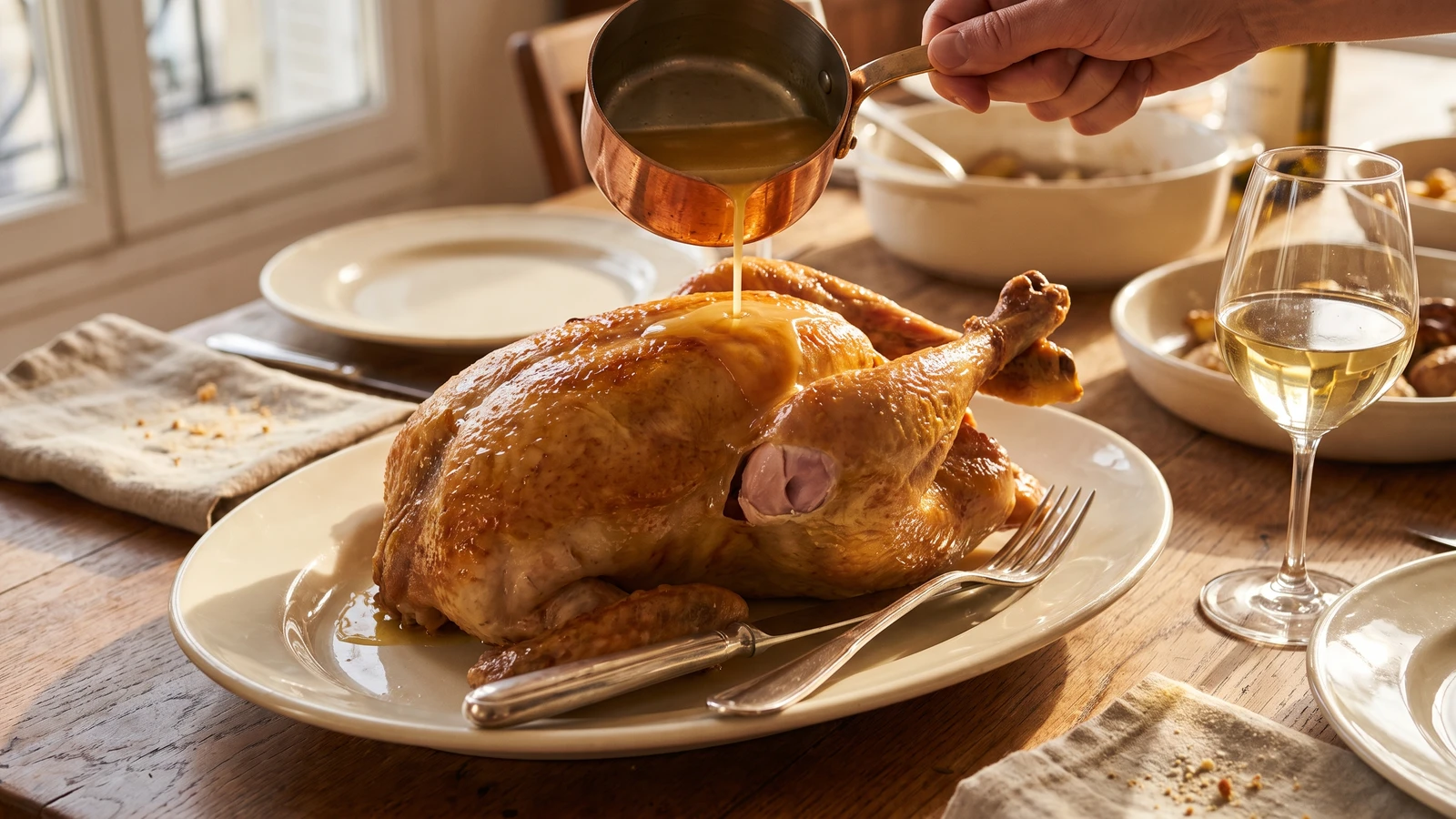
Poulardes et chapons pour relevés (pullets and capons for a grand course) teach the Paris poultry grammar in one bird. The one true thing to know before touching a pan is this: the bacon over the breast is protection, not decoration. Without that shield, the delicate fillets dry while the stronger legs finish cooking.
The original assumed a saucier on staff, stocks never off the fire, a larding needle for decorative work, a salamander ready to colour, and birds dressed with their feet intact. A home kitchen needs a prepared stock, a heavy lidded cocotte, butcher's twine, a thermometer, and the uncovered heat of the oven. We scale the brigade relevé to one bird for four, omit the studding and needle-larding because they are service ornament, and reduce the cooking liquor in the same pot instead of handing it to another cook. The compact truss replaces the folded claws. One cook, one stove, one evening.
Poêler (to butter-roast gently under cover) is the principal road here because it gives both succulent meat and a concentrated jus from one vessel. Pocher (to cook in liquid that never boils) preserves a pale, delicate bird, while braiser (to cook with measured stock and constant basting) gives the richest glaze. Whichever road you take, secure the bacon over the breast before the bird meets heat. That shield is the step that decides the dish.
These instructions belong to the classical Paris grand-kitchen repertory, where a relevé was a substantial whole piece carried to the table and carved as a formal course. The heading describes a family of methods rather than one fixed garnish: pullets and capons could be poached, poêléed, or more rarely braised according to the sauce and service around them. Barding the breast with pork fat traveled readily into cuisine bourgeoise because it solved the same problem at a family table, keeping the fillets moist while the legs caught up.
Quantity
1 bird, 4 to 5 lb (1.8 to 2.3 kg)
giblets removed
Quantity
2 teaspoons (10 ml / 12 g)
Quantity
¾ teaspoon (3.75 ml / 1.5 g)
Quantity
6 to 8 slices (about 6 oz / 170 g)
cut broadly enough to cover the breast
Quantity
1
halved
Quantity
1 home-scale preparation Poëlings (No. 250), including its butter, aromatics, and finishing stock, sufficient for 1 bird
Quantity
8 cups (1.9 L / 1.9 kg) from Poachings (No. 249), plus more if needed to cover
Quantity
1 home-scale preparation Braising of White Meats (No. 248), sufficient for 1 bird
Quantity
1 tablespoon (15 ml / 14 g)
cubed
| Ingredient | Quantity |
|---|---|
| fat pullet or small capongiblets removed | 1 bird, 4 to 5 lb (1.8 to 2.3 kg) |
| fine sea salt | 2 teaspoons (10 ml / 12 g) |
| finely ground white pepper | ¾ teaspoon (3.75 ml / 1.5 g) |
| unsmoked larding bacon or thinly sliced fatbackcut broadly enough to cover the breast | 6 to 8 slices (about 6 oz / 170 g) |
| lemon (optional)halved | 1 |
| Poëlings | 1 home-scale preparation Poëlings (No. 250), including its butter, aromatics, and finishing stock, sufficient for 1 bird |
| lightly salted chicken poaching stock (optional) | 8 cups (1.9 L / 1.9 kg) from Poachings (No. 249), plus more if needed to cover |
| Braising of White Meats (optional) | 1 home-scale preparation Braising of White Meats (No. 248), sufficient for 1 bird |
| cold unsalted buttercubed | 1 tablespoon (15 ml / 14 g) |
Heat the oven to 325°F (165°C) for the poêlé or braised route. Take the bird from the cold 30 minutes before cooking, dry it thoroughly, and season the cavity and skin with the salt and white pepper. Tuck the wing tips beneath the back, draw the legs close to the body, and tie them firmly with twine. A compact bird cooks more evenly than one sprawling across the pot.
If you are poaching, rub the lemon over the breast and legs to help preserve their pale colour. Do not use lemon for the poêlé or braised route. Overlap the bacon or fatback across the breast from neck to belly, leaving the legs exposed, then secure it with two loops of twine. The breast needs a shield; the legs need the heat.
For the principal route, set the bird over the prepared aromatics in Poëlings (No. 250), using a heavy covered cocotte that holds it closely. Spoon the prepared melted butter generously over the bird, cover, and cook for 45 minutes, basting with the butter every 15 minutes. When the breast reaches about 145°F (63°C), remove the bacon, add no more than ¼ cup (60 ml / 60 g) of the finishing stock supplied with the preparation, and baste again. Return the bird uncovered until its skin is evenly burnished and its final temperatures are reached, usually another 20 to 35 minutes.
Check the thickest part of the breast without touching bone, then the inner thigh. Remove the bird when the breast reaches 160 to 162°F (71 to 72°C) and the thigh reaches 170 to 175°F (77 to 79°C). Rest it loosely covered for 15 to 20 minutes and verify that the breast reaches 165°F (74°C) before carving. If the breast is ready but the thigh is not, cover the breast with the bacon and return the bird to the oven for 5 minutes at a time. The old prick-and-judge-the-juice test has served its turn; the thermometer is safer and more exact.
Lift the bird to a warm platter. Complete the Poëlings (No. 250) by adding its remaining finishing stock to the aromatics and butter, then simmer them together for the prescribed 10 minutes so the stock recovers the flavour held in the fat. Strain into a small saucepan, skim away the excess grease, and reduce until the jus lightly coats a spoon. Take it off the heat and whisk in the cold butter. If the jus looks greasy or separates, whisk in 1 teaspoon of cold water, then add the butter again a cube at a time. Ça se rattrape.
For a pale poached bird, complete steps 1 and 2, then use Poachings (No. 249) instead of steps 3 and 5. Place the bird in a narrow pot, breast up, and pour in the cold prepared chicken poaching stock until the bird is submerged. Bring the liquor rapidly to just below boiling, skim, cover, and hold it between 180 and 190°F (82 and 88°C), where the surface barely trembles. Begin checking after 55 minutes and use the temperatures in step 4. If the liquor boils, pull the pot from the heat and add a ladleful of cold stock; ça se rattrape. Strain and degrease enough cooking liquor for the table, reducing it only if it is not already well seasoned, then finish it off the heat with the cold butter.
For the richer braised route, complete steps 1 and 2 without the lemon, then apply Braising of White Meats (No. 248) in a cocotte just large enough to hold the bird. Keep a substantial layer of bacon over the breast throughout the cooking and follow the preparation's measured stock reductions and basting rather than adding all the liquid at once. Cook to the temperatures in step 4. If the glaze catches at the edge of the pot, lift it from the heat and loosen only that spot with a spoonful of stock, scraping gently. Strain and degrease the cooking liquor, then serve it as the accompanying sauce.
Remove the twine and bacon. Take off the legs at the joints, separate thighs from drumsticks, and carve the breast into generous slices. Arrange the dark and white meat together on the warm platter, spoon a little jus beneath the slices, and send the rest in a sauceboat. Do not drown the bird after working so carefully to preserve it. À table!
1 serving (about 350g)
Culinary guides, cultural storytelling, and the editorial depth that makes cooking meaningful.
Discover Culinary ExplorerChef Juliette
John Dory has the delicacy of sole and the firmness of turbot. A light flouring, a quick butter sauté, and nut-brown beurre noisette show exactly why looks never mattered.

Chef Juliette
Fresh haddock proves its delicacy in the meunière pan: a fine flour crust, moist pearly flakes, and beurre noisette sharpened with lemon and parsley, ready from one skillet in half an hour.

Chef Juliette
Éperlans à l’Anglaise turns small fish into a lesson in disciplined coating: boned smelts under a close, crisp crumb, pan-fried in clarified butter and finished with bright, half-melted maître d’hôtel butter.

Chef Juliette
Tiny smelts, shallot, mushrooms, white wine, gratin sauce, and fine bread raspings meet a fierce oven, where the fish must turn tender in the same breath the buttered crust bronzes.