
Chef Juliette
John Dory (St. Pierre)
John Dory has the delicacy of sole and the firmness of turbot. A light flouring, a quick butter sauté, and nut-brown beurre noisette show exactly why looks never mattered.
A cooking platform built around craft, culture, and the stories behind what we eat.
Created by Chef Juliette
Based on No. 249, Poachings, from Le Guide Culinaire (1907) by Auguste Escoffier
Volaille pochée teaches the quiet discipline of poaching: whole chicken held just below a boil in clear white stock, then carved and served with the liquor its own juices have deepened.
Volaille pochée au fond blanc (chicken poached in white stock) teaches the quiet law behind every poaching: a boiling that does not boil. The liquor must climb high enough to cook decisively, yet never break into a rolling boil, which clouds the stock, tightens the outer meat, and can burst a stuffed bird. Hold that line and a modest chicken becomes tender, lucid, and seasoned through.
The classical formula assumed a clear fond blanc never off the fire, a vessel chosen to fit the bird, and a saucier free to truss, skim, and, when the occasion demanded, lard or stud the skin with truffle, ham, or tongue. For four at home, use one young chicken, a narrow lidded pot, prepared unsalted fond blanc, and an instant-read thermometer. The larding needle, lemon rub, and brief scald are optional service scaffolding, so they go; the close pot, cold start, and prepared stock are the dish itself, so they stay. One cook, one stove, one evening.
The sauce is already in the pot. A close-fitting vessel lets the stock take on the bird's juices without the violent evaporation that ruins its clarity. Watch the surface before anything else: it may quiver and release an occasional quiet bubble, but it must never roll. That is the one step that decides the dish.
Volaille pochée belongs to cuisine bourgeoise and the national classical kitchen, not to one French province; the household pot and the grand kitchen share the same control of heat. In the canon, poaching names a whole family, from fish cooked with Fumet and quenelles in salted water to individual Mousselines and larger Mousses set in moulds. The common misconception is that poaching means plenty of water, when its true definition is liquor held close to the boil without boiling, whether a bird is submerged or a fillet cooks almost dry.
Quantity
1 chicken, 3½ to 4 lb (1.6 to 1.8 kg)
giblets removed
Quantity
10 to 12 cups (2.4 to 2.8 L / 2.4 to 2.8 kg)
prepared beforehand, enough to submerge the bird
Quantity
Up to 1½ teaspoons (7.5 ml / 9 g)
as needed
| Ingredient | Quantity |
|---|---|
| whole young chickengiblets removed | 1 chicken, 3½ to 4 lb (1.6 to 1.8 kg) |
| cold, clear, unsalted fond blanc (white chicken stock)prepared beforehand, enough to submerge the bird | 10 to 12 cups (2.4 to 2.8 L / 2.4 to 2.8 kg) |
| fine sea saltas needed | Up to 1½ teaspoons (7.5 ml / 9 g) |
Keep the chicken cold until you are ready to begin. Check the cavity for giblets, trim away only loose pieces of fat, and leave the skin intact. Tuck the wing tips behind the shoulders, draw the legs close alongside the breast, and bind the bird compactly with butcher's twine. A firm truss gives the chicken an even shape, protects the thinner parts, and makes it possible to lift the cooked bird without tearing its tender skin.
Set the trussed chicken breast-side up in a narrow, heavy pot that holds it closely. Pour in the cold fond blanc until the bird is completely submerged by about 1 inch (2.5 cm), reserving any stock left over. If the chicken floats, lay a small heatproof plate over it. Taste the stock and add only enough salt to make it lightly savory; it will gain flavor from the chicken, and an oversalted fond cannot be taken back.
Set the uncovered pot over medium-high heat and bring the cold liquor toward 190°F (88°C) as promptly as control allows, usually 20 to 25 minutes. As grey-white protein rises, skim it away gently with a shallow spoon without stirring the liquor. The moment bubbles begin appearing around the edge, lower the heat. If the surface breaks into a boil, lift the pot from the burner, uncover it, and wait until it becomes calm before returning it over lower heat. Ça se rattrape. A brief mistake is recoverable; allowing the pot to roll is not.
Cover the pot and hold the liquor between 185 and 190°F (85 and 88°C). The surface should remain nearly still, with an occasional small bubble at the perimeter, never a rolling simmer. Check the heat every ten minutes and adjust as needed. Poach for 55 to 70 minutes after the liquor reaches temperature, beginning to check the chicken at 50 minutes. Rougher heat will not shorten the cooking; it only evaporates the stock, clouds the sauce, and tightens the meat.
Insert an instant-read thermometer into the thickest part of the breast and then the inner thigh without touching bone. The chicken is ready when the breast reaches 165°F (74°C), the thigh reaches at least 170°F (77°C), and the liquid released near the leg joint is pale rather than rosy. The classical test watched for white juices; the thermometer is the home cook's more exact equivalent. Support the bird from beneath as you lift it, drain the cavity back into the pot, and rest it loosely covered for 15 minutes.
Let the poaching liquor settle for 3 minutes, skim away excess surface fat, and pass it through a fine-mesh strainer lined with a clean damp cloth. Pour about 2 cups (480 ml / 480 g) into a clean saucepan and warm it just below a simmer. It should taste full and chicken-rich, with a lightly gelatinous feel rather than the thickness of a flour-bound sauce. If it tastes weak, reduce only this measured portion by no more than one-quarter over controlled heat; if the salt sharpens, stop and loosen it with reserved unsalted fond blanc. Violent reduction is no substitute for the close pot.
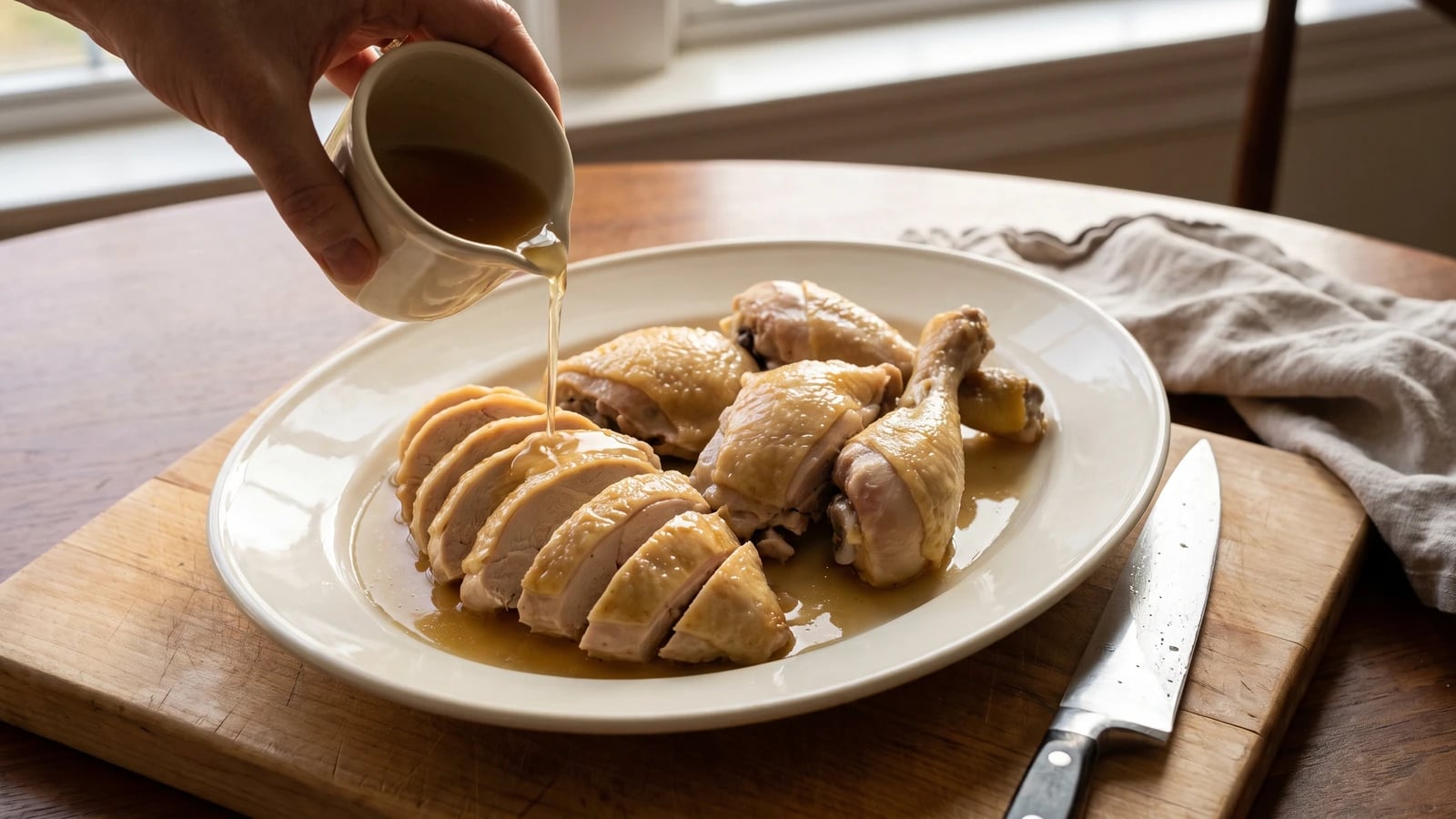
Remove the twine, separate the legs, divide each into thigh and drumstick, and slice the breasts across the grain. Arrange the meat on a warmed deep platter and spoon over enough clear poaching liquor to glaze the pieces and pool shallowly beneath them. Pass the remaining liquor at the table. The chicken should be tender, the skin ivory and supple, and the sauce clear enough to catch the light. À table!
1 serving (about 190g)
Culinary guides, cultural storytelling, and the editorial depth that makes cooking meaningful.
Discover Culinary ExplorerChef Juliette
John Dory has the delicacy of sole and the firmness of turbot. A light flouring, a quick butter sauté, and nut-brown beurre noisette show exactly why looks never mattered.

Chef Juliette
Fresh haddock proves its delicacy in the meunière pan: a fine flour crust, moist pearly flakes, and beurre noisette sharpened with lemon and parsley, ready from one skillet in half an hour.

Chef Juliette
Éperlans à l’Anglaise turns small fish into a lesson in disciplined coating: boned smelts under a close, crisp crumb, pan-fried in clarified butter and finished with bright, half-melted maître d’hôtel butter.

Chef Juliette
Tiny smelts, shallot, mushrooms, white wine, gratin sauce, and fine bread raspings meet a fierce oven, where the fish must turn tender in the same breath the buttered crust bronzes.