
Chef Juliette
John Dory (St. Pierre)
John Dory has the delicacy of sole and the firmness of turbot. A light flouring, a quick butter sauté, and nut-brown beurre noisette show exactly why looks never mattered.
A cooking platform built around craft, culture, and the stories behind what we eat.
Created by Chef Juliette
Based on No. 248, Braising of White Meats, from Le Guide Culinaire (1907) by Auguste Escoffier
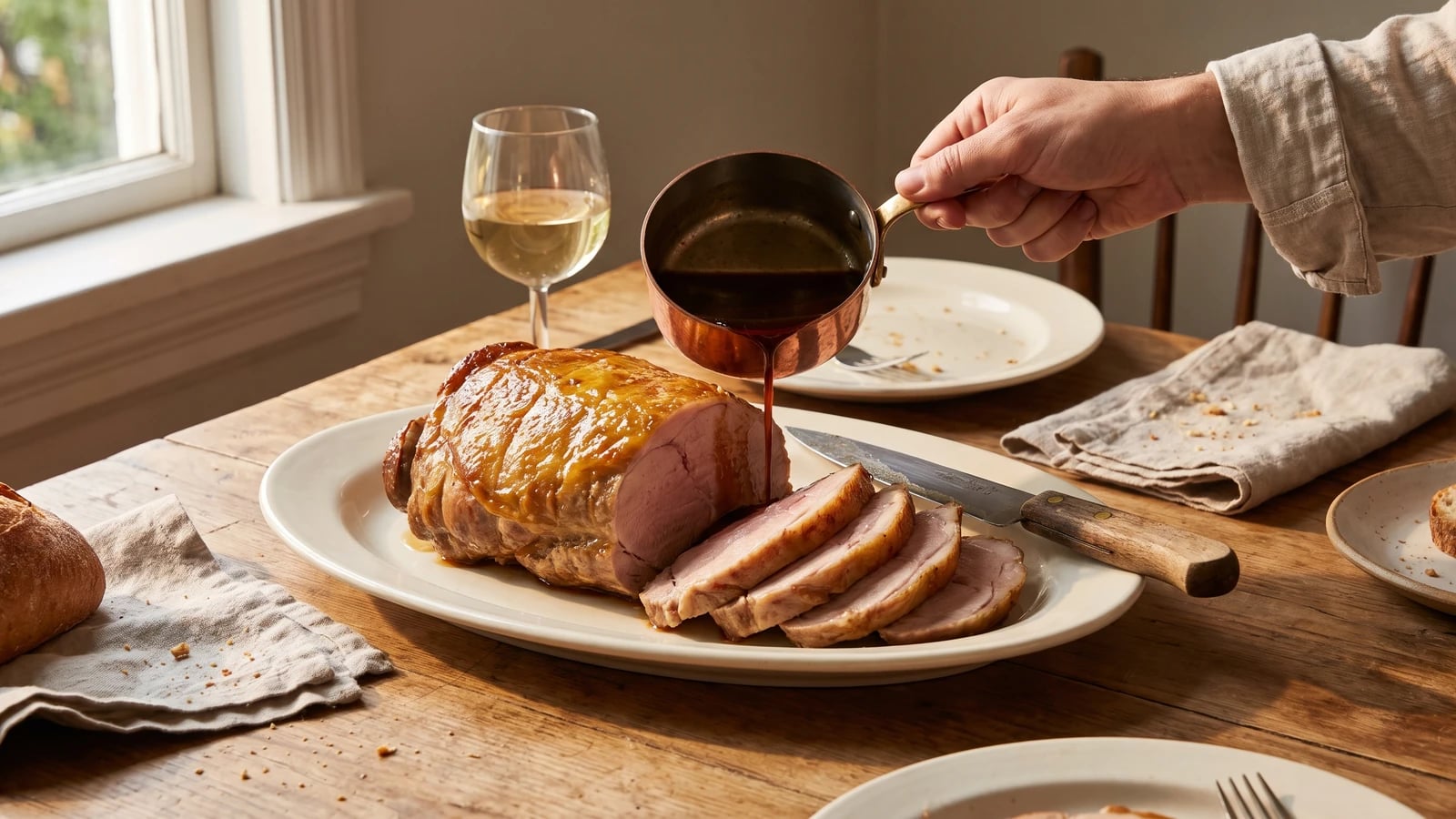
White braising is roast cookery conducted in stock: veal browned in butter, glazed through two measured reductions, then basted gently until its juices run clear and its surface shines.
Braisage des viandes blanches (braising of white meats) teaches one precise thing: stock added in stages protects tender meat better than a bath poured all at once. The first two additions must reduce to glaze, sealing the butter-browned veal beneath a gelatinous coat before the final moistening carries it through the oven. That staged reduction is the dish.
The professional formula assumed a six-pound joint, a saucier at the stove, Brown Veal Stock (No. 9) never off the fire, and a salamander ready to set the final glaze. Here, a tied two-and-a-half-pound veal roast, stock made ahead, a close-fitting casserole, and your oven's broiler do the same work. The brigade scale, larding needle, and separate glaze station are scaffolding, so they go. The repeated reductions and attentive basting stay. One cook, one stove, one evening.
An instant-read thermometer replaces the braiding needle, but the judgment remains the same: this is tender roast meat, not a forgiving stew, and an extra quarter hour can dry it beyond rescue. Before the veal meets the pan, remember the step that decides everything: reduce each of the first two measures of stock until it clings like glaze before adding another drop.
Braisage des viandes blanches belongs to the codified professional kitchens of Paris, where veal, young poultry, and occasionally lamb were treated as tender roasting meats rather than forgiving stewing cuts. The method passed readily into cuisine bourgeoise because a close-fitting casserole, good veal stock, and attentive basting could replace a turning spit. Its surviving name misleads: this is not a long braise, but a roast moistened in stages and stopped the instant its center is cooked.
Quantity
1 roast, 2½ lb (1.1 kg)
tied at 1-inch (2.5 cm) intervals
Quantity
4 large, about 1½ lb (680 g), prepared through Blanchings (No. 273)
Quantity
1½ teaspoons (7.5 ml / 9 g)
Quantity
¾ teaspoon (4 ml / 2 g)
Quantity
3 tablespoons (45 ml / 42 g), plus 1 tablespoon (15 ml / 14 g) if needed
Quantity
1 medium, about ½ cup (120 ml / 75 g)
sliced ¼ inch (6 mm) thick
Quantity
1 medium, about 1 cup (240 ml / 150 g)
sliced
Quantity
1
| Ingredient | Quantity |
|---|---|
| boneless veal loin or top-round roasttied at 1-inch (2.5 cm) intervals | 1 roast, 2½ lb (1.1 kg) |
| veal sweetbreads, for the variation instead of the roast (optional) | 4 large, about 1½ lb (680 g), prepared through Blanchings (No. 273) |
| fine sea salt | 1½ teaspoons (7.5 ml / 9 g) |
| freshly ground black pepper | ¾ teaspoon (4 ml / 2 g) |
| unsalted butter | 3 tablespoons (45 ml / 42 g), plus 1 tablespoon (15 ml / 14 g) if needed |
| carrotsliced ¼ inch (6 mm) thick | 1 medium, about ½ cup (120 ml / 75 g) |
| yellow onionsliced | 1 medium, about 1 cup (240 ml / 150 g) |
| bouquet garni of parsley stems, thyme, and bay leaf | 1 |
| Brown Veal Stockwarmed | 3 cups (720 ml / 720 g) Brown Veal Stock (No. 9) |
Heat the oven to 325°F (165°C), with a rack in the lower middle. Take the veal from the cold about 30 minutes before cooking, then dry it thoroughly and season all over with the salt and pepper. Check that the ties hold the roast in an even cylinder; an even shape cooks evenly, which matters when a few minutes separate succulent veal from dry veal. If using the sweetbread variation, begin with the sweetbreads already prepared through Blanchings (No. 273), pat them very dry, and season them in the same way.
Melt 3 tablespoons (45 ml / 42 g) butter over medium heat in a heavy casserole just large enough to hold the meat. When the foam subsides, add the veal and raidir, lightly firm and color, every surface for 8 to 10 minutes. Aim for an even butter-gold crust, not the dark mahogany of a brown braise. If the butter's milk solids blacken before the veal colors, lift out the meat, wipe away only the burnt specks, lower the heat, and add the extra butter. Ça se rattrape. Set the veal briefly on a plate.
Spread the carrot, onion, and bouquet garni across the bottom of the casserole and settle the veal on top. Pour in ½ cup (120 ml / 120 g) Brown Veal Stock (No. 9), bring it to a moderate simmer, and cover with the lid slightly ajar. A tight home casserole traps more moisture than the professional pan assumed, so the narrow opening lets the stock reduce as intended. Turn and baste the veal every few minutes until the stock has become a sticky glaze on the meat and pan, about 8 to 12 minutes. If the pan dries before the glaze forms, add 2 tablespoons (30 ml / 30 g) more stock. If the glaze smells bitter, transfer the meat and any clean liquid to a fresh pan without scraping up the scorched film.
Add another ½ cup (120 ml / 120 g) Brown Veal Stock (No. 9). Cover with the lid slightly ajar and repeat the reduction, turning and basting until this second measure also clings in a glossy coat. Do not hurry by raising the heat hard; gelatin-rich stock can pass from glaze to burnt sugar in moments. Reserve ¼ cup (60 ml / 60 g) stock for adjusting the finished sauce, then add the remaining 1¾ cups (420 ml / 420 g). In the close-fitting pan, the liquid should reach roughly halfway up the veal. If it falls well short, use a smaller casserole rather than adding water.
Bring the liquid back to a gentle simmer, cover, and place the casserole in the oven. Baste the veal generously every 10 minutes, rolling it once halfway through so the gelatinous stock repeatedly coats every surface. Begin checking after 40 minutes. Remove the roast when its center reaches 140 to 142°F (60 to 61°C), usually after 45 to 60 minutes; the final glazing and rest must carry it to at least 145°F (63°C). Its juices should be clear, not red. If using sweetbreads prepared through Blanchings (No. 273), begin checking after 20 minutes and cook until firm-tender and 160°F (71°C), usually 25 to 35 minutes.
Transfer the veal to a rimmed plate and rest it loosely covered for 10 minutes. Strain the braising liquid into a clean saucepan without pressing the spent aromatics, then skim away excess surface fat. Boil steadily until the liquid coats the back of a spoon and leaves a clear trail when you draw a finger through it. If it becomes too thick or salty before it shines, stop reducing and loosen it with the reserved Brown Veal Stock (No. 9), a spoonful at a time. Return any juices from the resting plate to the sauce and taste for seasoning.
Heat the broiler and place the rested veal on a rimmed metal tray about 6 inches (15 cm) below it. Brush the roast with a thin coat of reduced sauce and broil for 30 to 45 seconds, just until the glaze sets and gleams. Repeat once or twice, watching without distraction; this is the home equivalent of the salamander, and the line between lacquered and burnt is brief. If an edge darkens too far, trim that small spot and brush the surface again with clean sauce. Confirm that the center has reached at least 145°F (63°C), returning it to a 300°F (150°C) oven in 5-minute intervals if needed.
Remove the ties and carve the veal across the grain into ½-inch (1.25 cm) slices. Arrange the slices on a warmed platter, keeping the remainder together so it stays succulent, and spoon over enough sauce to gloss the meat without drowning it. Serve the rest of the sauce at the table. À table!
1 serving (about 260g)
Culinary guides, cultural storytelling, and the editorial depth that makes cooking meaningful.
Discover Culinary ExplorerChef Juliette
John Dory has the delicacy of sole and the firmness of turbot. A light flouring, a quick butter sauté, and nut-brown beurre noisette show exactly why looks never mattered.

Chef Juliette
Fresh haddock proves its delicacy in the meunière pan: a fine flour crust, moist pearly flakes, and beurre noisette sharpened with lemon and parsley, ready from one skillet in half an hour.

Chef Juliette
Éperlans à l’Anglaise turns small fish into a lesson in disciplined coating: boned smelts under a close, crisp crumb, pan-fried in clarified butter and finished with bright, half-melted maître d’hôtel butter.

Chef Juliette
Tiny smelts, shallot, mushrooms, white wine, gratin sauce, and fine bread raspings meet a fierce oven, where the fish must turn tender in the same breath the buttered crust bronzes.