
Chef Juliette
Saddle of Mutton
Selle de mouton rôtie teaches that the roast is decided before the oven: trim cleanly, fold the flanks close, tie firmly, then carve rosy slices beside vegetables glossed with real butter.
A cooking platform built around craft, culture, and the stories behind what we eat.
Created by Chef Juliette
Based on No. 1348, Émincés et Hachis, from Le Guide Culinaire (1907) by Auguste Escoffier
Cold roast gets a second life three ways, but the law never changes: slice or mince it finely, bring the sauce to heat, and never let the meat boil.
Émincés et hachis (thin slices and hashes) teach one unalterable rule: cooked meat must never boil during reheating. Let it bubble in its sauce and it hardens. Slice it finely, heat its sauce or garnish first, then warm the meat only long enough to reach the table tender and glossy. This entry is a family of preparations governed by that single technique, not three dishes meant to be cooked together.
The original kitchen assumed a saucier at hand, reduced veal gravy from a stockpot never off the fire, and warm service moving without pause. A salamander has no honest job here because the meat needs warming, not scorching. For one cook, choose one four-serving preparation and use a small saucepan, a heatproof bowl over barely simmering water, or a covered low oven. The brigade's separate sauce station and hot cupboard are scaffolding, so they go. Fine cutting and heat without boiling are the dish, so they stay.
The source's brief oven finish for the stuffed potatoes assumes a freshly made, already warm filling. A refrigerator-cold home batch needs longer under cover to become safely hot, and that extra time is for temperature, not browning. Before touching a pan, decide which branch you are serving and arrange for its sauce or garnish to take the heat first. The meat joins last.
Émincés et hachis belong to the Parisian classical kitchen and the cuisine bourgeoise table, where cold roast returned as a deliberate second-service main dish rather than a plate of scraps. Potato-bound hachis moved easily between household thrift and grand-kitchen presentation, from a hot timbale to baked shells made to appear untouched. The familiar casserole is not the only Parmentier form: this entry hides the hash inside baked potatoes, while à l’Américaine signals a French garnish of tomato, gravy, and crisp potato rather than an American origin.
Quantity
1 four-serving preparation Émincé de Bœuf (No. 1175)
held before its final warming; choose one preparation
Quantity
1 four-serving preparation Hachis de Bœuf à l’Américaine (No. 1178)
base and crisp potato garnish held separately; choose one preparation
Quantity
1 four-serving preparation Hachis de Bœuf Parmentier (No. 1179)
filled potato shells ready for their oven warming; choose one preparation
| Ingredient | Quantity |
|---|---|
| Émincé de Bœuf, prepared through its own entry (optional)held before its final warming; choose one preparation | 1 four-serving preparation Émincé de Bœuf (No. 1175) |
| Hachis de Bœuf à l’Américaine, prepared through its own entry (optional)base and crisp potato garnish held separately; choose one preparation | 1 four-serving preparation Hachis de Bœuf à l’Américaine (No. 1178) |
| Hachis de Bœuf Parmentier, prepared through its own entry (optional)filled potato shells ready for their oven warming; choose one preparation | 1 four-serving preparation Hachis de Bœuf Parmentier (No. 1179) |
Select one four-serving branch: Émincé de Bœuf (No. 1175), Hachis de Bœuf à l’Américaine (No. 1178), or Hachis de Bœuf Parmentier (No. 1179). Each preparation keeps its own formula and proportions. This entry supplies the law governing their final warming, so do not combine the three or rebuild their sauces here.
For the sliced preparation, warm a shallow serving dish with hot water, then dry it. For the hachis in a timbale, set a heatproof bowl over a saucepan containing 2 cm (¾ inch) of barely simmering water. For the stuffed potatoes, heat the oven to 160°C / 325°F. Keep an instant-read thermometer beside the stove; the aim is 74°C / 165°F without allowing the meat's sauce or garnish to boil.
For Émincé de Bœuf (No. 1175), keep the cold beef slices out of their accompanying sauce or garnish while you bring that sauce to a full boil. Fan the meat in the warmed shallow dish, immediately pour the boiling sauce over it, cover, and leave it for two to three minutes. Check the centre of an overlapping stack for 74°C / 165°F. If it needs more heat, place the covered dish over barely simmering water and turn the slices once, stopping as soon as they are hot. If the sauce bubbles around the meat, lift the dish away at once. Ça se rattrape: remove the beef, cut any tightened slices still finer across the grain, let the sauce settle off the heat, then return the meat only to coat.
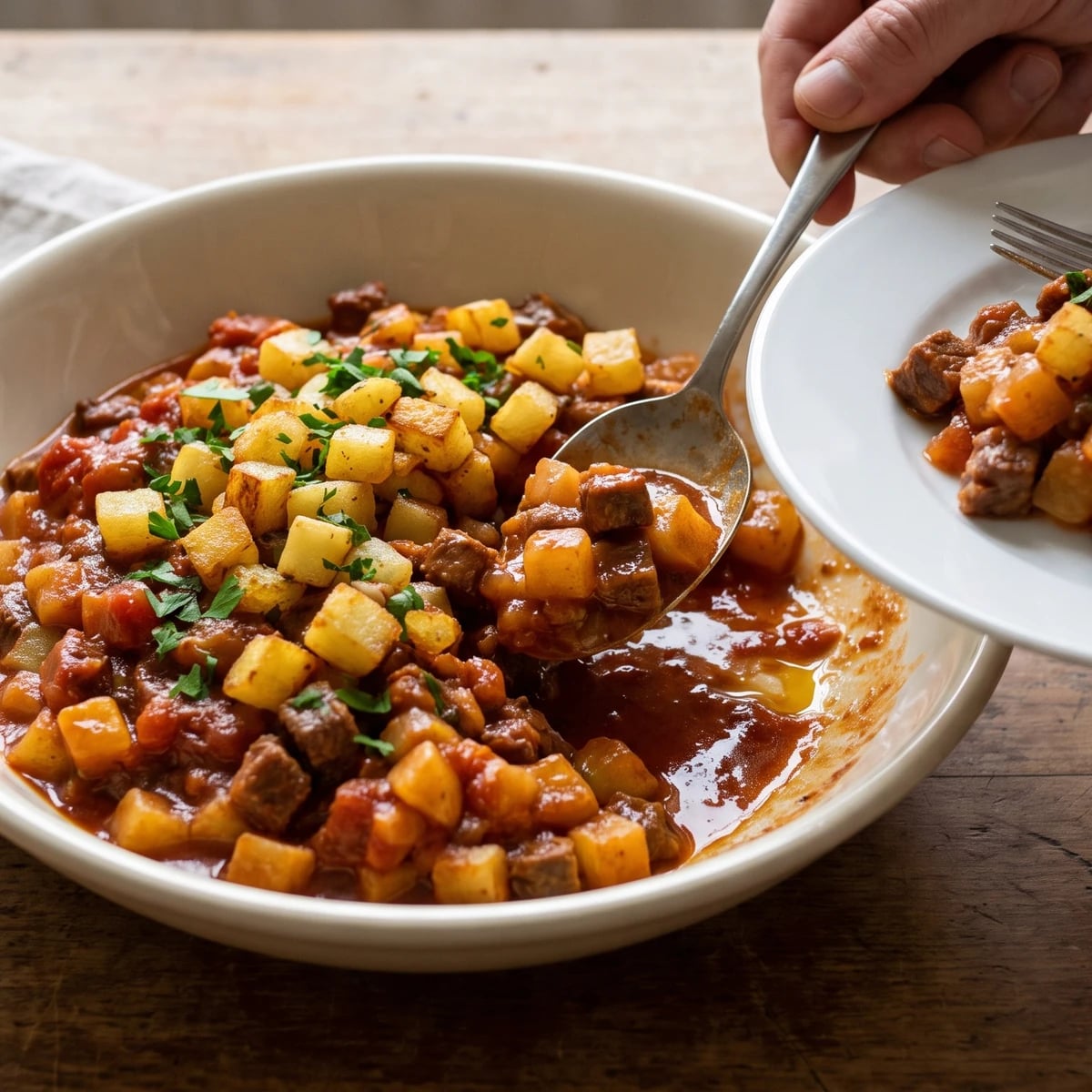
For Hachis de Bœuf à l’Américaine (No. 1178), place the prepared beef, potato, tomato sauce, and reduced gravy mixture in the heatproof bowl. Warm it over barely simmering water, folding gently from the bottom until it reaches 74°C / 165°F without a single bubble breaking through the mixture. Recrisp the reserved potato dice separately in a dry skillet, then scatter them over the hot hachis with its parsley. If the base begins bubbling, lift the bowl off immediately. If some beef has firmed, chop those pieces finer and fold them back through the potato off the heat. The texture changes, but supper is saved.
For Hachis de Bœuf Parmentier (No. 1179), arrange the filled, capped potato shells in a snug baking dish and cover loosely. Warm freshly assembled shells for about ten minutes; if they have come directly from the refrigerator, allow fifteen to twenty-five minutes, until the centre reaches 74°C / 165°F. Do not chase a browned cap under a salamander or broiler. This version is meant to keep its shell looking intact. If the filling starts to sizzle, remove the dish at once. Ça se rattrape: split the shells, chop any firm beef still finer, fold it back through the potato and sauce, and serve them open.
Bring the chosen preparation straight to the table in its warmed platter, timbale, or potato shells. Do not hold it over heat while bread is cut or glasses are filled; these dishes reward prompt service and punish a distracted cook. Sauce gleaming, potatoes crisp where promised, meat hot but never boiled. À table!
1 serving (about 275g)
Culinary guides, cultural storytelling, and the editorial depth that makes cooking meaningful.
Discover Culinary Explorer
Chef Juliette
Selle de mouton rôtie teaches that the roast is decided before the oven: trim cleanly, fold the flanks close, tie firmly, then carve rosy slices beside vegetables glossed with real butter.

Chef Juliette
A true baron keeps saddle and both legs together, then asks for disciplined trimming, tight trussing, and patient roasting before it reaches the table bronzed, juicy, and ringed with buttered vegetables.

Chef Juliette
Two lamb legs left joined, trussed into one even roast and cooked slowly over their own fond, with butter-bound flageolets and bronze potatoes for a generous French table.

Chef Juliette
Filets de mouton teach the roast through the knife: saddle halves skinned, rolled tightly around their kernels, tied evenly, then brought to a bronze crust and a rosy, juicy centre.