
Chef Juliette
John Dory (St. Pierre)
John Dory has the delicacy of sole and the firmness of turbot. A light flouring, a quick butter sauté, and nut-brown beurre noisette show exactly why looks never mattered.
A cooking platform built around craft, culture, and the stories behind what we eat.
Created by Chef Juliette
Based on No. 1175, Émincé de Bœuf, from Le Guide Culinaire (1907) by Auguste Escoffier
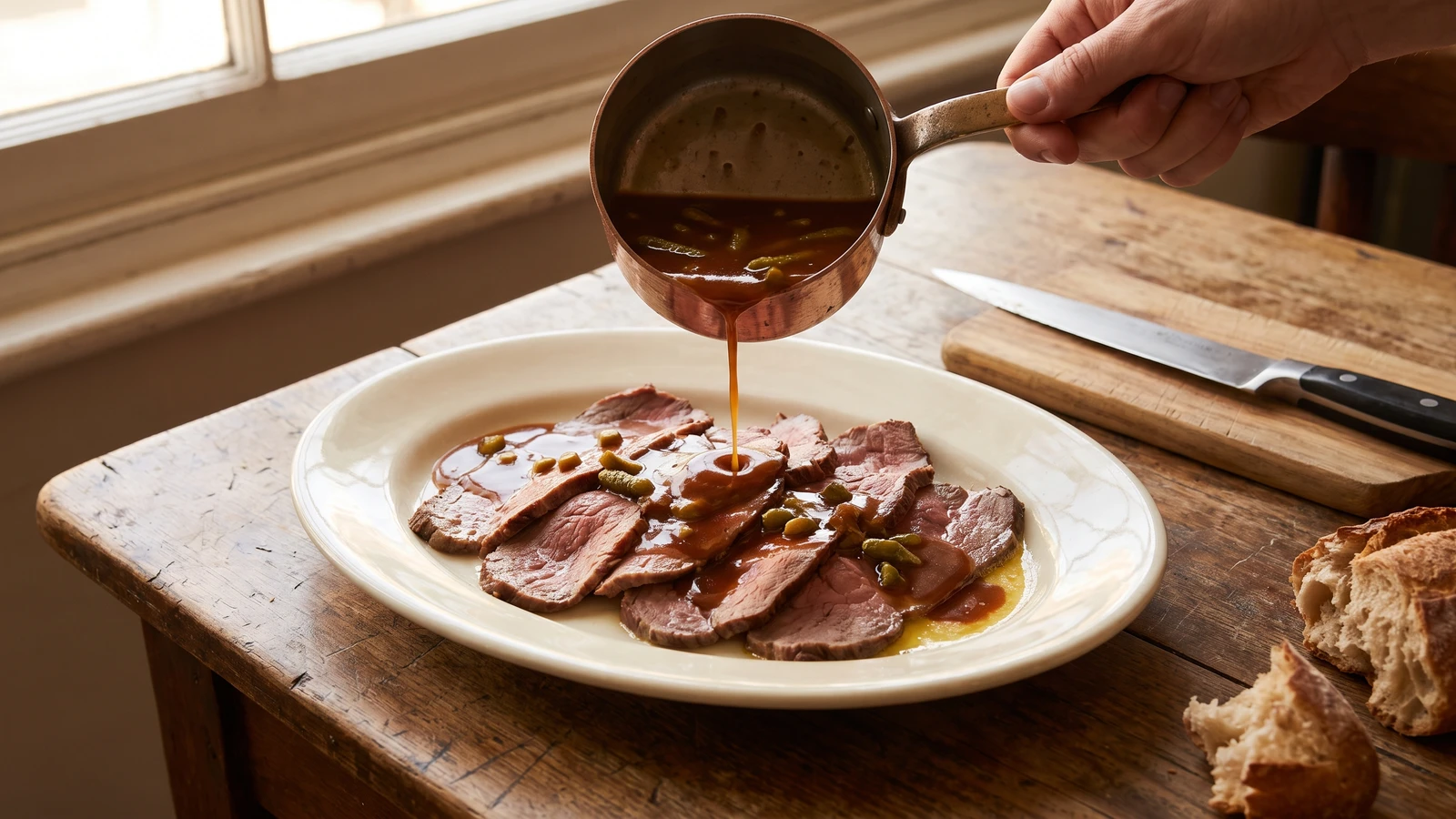
Cold roast beef, sliced nearly translucent and warmed beneath a boiling classical sauce, proves the rule of every émincé: heat the sauce fiercely, treat the meat gently, and never let the two simmer together.
Émincé de Bœuf (thin slices of beef warmed beneath sauce) teaches the gentlest rule in the canon: the beef never cooks twice. Slice it nearly translucent, arrange it in a warm dish, and let boiling sauce carry the heat into it. Put the meat into the pan and let it simmer, and tenderness leaves before supper reaches the table.
The original entry assumed a saucier on staff, a stock never off the fire, several finished sauces waiting, and enough cold beef left from service to feed a dining room. At home, the stockpot and sauce station become one small saucepan holding 600 ml of one finished sauce. A warmed platter replaces the service line, and a salamander is neither required nor wanted because overhead heat would dry the exposed slices. Holding seven sauces ready is brigade scaffolding and goes; the finished sauce, thin slicing, and off-heat warming are the dish and must stay. One cook, one stove, one evening.
This is economy with discipline, not leftovers disguised. Warm the platter, bring the sauce to a true boil, then pour and cover at once. If the centre remains cool, reboil the sauce alone and pour it again. Ça se rattrape. The one step that matters most is simple: keep the beef out of the saucepan.
Émincé de bœuf belongs less to one province than to cuisine bourgeoise, the well-run household table, and the classical kitchens of Paris, where cold roast and pot-au-feu beef returned as composed dishes rather than being discarded. Émincer means to cut into very thin slices; here the title is the method, and grand kitchens paired that household economy with finished sauces ranging from sharp Piquante to truffle-rich Périgueux. It is often mistaken for a sauté, but the defining practice is the opposite: the cooked meat is warmed by sauce rather than fried or simmered again.
Quantity
1 lb 5 oz (600 g)
chilled in one piece, with visible fat and gristle trimmed
Quantity
2½ cups (600 ml / about 625 g)
choose one
Quantity
Up to 2 tablespoons (30 ml / 30 g)
only if needed to loosen the sauce
| Ingredient | Quantity |
|---|---|
| cold cooked beef from a roast or boiled beefchilled in one piece, with visible fat and gristle trimmed | 1 lb 5 oz (600 g) |
| finished Bordelaise, Piquante, Italienne, Chasseur, Poivrade, Périgueux, or Tomato saucechoose one | 2½ cups (600 ml / about 625 g) |
| hot water (optional)only if needed to loosen the sauce | Up to 2 tablespoons (30 ml / 30 g) |
Keep the beef cold while you cut it, because firm meat gives cleaner slices. With a long, very sharp knife, slice directly across the grain into pieces 1 to 2 mm thick, as close to translucent as the cut permits. Use long strokes rather than sawing, and keep the slices loose instead of compressing them into a stack. Spread them on a plate, cover lightly, and let them lose the hardest refrigerator chill for no more than 20 minutes while you ready the sauce.
Put the chosen finished Bordelaise, Piquante, Italienne, Chasseur, Poivrade, Périgueux, or Tomato sauce into a 1.5 litre saucepan. Warm it over medium-low heat, stirring along the base and corners, until it moves in slow waves and begins trembling at the edge. The sauce is already a finished preparation, so do not rebuild or season it casually here; this entry uses it whole, exactly as the classical kitchen did.
Fill a shallow heatproof serving dish with the hottest water available and leave it for 5 minutes. Empty and dry it thoroughly just before arranging the meat. This warmed dish is the home kitchen's service line: it keeps the sauce from surrendering its heat to cold porcelain before it reaches the beef.
Raise the heat beneath the sauce and bring it to a full boil for 15 seconds, stirring constantly. It must flow readily enough to reach every slice. If reduction has made it too tight, whisk in the hot water a teaspoonful at a time, using no more than 2 tablespoons, then return it to the boil. Only the sauce boils. Remove the saucepan from the heat immediately.
Overlap the beef loosely in the warmed dish, using two shallow layers rather than a dense heap. Immediately pour the boiling sauce across the entire surface, nudging the slices apart with a flexible spatula so the sauce runs between them. Cover with a warmed lid or inverted platter and leave undisturbed for 3 to 5 minutes. Do not place the dish over heat. If the beef has accidentally gone into the saucepan and you see the first bubble, lift it out at once. Ça se rattrape: arrange it in the warm dish, boil the sauce alone, and pour again. Continued simmering is what toughens the meat.
Lift a slice from the centre and touch it with the back of a clean finger; it should be thoroughly warm, supple, and coated in glossy sauce. If the centre is still cool, hold the beef back with the spatula and carefully tip only the sauce into the saucepan. Boil it again for 15 seconds, pour it back over the meat, and cover for another 2 minutes. Serve immediately, while the sauce still gleams and the slices remain tender. À table!
1 serving (about 305g)
Culinary guides, cultural storytelling, and the editorial depth that makes cooking meaningful.
Discover Culinary ExplorerChef Juliette
John Dory has the delicacy of sole and the firmness of turbot. A light flouring, a quick butter sauté, and nut-brown beurre noisette show exactly why looks never mattered.

Chef Juliette
Fresh haddock proves its delicacy in the meunière pan: a fine flour crust, moist pearly flakes, and beurre noisette sharpened with lemon and parsley, ready from one skillet in half an hour.

Chef Juliette
Éperlans à l’Anglaise turns small fish into a lesson in disciplined coating: boned smelts under a close, crisp crumb, pan-fried in clarified butter and finished with bright, half-melted maître d’hôtel butter.

Chef Juliette
Tiny smelts, shallot, mushrooms, white wine, gratin sauce, and fine bread raspings meet a fierce oven, where the fish must turn tender in the same breath the buttered crust bronzes.