
Chef Juliette
John Dory (St. Pierre)
John Dory has the delicacy of sole and the firmness of turbot. A light flouring, a quick butter sauté, and nut-brown beurre noisette show exactly why looks never mattered.
A cooking platform built around craft, culture, and the stories behind what we eat.
Created by Chef Juliette
Based on No. 1179, Hachis de Bœuf Parmentier, from Le Guide Culinaire (1907) by Auguste Escoffier
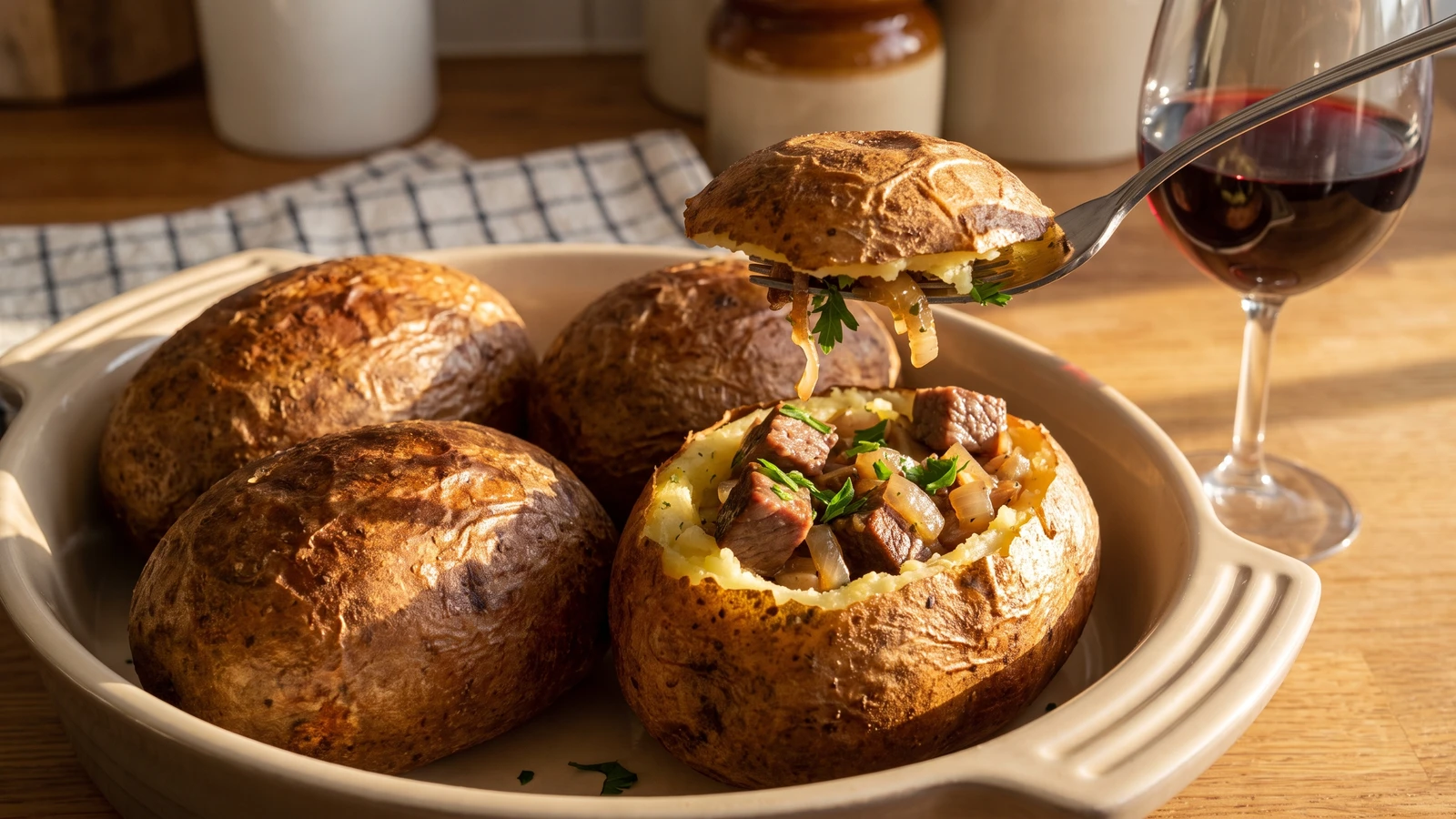
Whole baked potatoes hide a buttery hash of equal parts potato and diced beef, sharpened with onion, parsley, vinegar, and glossy Sauce Lyonnaise, then capped and baked until the shells crisp.
Hachis de Bœuf Parmentier (beef hash in baked potato shells) teaches the proper use of cooked meat: don't grind it into anonymity. Dice it, match its loose volume with the baked potato pulp, and let just enough Sauce Lyonnaise bind the two. The one true thing to know before you touch a pan is that the filling must remain a hash, moist enough to hold together but dry enough that the shell stays crisp.
The entry was written for a kitchen where a saucier kept Sauce Lyonnaise ready from stock never far from the fire, a tammy sat within reach, and a hot service oven waited. At home, use the finished sauce from its own preparation, a fine-mesh sieve in place of the tammy, and the upper third of a fully heated oven. A salamander isn't wanted here; the entry calls for a second bake, not a gratin crust. The napkin-lined serving dish is brigade ceremony and can go. The baked shell, equal measures of beef and potato, buttered onion, parsley, vinegar, and second bake are the dish, so every one stays. One cook, one stove, one evening.
Slice the caps off the moment the potatoes are tender and hollow them while they're still hot, using a narrow teaspoon where the old kitchen used a spoon handle. This is the step that matters most. Leave a sturdy wall beneath the skin and don't pierce the bottom; those intact shells are what turn excellent leftovers into supper worth carrying proudly to the table.
Hachis Parmentier belongs to French cuisine bourgeoise, where the remains of a roast or pot-au-feu were chopped and given another meal with potatoes rather than treated as scraps. Parmentier became the classical marker for potato preparations, but the familiar layered casserole is only one expression: this grand-kitchen formula packs the hash into baked shells and restores the caps so the potatoes arrive apparently whole. Sauce Lyonnaise brings onions and vinegar in the manner named for Lyon, yet this is not a bouchon specialty; it is a national table dish wearing one precise Lyonnais accent.
Quantity
4 large, about 10 ounces each (2½ pounds / 1.13 kg total)
Quantity
equal in loose volume to the recovered potato pulp, usually about 2½ cups (600 ml / 400 g)
cut into ¼-inch dice
Quantity
1 small, about ½ cup (120 ml / 80 g), enough to yield about 4 tablespoons when cooked
finely chopped
Quantity
4 tablespoons (60 ml / 57 g), divided
Quantity
1 teaspoon (5 ml / 1 g)
finely chopped
Quantity
⅛ teaspoon (0.6 ml / 0.6 g), plus a few drops only if needed
Quantity
1 cup (240 ml / 250 g)
warmed
Quantity
as needed
| Ingredient | Quantity |
|---|---|
| floury baking potatoes | 4 large, about 10 ounces each (2½ pounds / 1.13 kg total) |
| cooked roast beefcut into ¼-inch dice | equal in loose volume to the recovered potato pulp, usually about 2½ cups (600 ml / 400 g) |
| yellow onionfinely chopped | 1 small, about ½ cup (120 ml / 80 g), enough to yield about 4 tablespoons when cooked |
| unsalted butter | 4 tablespoons (60 ml / 57 g), divided |
| flat-leaf parsleyfinely chopped | 1 teaspoon (5 ml / 1 g) |
| red wine vinegar | ⅛ teaspoon (0.6 ml / 0.6 g), plus a few drops only if needed |
| prepared Sauce Lyonnaisewarmed | 1 cup (240 ml / 250 g) |
| fine salt | as needed |
Heat the oven to 425°F (220°C), with a rack in the upper third. Scrub and dry the potatoes, prick each once with the point of a knife, and set them directly on a rimmed baking sheet. Bake for 50 to 65 minutes, until the skins feel firm and a narrow knife passes through the centres without resistance. The shells must be thoroughly baked and dry, not merely softened, because they have to survive hollowing and a second visit to the oven.
While the potatoes bake, melt 1 tablespoon of the butter in a heavy skillet over medium-low heat. Add the onion with a small pinch of salt and cook gently until tender and translucent, about 8 minutes, without letting it brown. You want roughly 4 tablespoons of cooked onion, preserving the book's measure of 2 tablespoons per pound of potato-and-beef preparation. Transfer the onion to a plate and keep the skillet ready.
As soon as the potatoes are tender enough to handle in a folded towel, cut a shallow cap lengthwise from the top of each one. Scoop out the pulp with a narrow teaspoon, leaving a wall about ⅜ inch (1 cm) thick beneath the skin. Keep every cap with its own shell. Measure the recovered pulp loosely, then measure the same loose volume of diced beef; that equal proportion is the backbone of this particular hachis.
Crush the hot potato pulp with a fork, leaving a little texture. Melt the remaining 3 tablespoons butter in the skillet over medium heat, add the potato, and toss it for 3 to 4 minutes in the manner of Pommes de Terre Macaire, until the butter is absorbed and a few golden flecks appear. Add the diced beef, cooked onion, parsley, and vinegar. Toss for another 3 minutes, just until the beef is hot and evenly distributed. Taste before adding salt, since the beef and Sauce Lyonnaise may already carry enough.
Press the warm Sauce Lyonnaise through a fine-mesh sieve, the home equivalent of the book's tammy. Add it to the hash a few spoonfuls at a time, folding after each addition and stopping when the mixture holds together with a light gloss. It should absorb the sauce without leaving a puddle in the skillet. If it turns loose, keep it over low heat and fold gently for a minute or two; if it remains dry, add another spoonful of sauce. Ça se rattrape.
Divide the hot hash among the potato shells, pressing it lightly into the cavities and mounding it where necessary. Replace each cap so its cut edges align. Potato sizes vary, and the source's equal-volume ratio can leave a little extra filling; preserve the ratio rather than forcing the shells, and bake any remainder beside them in a small dish. Arrange the capped potatoes on the baking sheet and return them to the 425°F (220°C) oven for 10 minutes, until the shells are crisp and the centres are thoroughly hot, reaching 165°F (74°C) if checked. Transfer them to a warm platter and serve at once. À table!
1 serving (about 400g)
Culinary guides, cultural storytelling, and the editorial depth that makes cooking meaningful.
Discover Culinary ExplorerChef Juliette
John Dory has the delicacy of sole and the firmness of turbot. A light flouring, a quick butter sauté, and nut-brown beurre noisette show exactly why looks never mattered.

Chef Juliette
Fresh haddock proves its delicacy in the meunière pan: a fine flour crust, moist pearly flakes, and beurre noisette sharpened with lemon and parsley, ready from one skillet in half an hour.

Chef Juliette
Éperlans à l’Anglaise turns small fish into a lesson in disciplined coating: boned smelts under a close, crisp crumb, pan-fried in clarified butter and finished with bright, half-melted maître d’hôtel butter.

Chef Juliette
Tiny smelts, shallot, mushrooms, white wine, gratin sauce, and fine bread raspings meet a fierce oven, where the fish must turn tender in the same breath the buttered crust bronzes.