
Chef Juliette
John Dory (St. Pierre)
John Dory has the delicacy of sole and the firmness of turbot. A light flouring, a quick butter sauté, and nut-brown beurre noisette show exactly why looks never mattered.
A cooking platform built around craft, culture, and the stories behind what we eat.
Created by Chef Juliette
Based on No. 1308, Gigot Marine en Chevreuil, from Le Guide Culinaire (1907) by Auguste Escoffier
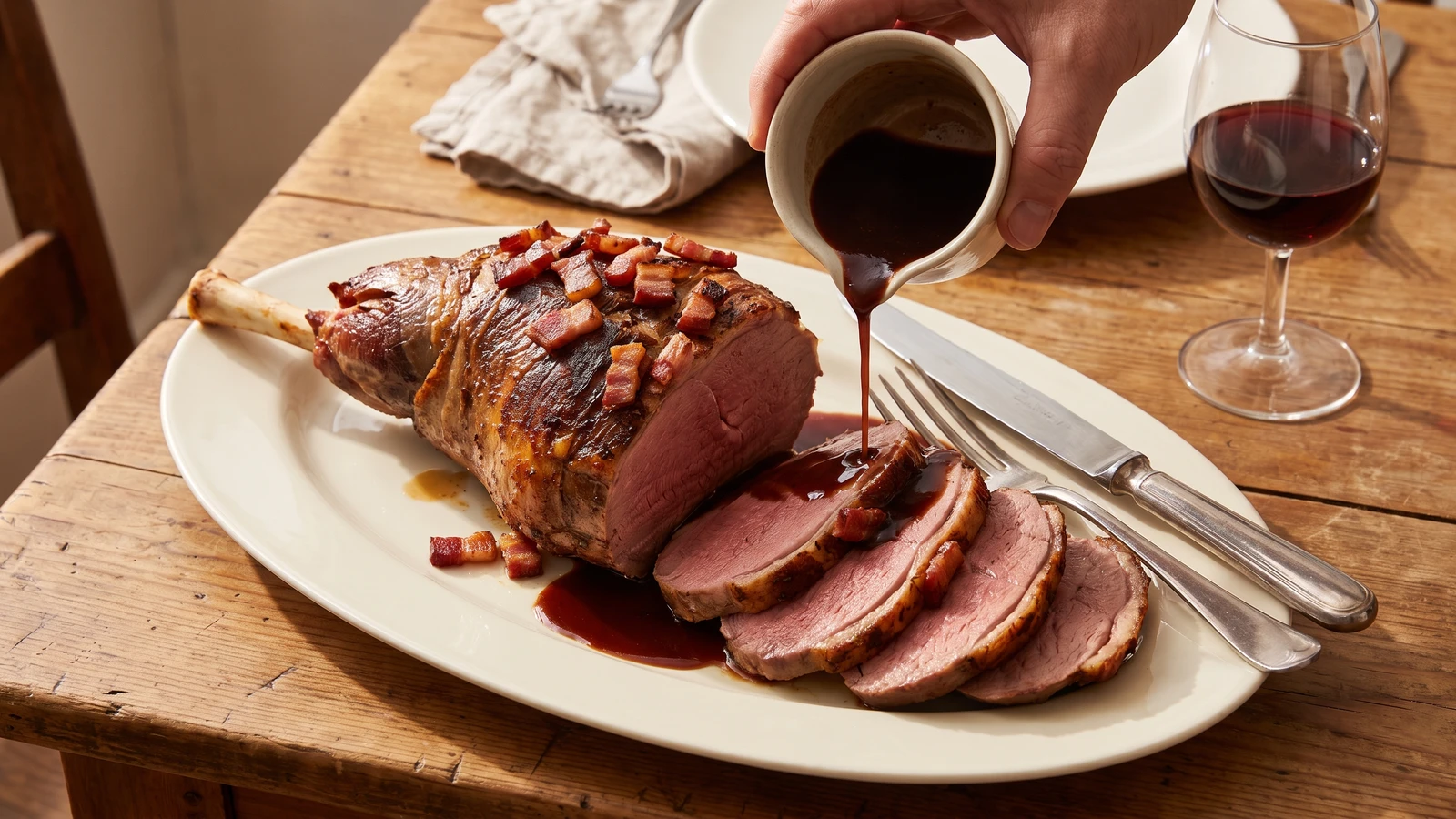
Juniper-marinated, bacon-larded lamb meets a fierce oven, then a glossy poivrade sharpened with red wine and cayenne. The lesson is simple: dry the gigot thoroughly, and the roast browns rather than turns gray.
Gigot mariné en chevreuil (marinated leg of lamb in the manner of roe deer) teaches the discipline of a marinated roast. The one true thing is that the leg must feel dry and slightly tacky before it enters a fierce oven. A wet surface fights browning; a dry one lets the lamb bronze and the exposed bacon rissole while the interior stays tender.
The original recipe assumed a larder cook to shorten the bones and work a larding needle, then a saucier tending poivrade from a stockpot that never went cold. At home, the butcher prepares the joint, a metal skewer opens channels for the bacon, and a fine-mesh strainer replaces the tammy. The leg and marinade are scaled for four, and young lamb receives 48 refrigerated hours rather than several days judged by weather. The paper frill is brigade scaffolding and can go. The larding, cooked marinade, fierce opening heat, pressed aromatics, and patient skimming are the dish, so they stay.
The marinating begins two days ahead, but the roasting and sauce come together with one cook, one stove, one evening. Before the gigot meets its roasting pan, dry it without mercy. Heat can brown a dry roast; it can't argue with a wet one.
Gigot mariné en chevreuil belongs to the Parisian grand-kitchen table rather than the hunting cookery of one rural region. In classical French usage, en chevreuil means that mutton or lamb receives the cooked, juniper-scented marinade and peppery poivrade associated with roe deer; the joint itself is not venison, a distinction the name often obscures. The preparation moved readily to bourgeois dinner tables because marination seasoned older mutton deeply and the generous sauce made one roast worthy of company.
Quantity
1 leg, 3½ to 4 pounds (1.6 to 1.8 kg)
aitch bone removed, shank bone shortened, and broad upper surface skinned of fell and excess fat
Quantity
4 ounces (115 g)
cut into strips about ⅛ inch (3 mm) square and 1½ inches (4 cm) long, then thoroughly chilled
completely cold
Quantity
1½ tablespoons (22 ml / 21 g)
Quantity
1 cup (240 ml / about 150 g) Mirepoix (No. 228)
Quantity
2 cups (480 ml / about 500 g) Ordinary Poivrade Sauce (No. 49)
Quantity
3 tablespoons (45 ml / 45 g)
Quantity
1 small pinch
Quantity
¼ teaspoon (1.25 ml / 1 g)
Quantity
Up to ½ teaspoon (2.5 ml / 3 g)
use only after tasting the finished sauce
| Ingredient | Quantity |
|---|---|
| bone-in leg of lambaitch bone removed, shank bone shortened, and broad upper surface skinned of fell and excess fat | 1 leg, 3½ to 4 pounds (1.6 to 1.8 kg) |
| unsmoked streaky bacon or fresh side porkcut into strips about ⅛ inch (3 mm) square and 1½ inches (4 cm) long, then thoroughly chilled | 4 ounces (115 g) |
| prepared cold marinadecompletely cold | 8 cups (1.9 L / about 2 kg) Marinade for Mutton, Roebuck-style (No. 170), made from Cooked Marinade for Venison (No. 168) |
| unsalted butter | 1½ tablespoons (22 ml / 21 g) |
| ham mirepoix | 1 cup (240 ml / about 150 g) Mirepoix (No. 228) |
| prepared poivrade | 2 cups (480 ml / about 500 g) Ordinary Poivrade Sauce (No. 49) |
| good dry red wine | 3 tablespoons (45 ml / 45 g) |
| cayenne | 1 small pinch |
| granulated sugar | ¼ teaspoon (1.25 ml / 1 g) |
| fine salt (optional)use only after tasting the finished sauce | Up to ½ teaspoon (2.5 ml / 3 g) |
Ask the butcher to remove the aitch bone, shorten the shank bone, and expose the meat across the broad upper face of the leg. Chill the bacon until firm. With a larding needle, or a clean metal skewer followed by a narrow chopstick, open 12 to 16 channels running with the grain of the meat. Push a bacon strip through each channel, leaving tiny ends visible at the surface, then tie the leg into a compact shape. If the bacon smears or tears, stop and chill it again for 15 minutes. Ça se rattrape; cold bacon threads cleanly.
Set the larded leg in a snug nonreactive dish or heavy food-safe bag and cover it with the completely cold Marinade for Mutton, Roebuck-style (No. 170), made from Cooked Marinade for Venison (No. 168). Refrigerate for 48 hours, turning the joint morning and evening if it isn't fully submerged. Young lamb doesn't need the longer treatment once used for mature mutton, and too much time in the acidic bath makes its surface woolly rather than tender. When ready to cook, lift out the lamb and measure 1 cup (240 ml / about 250 g) of the used marinade for the sauce. Discard the remainder.
Remove every clinging aromatic and pat the leg dry with several changes of towel. Set it uncovered on a rack in the refrigerator for 1 hour, then leave it at room temperature for 30 minutes while the oven heats to 500°F (260°C). The surface should feel tacky, never wet. If beads of marinade remain, pat again rather than trusting extra heat to solve the problem. This dryness is the principle that decides the roast.
Melt the butter in a medium saucepan until its foam subsides. Add the Mirepoix (No. 228), prepared with ham, and cook over medium heat until thoroughly browned, about 8 minutes. If the vegetables begin to catch, add a spoonful of the measured Marinade for Mutton, Roebuck-style (No. 170), made from Cooked Marinade for Venison (No. 168), and scrape the pan clean. Pour in the rest of that 1 cup of used marinade, bring it to a full boil, and boil for at least 5 minutes before it goes anywhere near a tasting spoon. Reduce it by about two-thirds, then add the Ordinary Poivrade Sauce (No. 49) and hold everything at a bare simmer for 15 minutes.
Set the lamb broad side up on a rack in a roasting pan and place it in the fierce oven for 12 to 15 minutes, until the surface takes a dark bronze crust. Lower the heat to 375°F (190°C) and continue roasting for 35 to 50 minutes. During the final 5 minutes, return the oven to 500°F (260°C) if needed to rissole the exposed bacon, meaning brown it deeply. Shield any patch that darkens too quickly with a loose piece of foil. Remove the roast when a thermometer in the thickest meat, clear of bone and bacon channels, reads 140°F (60°C); it should reach 145°F (63°C) as it rests.
Press the sauce firmly through a coarse strainer, squeezing the aromatics with the back of a ladle, then return it to a clean saucepan. Hold it at the gentlest simmer for 30 minutes and despumate it, skimming away every patch of fat and froth that rises. Add the red wine little by little during the final few minutes, letting each addition lose its raw edge before the next. Stir in the cayenne and sugar, taste, and add salt only if the sauce asks for it. Pass it once more through a fine-mesh strainer. If it is too thin, reduce it; if too tight, loosen it with a tablespoon of hot water. If fat beads across the top, let the sauce settle for 2 minutes and skim again. Ça se rattrape.
Move the gigot to a warm platter and tent it loosely with foil for 20 to 25 minutes. Verify that the centre reaches 145°F (63°C); if it doesn't, return the joint to the 375°F (190°C) oven briefly. Resting lets the heat settle through the meat and keeps the first slice from emptying its juices across the platter. Keep the sauce warm over the lowest heat, never at a hard boil.
Remove the twine and carve the lamb across the grain into generous slices, cutting around the remaining bone. Arrange the slices against the intact portion of the leg on a long warm platter so the burnished surface and bacon larding remain visible. Pour the chevreuil sauce into a warmed sauceboat and serve it separately, as the source intends. No paper frill is required. Cooking well is not cooking fancy. À table!
1 serving (about 410g)
Culinary guides, cultural storytelling, and the editorial depth that makes cooking meaningful.
Discover Culinary ExplorerChef Juliette
John Dory has the delicacy of sole and the firmness of turbot. A light flouring, a quick butter sauté, and nut-brown beurre noisette show exactly why looks never mattered.

Chef Juliette
Fresh haddock proves its delicacy in the meunière pan: a fine flour crust, moist pearly flakes, and beurre noisette sharpened with lemon and parsley, ready from one skillet in half an hour.

Chef Juliette
Éperlans à l’Anglaise turns small fish into a lesson in disciplined coating: boned smelts under a close, crisp crumb, pan-fried in clarified butter and finished with bright, half-melted maître d’hôtel butter.

Chef Juliette
Tiny smelts, shallot, mushrooms, white wine, gratin sauce, and fine bread raspings meet a fierce oven, where the fish must turn tender in the same breath the buttered crust bronzes.