
Chef Juliette
Court-bouillon with Vinegar
The clear, sharp poaching liquor that teaches restraint: vegetables simmered gently with vinegar, then peppercorns held to the final twelve minutes so trout, salmon, and shellfish taste clean, never bitter.
A cooking platform built around craft, culture, and the stories behind what we eat.
Created by Chef Juliette
Based on No. 170, Marinade for Mutton, Roebuck-style, from Le Guide Culinaire (1907) by Auguste Escoffier
A sharper cooked marinade of white wine, vinegar, juniper, wild thyme, basil, rosemary, and garlic, reduced enough to give mature mutton the dark woodland character of roebuck.
Marinade cuite pour mouton façon chevreuil (cooked marinade for mutton, roebuck-style) teaches concentration. Less water is not a footnote here, it is the dish: the sharper balance of wine, vinegar, juniper, wild herbs, and garlic gives mature mutton the woodland character associated with roebuck.
The original formula assumed five-quart quantities, a saucier to tend them, and a cool larder where marinade touching meat could be boiled again every few days. One cook needs none of that scaffolding. Start with a half quantity of Cooked Marinade for Venison (No. 168), reduce it by exactly two cups, then infuse the added aromatics. The order changes because the referenced marinade remains a finished preparation; the final concentration and the book's half-scale proportions do not.
When it is right, the marinade is clear amber, sharply fragrant, and resinous without tasting medicinal. Refrigeration replaces repeated boiling, but the reduced water and extra aromatics must stay. Measure the finished volume rather than trusting the clock. That is the step that decides the dish.
Marinade pour mouton façon chevreuil belongs to the French classical repertoire of venaison, the cookery of game, rather than to one particular province. Its title describes an intention, not a deception: concentrated wine and vinegar, juniper, wild thyme, rosemary, basil, and garlic lend mature mutton the aromatic register traditionally used for roebuck. The preparation moved from game-house practice into the grand-kitchen system, where one established cooked marinade could become another by changing its concentration and aromatics.
Quantity
2½ quarts (2.4 L / about 2.4 kg) Cooked Marinade for Venison (No. 168)
Quantity
2 tablespoons (30 ml / 14 g)
lightly cracked
Quantity
2 small sprigs
Quantity
2 small sprigs
Quantity
2 small sprigs
Quantity
1 extra clove
lightly crushed
| Ingredient | Quantity |
|---|---|
| Cooked Marinade for Venison | 2½ quarts (2.4 L / about 2.4 kg) Cooked Marinade for Venison (No. 168) |
| juniper berrieslightly cracked | 2 tablespoons (30 ml / 14 g) |
| fresh rosemary | 2 small sprigs |
| fresh wild thyme | 2 small sprigs |
| fresh basil | 2 small sprigs |
| garliclightly crushed | 1 extra clove |
Pour the Cooked Marinade for Venison (No. 168) into a broad 6-quart nonreactive saucepan. Confirm that you have 2½ quarts before heating. The roebuck-style balance depends on removing exactly two cups from this half-scale quantity, so begin with a measured volume, not an estimate.
Bring the marinade to a steady uncovered simmer over medium heat. Cook until exactly 2 quarts remain, usually 15 to 20 minutes in a broad pan, stirring near the end so the sugar already present in the base cannot catch. Check the volume with the pan's markings or a heatproof measuring jug. If it falls below 2 quarts, ça se rattrape: add enough hot water to restore the proper volume, return it briefly to the simmer, and stop there.
Crack the juniper berries just until their skins split, never grind them to powder. Add them to the reduced marinade with the rosemary, wild thyme, basil, and extra garlic. Hold at a gentle simmer for 10 minutes. This brief second cooking is the honest home equivalent of incorporating the additions while the larger base is being made, and it preserves their fragrance without rebuilding the referenced preparation.
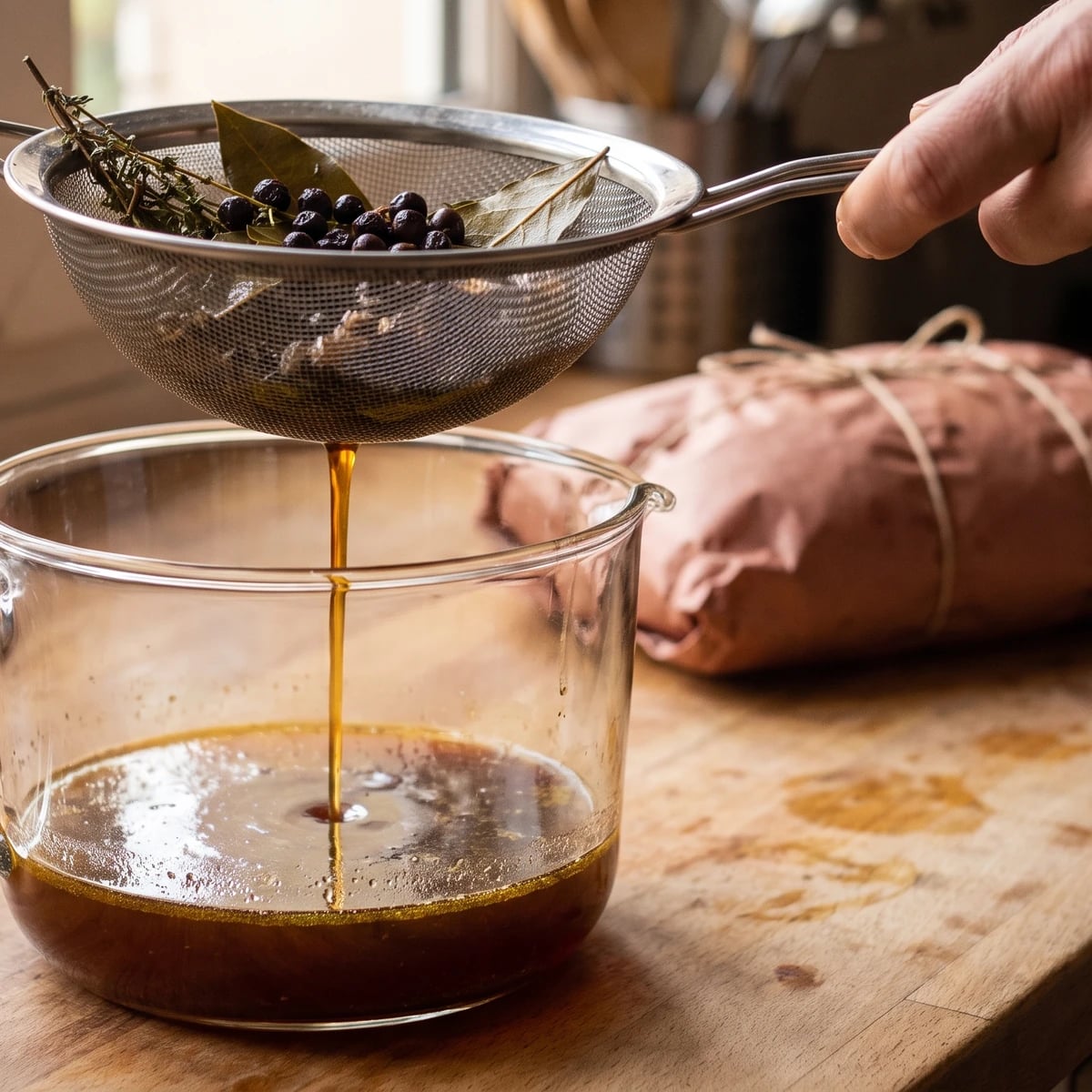
Pass the marinade through a fine-mesh strainer into a clean nonreactive container without pressing on the herbs or berries. Pressing clouds the liquid and can force out bitter juniper dust; if that happens, strain it again through damp muslin. Set the container in an ice bath and stir occasionally until completely cold, then cover and refrigerate below 40°F (4°C). Warm marinade must never meet raw mutton.
Place a 5 to 6 lb leg of mature mutton in a snug glass, glazed ceramic, stainless-steel, or food-safe plastic container and pour the cold marinade over it. Refrigerate for 24 to 48 hours, turning the meat morning and evening. If the liquid does not cover the meat, choose a smaller vessel rather than adding water, which would undo the concentration you built. Lift out the mutton, dry it thoroughly before browning or roasting, and discard marinade that has touched the raw meat. Reserve any portion intended for a later sauce before the meat goes in.
1 serving (about 120g)
Culinary guides, cultural storytelling, and the editorial depth that makes cooking meaningful.
Discover Culinary Explorer
Chef Juliette
The clear, sharp poaching liquor that teaches restraint: vegetables simmered gently with vinegar, then peppercorns held to the final twelve minutes so trout, salmon, and shellfish taste clean, never bitter.

Chef Juliette
A clear, wine-bright court-bouillon for freshwater fish, built on equal measures of white wine and water, thirty minutes of aromatic extraction, and one essential discipline: salt for the reduction you intend.

Chef Juliette
Court-bouillon au vin rouge is the brief, wine-dark poaching liquor for river fish: two parts excellent red wine, one part water, carrots and aromatics, simmered gently so the wine stays supple.

Chef Juliette
Cold fish, salted water, milk, and lemon rise together toward one quiet boil. Move the pan off heat at once, and whole turbot or brill finishes gently, pale, moist, and intact.