
Chef Juliette
John Dory (St. Pierre)
John Dory has the delicacy of sole and the firmness of turbot. A light flouring, a quick butter sauté, and nut-brown beurre noisette show exactly why looks never mattered.
A cooking platform built around craft, culture, and the stories behind what we eat.
Created by Chef Juliette
Based on No. 1218, Ris de Veau (Sweetbreads), from Le Guide Culinaire (1907) by Auguste Escoffier
Veal heart sweetbreads, soaked white, blanched gently, trimmed and pressed, then handed to the canonical braise, poach, or grill: the preparation that turns delicate offal into a poised main dish.
Ris de veau (veal sweetbreads) teaches that delicacy is built before the pan. The one true thing to know is this: the final cooking cannot repair careless preparation. Soak them until pale, blanch without violence, trim only when cold, and press them into an even shape. Do that well and the ris de veau will cook tender and compact, with none of the rubberiness that gives offal an undeserved reputation.
The old entry sends water running, then hands the final cooking to a kitchen with a saucier free to baste, a stockpot never off the fire, and a salamander ready to set a glaze. At home, use a cold bowl in the refrigerator with frequent water changes, two sheet pans and a few tins for the press, a small quantity of excellent prepared stock within the linked braise, and the broiler only when a linked presentation calls for glazing. The larding needle disappears entirely. The source itself concedes that bacon, tongue, and truffle studding improve neither quality nor appearance, so that is brigade scaffolding we can remove honestly. One cook, one stove, one evening.
What remains is the dish and must stay: the cold soak, the measured blanching, the careful trimming, and the full two-hour press. Protect the blanch above all. Bring the water up gently and give the sweetbreads ten quiet minutes, never a furious boil.
Ris de veau belongs less to one province than to France's classical dinner table, particularly the grand and bourgeois kitchens of Paris, where careful blanching and pressing turned a butcher's delicate gland into a prized course. The round heart sweetbread, also called the kernel, is not cardiac meat but the compact chest portion of the calf's thymus; the elongated throat portion is coarser and traditionally ranked below it. Larding and truffle studding traveled with formal service, yet the canon itself admits that neither improves the sweetbread, leaving exact preparation and cooking as the sounder measure of the dish.
Quantity
2 (about 1½ pounds / 680 g), for Blanchings (No. 273)
very white and free of blood stains
Quantity
As needed, about 8 quarts (7.6 L / 7.6 kg) over several changes
| Ingredient | Quantity |
|---|---|
| veal heart sweetbreadsvery white and free of blood stains | 2 (about 1½ pounds / 680 g), for Blanchings (No. 273) |
| cold water | As needed, about 8 quarts (7.6 L / 7.6 kg) over several changes |
| chosen final treatment | 1 complete preparation of Braising of White Meats (No. 248), Poachings (No. 249), or White-meat Grills (No. 259) |
Ask for two round kernel or heart sweetbreads, not the long, irregular throat portion. Put them in a nonreactive bowl, cover generously with cold water, and refrigerate for at least 2 hours, changing the water every 30 minutes. They should grow noticeably paler as the blood leaves them. A running tap was a professional convenience, not the heart of the technique; cold, frequently renewed water does the same work without warming the sweetbreads or wasting a river. If the final water remains pink, continue soaking in the refrigerator for up to overnight.
Put the soaked sweetbreads in a saucepan just large enough to hold them and cover them completely with fresh cold water. Carry out Blanchings (No. 273): bring the water gradually to the boil over medium-low heat, then hold it at a quiet boil for exactly 10 minutes. The purpose is to firm the surface for trimming, not to finish the cooking. If the water suddenly rolls hard, move the pan off the heat until it calms, then return it gently and complete only the remaining time. Ça se rattrape.
Lift the sweetbreads directly into a basin of fresh cold water and leave them until thoroughly cold, about 15 minutes. Drain and pat dry. Working with your fingers and the tip of a small knife, peel away the tough outer membrane, cartilage, thick veins, and heavy connective tissue while leaving the fine tissue that holds the lobules together. Cold sweetbreads trim cleanly; warm ones tear. If a lobe splits, nest the pieces back together rather than discarding them. Ça se rattrape: the press will restore a compact shape.
Lay the trimmed sweetbreads between two pieces of clean lint-free linen or two folded tea towels. Set them between two small sheet pans or flat plates, place a light 2 to 3 pound (900 g to 1.4 kg) weight on top, and refrigerate for 2 hours. The pressure evens their thickness and makes them hold together during the final cooking. More weight is not better; crush them and you force out the moisture you worked to preserve. Leave them unlarded and unstudded. The larding needle was ornament here, not necessity.
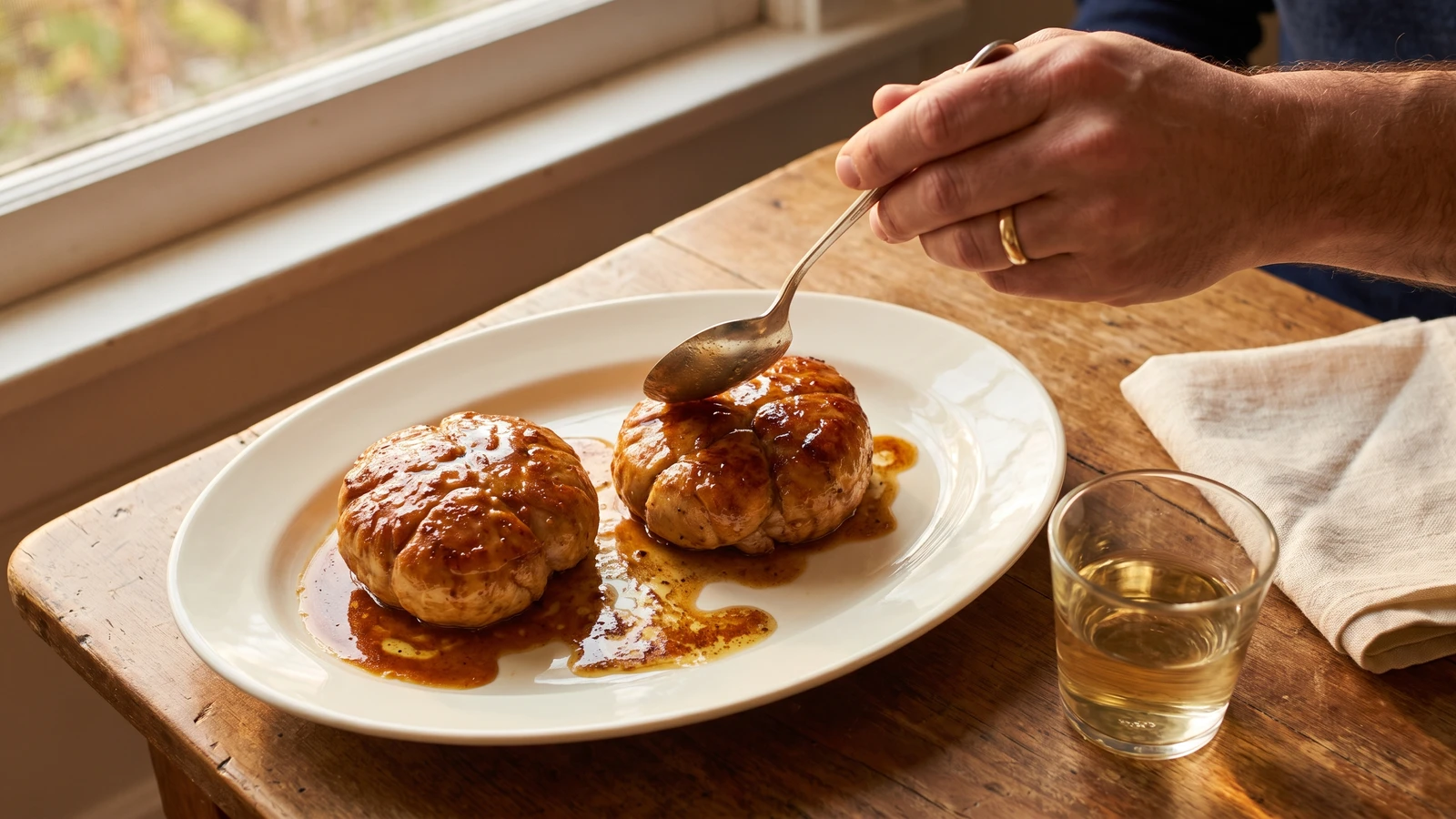
When pressed, hand the sweetbreads to exactly one of the book's linked final treatments. Choose Braising of White Meats (No. 248) for the glazed main dish pictured here, Poachings (No. 249) for the palest and most delicate result, or White-meat Grills (No. 259) for a firmer surface and deeper bronze. Follow the chosen preparation whole, including its cooking liquor, heat, and basting. These are alternatives, not successive steps; combining them only overcooks what should remain tender.
Complete the chosen final treatment and check the thickest sweetbread with an instant-read thermometer; it should reach 160°F (71°C), feel tender with a slight resilience, and release no pink or bloody liquid. For the braised version, bring the round kernels to the table whole with their glossy reduced cooking liquor spooned over and around them. Serve immediately, while the surface still gleams and the center remains delicate. À table!
1 serving (about 130g)
Culinary guides, cultural storytelling, and the editorial depth that makes cooking meaningful.
Discover Culinary ExplorerChef Juliette
John Dory has the delicacy of sole and the firmness of turbot. A light flouring, a quick butter sauté, and nut-brown beurre noisette show exactly why looks never mattered.

Chef Juliette
Fresh haddock proves its delicacy in the meunière pan: a fine flour crust, moist pearly flakes, and beurre noisette sharpened with lemon and parsley, ready from one skillet in half an hour.

Chef Juliette
Éperlans à l’Anglaise turns small fish into a lesson in disciplined coating: boned smelts under a close, crisp crumb, pan-fried in clarified butter and finished with bright, half-melted maître d’hôtel butter.

Chef Juliette
Tiny smelts, shallot, mushrooms, white wine, gratin sauce, and fine bread raspings meet a fierce oven, where the fish must turn tender in the same breath the buttered crust bronzes.