
Chef Lupita
Acitrón de Cidra Conventual
Puebla's convent-style acitrón, made from cidra peel instead of endangered biznaga, built through repeated syrup soakings until the cubes turn firm, translucent, and ready for rosca or chiles en nogada.
A cooking platform built around craft, culture, and the stories behind what we eat.
Created by
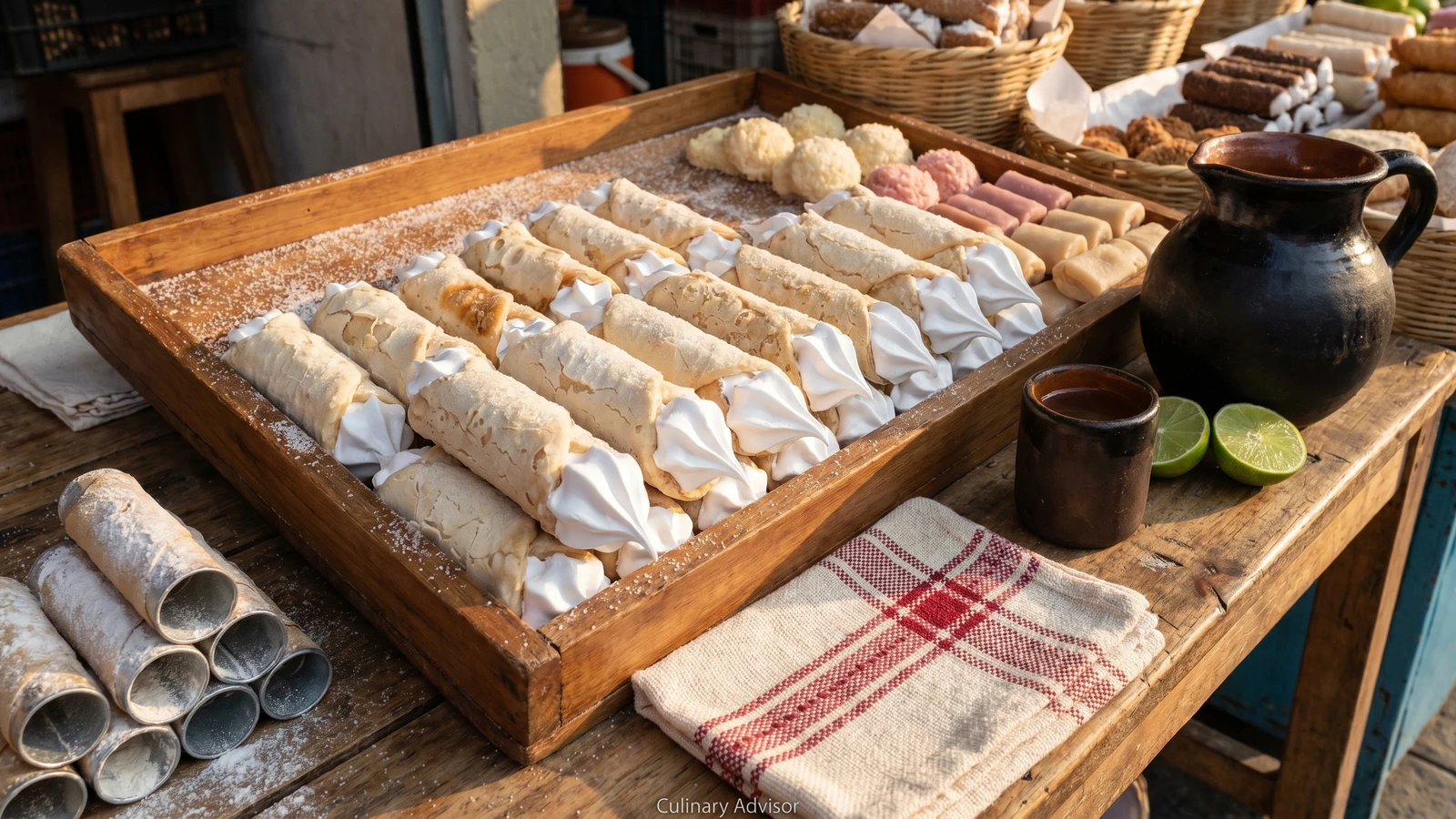
Villa de Etla's convent dessert from Oaxaca's Valles Centrales: fried wheat-paste cylinders, blistered and crackling, filled with stiff Italian meringue spiked with mezcal espadin.
Gaznates are from Villa de Etla, in Oaxaca's Valles Centrales, about a half hour north of the capital. Every Wednesday is market day in Etla and the dulceria stalls line up under the portales with trays of these pastel-white cylinders stacked next to the cocadas, the alfeniques, the jamoncillos, and the nicuatole. If you have not eaten one at the Etla market, you have not eaten one in its proper home.
The shell is wheat flour, lard, egg yolk, and mezcal, kneaded into a stiff dough, rolled thin enough to read through, wrapped around little tin tubes called canutos, and fried in lard until it blisters and crackles. The mezcal does the work. It cuts the gluten and evaporates in the fryer and leaves the shell with that characteristic shatter under the tooth. The filling is merengue italiano, stiff and glossy, sometimes flavored with mezcal espadin, sometimes with lime zest, sometimes only with vanilla. Every dulcera in Etla has her version. None of them agree.
This is a convent dessert, like so many of Oaxaca's confections. The nuns of the colonial period had wheat flour, eggs, sugar, and lard, and they had time, and they had the obligation to make sweets for festival days and for the families that supported the convents. What survives in the dulceria stalls today is a direct line back to that tradition. La cocina no es decoracion, es trabajo. A gaznate looks delicate. It is not. It is technique stacked on technique. Cada estado, su propia cocina, and this one belongs to Etla.
The gaznate, whose name derives from an old Spanish word for the throat or windpipe (a reference to the cylindrical shape), traces directly to the convent dulceria tradition that flourished across colonial Oaxaca beginning in the 17th century. Convents such as Santa Catalina de Siena and the Concepcionistas in the city of Oaxaca trained generations of indigenous and mestiza women in Iberian wheat pastry, who in turn carried the techniques out into village dulcerias when the convents were dissolved under the 19th-century Reform Laws. Villa de Etla, a Zapotec town with a long-established Wednesday tianguis, became one of the principal markets where this convent inheritance survived in vendor form, and the local custom of perfuming the dough and the filling with mezcal espadin from the surrounding palenques distinguishes the etlateco gaznate from the plainer versions sold in other Oaxacan markets.
Quantity
2 cups (260 grams), plus more for rolling
Quantity
1/4 teaspoon
Quantity
2 tablespoons
at room temperature
Quantity
2
Quantity
3 tablespoons
Quantity
3 to 4 tablespoons, as needed
Quantity
4 cups
Quantity
1 cup (200 grams)
Quantity
1/3 cup
Quantity
3
at room temperature
Quantity
1/4 teaspoon
Quantity
1 teaspoon, plus more to taste
Quantity
1/2 teaspoon
Quantity
from 1 lime
| Ingredient | Quantity |
|---|---|
| all-purpose wheat flour | 2 cups (260 grams), plus more for rolling |
| fine sea salt | 1/4 teaspoon |
| pork lard (manteca de cerdo)at room temperature | 2 tablespoons |
| large egg yolks | 2 |
| mezcal espadin (or aguardiente de cana) | 3 tablespoons |
| cold water | 3 to 4 tablespoons, as needed |
| pork lard or neutral oil for frying | 4 cups |
| granulated sugar | 1 cup (200 grams) |
| water (for syrup) | 1/3 cup |
| large egg whitesat room temperature | 3 |
| cream of tartar | 1/4 teaspoon |
| mezcal espadin (for the meringue) | 1 teaspoon, plus more to taste |
| Mexican vanilla extract | 1/2 teaspoon |
| finely grated lime zest (optional) | from 1 lime |
Whisk the flour and salt together in a wide bowl. Rub the lard into the flour with your fingertips until the mixture looks like coarse meal. Make a well in the center and add the egg yolks and the mezcal. Stir with a fork, drawing the flour into the wet ingredients. Add the cold water a tablespoon at a time, only as much as you need to bring the dough together. The dough should be firm and slightly stiff, never sticky. Wet dough fries soft and you want a gaznate that holds its shape.
Turn the dough onto a lightly floured surface and knead for eight to ten minutes. Real kneading. The dough goes from rough to smooth and elastic, the way pasta dough does. The mezcal cuts the gluten and gives the fried pastry that signature crackle. Wrap the dough tightly in plastic and rest for 30 minutes at room temperature. Resting is not optional. Skip it and the dough will spring back when you try to roll it.
You need metal tubes about 4 inches long and 3/4 inch in diameter to wrap the dough around. The dulceras of Etla use small tin canutos passed down through generations. At home, cut clean 4-inch lengths from the cardboard core of a roll of foil and wrap each tightly in two layers of aluminum foil, or use stainless steel cannoli forms. Lightly grease the outside of each tube with lard.
Divide the rested dough in half. Keep one half wrapped while you work the other. On a lightly floured surface, roll the dough as thin as you can manage without tearing it, about the thickness of a thick sheet of paper. The senoras at the dulceria stalls in Etla roll it until you can almost see the wood of the table through it. Cut into rectangles roughly 4 by 5 inches.
Wrap each rectangle around a greased tube on the diagonal, overlapping the dough slightly along the seam. Press the seam firmly with a wet fingertip to seal. The dough must close cleanly or the gaznate will unravel in the fryer. Set the wrapped tubes seam side down on a tray as you work. Repeat with the remaining dough.
Heat the lard in a heavy pot or cazuela to 350F (175C). Use a thermometer. Lard fries cleaner and crisper than oil and the flavor is correct for Oaxaca, but neutral oil will work if you must. La manteca es el sabor. Lower three or four wrapped tubes into the fat, seam side down first. Fry for 2 to 3 minutes, turning gently, until the dough is pale golden and blistered all over. Lift out with tongs and drain on a wire rack. While each one is still hot, slide the tube out by gripping it with a folded kitchen towel. The shell will be hollow, crackled, and rigid. Cool completely before filling.
Combine the sugar and water in a small heavy saucepan. Stir once to wet the sugar, then leave it alone. Bring to a boil over medium-high heat and cook without stirring until the syrup reaches the soft-ball stage, 240F (115C) on a candy thermometer. This takes about 7 to 9 minutes. Do not walk away. Sugar burns in the time it takes you to answer a phone.
While the syrup climbs the last few degrees, whip the egg whites with the cream of tartar in a clean, dry bowl on medium speed until soft peaks form. The moment the syrup hits 240F, raise the mixer to medium-high and pour the hot syrup down the inside wall of the bowl in a thin steady stream. Do not let the syrup hit the whisk or it will fling sugar threads everywhere. Once all the syrup is in, whip on high until the meringue is stiff, glossy, and the bowl is barely warm to the touch, about 7 minutes. This is merengue italiano. It must be stiff enough to hold a sharp peak. Soft meringue weeps inside the gaznate and ruins it.
Fold the mezcal, vanilla, and lime zest into the finished meringue with a clean spatula. Taste. The meringue should taste sweet and faintly smoky, with a clean lift from the citrus. Transfer to a piping bag fitted with a 1/2-inch round tip. Pipe the meringue into both ends of each cooled gaznate shell until the filling meets in the middle and just kisses the opening. Wipe the rim clean. Serve within an hour. The shells go soft if they sit filled. Asi se hace y punto.
1 serving (about 32g)
Culinary guides, cultural storytelling, and the editorial depth that makes cooking meaningful.
Discover Culinary ExplorerChef Lupita
Puebla's convent-style acitrón, made from cidra peel instead of endangered biznaga, built through repeated syrup soakings until the cubes turn firm, translucent, and ready for rosca or chiles en nogada.

Chef Lupita
Ciudad de México's Tulyehualco alegría is popped huautli folded into piloncillo honey, pressed with peanuts, pepitas, and raisins, then cut into the rectangular bars that built a pueblo's identity.

Chef Lupita
Oaxaca's pre-Columbian amaranth bar, popped on a hot comal and bound with piloncillo, honey, and the sacred Zapotec grain that the Spanish tried, and failed, to outlaw.

Chef Lupita
Querétaro's mercado candy of popped amaranto pressed with dark piloncillo syrup, pepitas, pecans, and cacahuate, a Bajío sweet that respects the seed before it decorates the table.