
Chef Lupita
Alegrías de Amaranto de Tulyehualco
Ciudad de México's Tulyehualco alegría is popped huautli folded into piloncillo honey, pressed with peanuts, pepitas, and raisins, then cut into the rectangular bars that built a pueblo's identity.
A cooking platform built around craft, culture, and the stories behind what we eat.
Created by
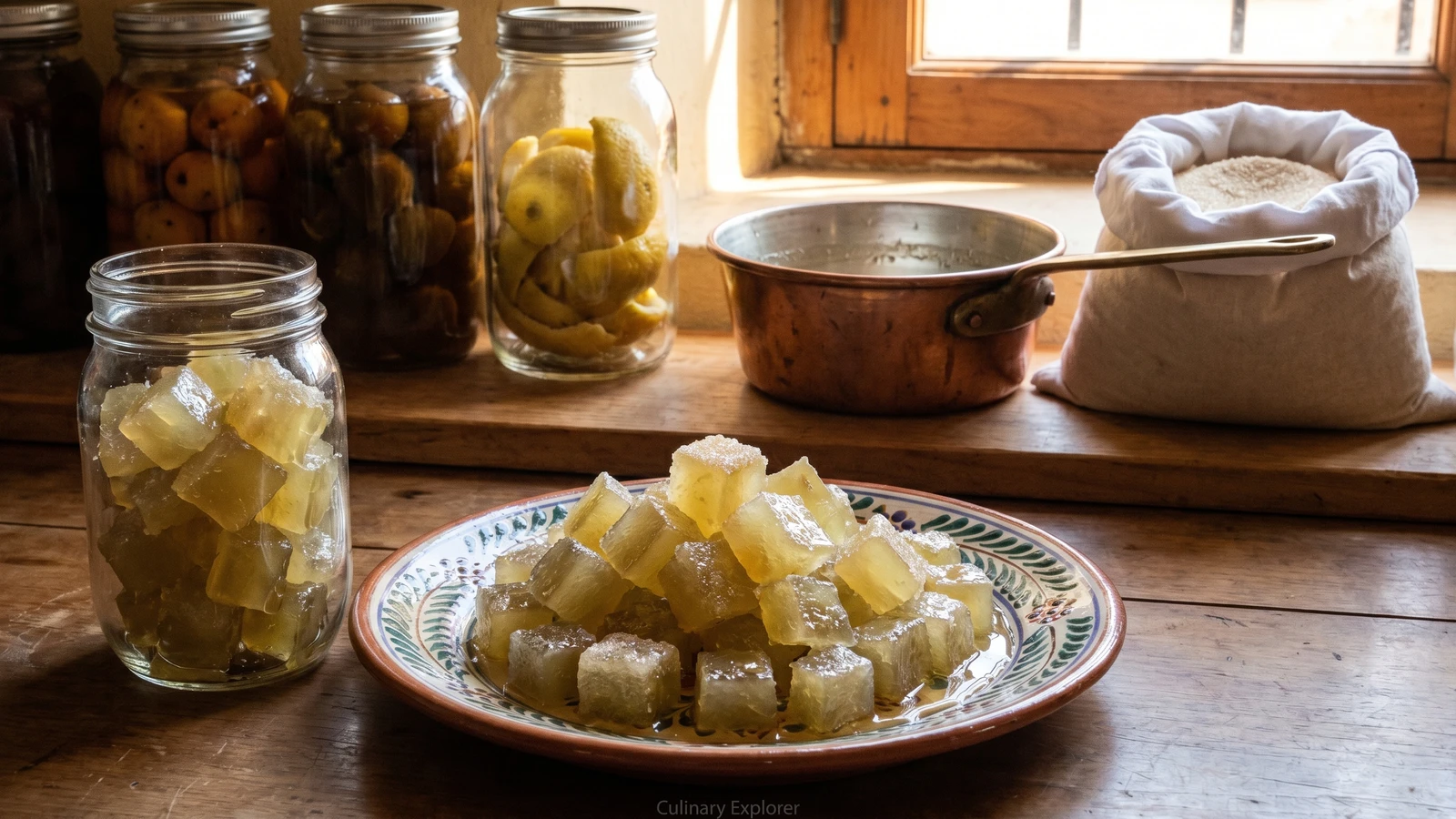
Puebla's convent-style acitrón, made from cidra peel instead of endangered biznaga, built through repeated syrup soakings until the cubes turn firm, translucent, and ready for rosca or chiles en nogada.
Puebla, in the Valle de Puebla, is where this acitrón belongs: the convent kitchens of Puebla de los Ángeles, the city of Santa Clara's sweets, Santa Rosa's sugar discipline, and Santa Mónica's feast-day memory. This is not biznaga. That cactus has been abused enough for roscas and picadillos. Here the fruit is cidra, citron, with thick white pith that drinks syrup slowly and turns translucent when the cook has patience.
The women who perfected this work were nuns and lay cooks behind convent walls, not pastry influencers arranging tiny cubes with tweezers. They worked with copper cazos, clay jars, cane sugar, orchard fruit, and time. The method is repeated soaking: bitter water first, limewater to firm the pith, blanching to tame the sharpness, then three syrup rests so the sugar enters the fruit without collapsing it. La paciencia es la regla del huerto. The fruit was the easy part. The technique made it last.
I place this on a Pueblan Talavera plate because the city should be visible before the first bite. Dice it small for chiles en nogada, cut it in batons for rosca de Reyes, or keep it in cubes for a convent sweet after dinner. Cada estado, su propia cocina. And in Puebla, sugar work is not decoration. It is architecture.
Acitrón entered New Spanish confectionery as candied cidra, citron peel preserved in sugar, a technique shaped by Arab-Andalusian sugar work and adopted by convent kitchens in Puebla de los Ángeles during the 17th and 18th centuries. The Clarisa nuns of the Convento de Santa Clara de Puebla are documented in the city's sweetmaking tradition for camotes and tortitas, while nearby convents such as Santa Rosa and Santa Mónica kept preserved fruits, ates, and sugarwork tied to feast days and gift economies. In the 20th century the word acitrón in Mexico became attached to candied biznaga, especially for rosca de Reyes and chiles en nogada, but overharvest of protected biznaga dulce makes cidra the older and cleaner path.
Quantity
2 large (about 2 pounds total)
scrubbed
Quantity
as needed
for soaking and blanching
Quantity
1 tablespoon
Quantity
1 tablespoon
for making clear limewater
Quantity
2 quarts
Quantity
5 cups
divided across three syrup soakings
Quantity
4 cups
Quantity
1 tablespoon
Quantity
1/4 teaspoon
Quantity
1/2 cup
for rolling if serving as candy, omit for chiles en nogada or rosca de Reyes
| Ingredient | Quantity |
|---|---|
| cidra or citronscrubbed | 2 large (about 2 pounds total) |
| cold waterfor soaking and blanching | as needed |
| kosher salt | 1 tablespoon |
| food-grade cal (pickling lime or calcium hydroxide)for making clear limewater | 1 tablespoon |
| cold water for limewater | 2 quarts |
| cane sugardivided across three syrup soakings | 5 cups |
| water for syrup | 4 cups |
| fresh lime juice | 1 tablespoon |
| fine sea salt | 1/4 teaspoon |
| extra cane sugar (optional)for rolling if serving as candy, omit for chiles en nogada or rosca de Reyes | 1/2 cup |
Quarter the cidras lengthwise. Remove the pulp and seeds, then pare away only the rough outer yellow skin if it is thick and bitter. Do not remove the white pith. The pith is the candy. Cut the peel and pith into 1/2-inch cubes for picadillo and rellenos, or into short batons if you want pieces for rosca de Reyes.
Put the cut cidra in a nonreactive bowl and cover with cold water by two inches. Stir in the kosher salt. Let it rest for 12 hours, changing the water once or twice if you can. The water will smell sharp and floral. That is the bitterness leaving. If you skip this, the finished acitrón will fight every dish it touches.
Stir the food-grade cal into 2 quarts cold water and let it settle for 15 minutes. Pour only the clear limewater over the drained cidra, leaving the chalky sediment behind. Soak for 6 hours, then drain and rinse the pieces under running water until the water runs clear. This is what gives the cubes their firm bite instead of a tired, mushy texture.
Move the rinsed cidra to a heavy pot and cover with fresh cold water. Bring to a gentle simmer and cook 10 minutes, then drain. Repeat this blanching two more times with fresh water each time. After the third blanch, the pieces should bend slightly without breaking and taste cleanly bitter, not harsh. If they still bite like medicine, blanch once more. No me vengas con atajos.
In a wide heavy pot or tinned copper cazo, combine 4 cups water, 2 cups of the cane sugar, the lime juice, and the sea salt. Warm over medium heat until the sugar dissolves. Add the blanched cidra and keep the syrup at the gentlest simmer for 45 minutes. The pieces should stay whole, with the edges beginning to look glassy.
Turn off the heat and press a round of parchment or a small clean plate over the cidra so every piece stays under the syrup. Cover the pot and let it rest 12 hours. This rest matters more than more boiling. Sugar needs time to enter the fruit. Force it with high heat and the outside candies while the center stays empty.
The next day, lift out the cidra with a slotted spoon. Stir 1 1/2 cups cane sugar into the syrup and warm until dissolved. Return the cidra and simmer gently for 30 to 40 minutes. The cubes will look more translucent at the edges and heavier in the spoon. Cover again and rest 12 hours. This is the second soaking. Three means three.
On the third day, add the remaining 1 1/2 cups cane sugar to the syrup and warm until dissolved. Simmer the cidra 45 to 60 minutes, turning the pieces carefully once or twice. They are ready when the centers are translucent, the syrup falls from a spoon in a slow thread, and the cubes feel firm between your fingers. If you use a thermometer, the syrup should sit around 220F to 222F. The fruit tells you first.
Let the cidra cool completely in the syrup, at least 8 hours. For acitrón to dice into chiles en nogada or rosca de Reyes, drain the pieces on a rack for 12 to 24 hours until tacky but not wet, then cut as needed. For candy to serve by itself, roll the tacky cubes lightly in extra cane sugar. For keeping, pack the pieces in clean glass jars with enough syrup to cover and refrigerate.
Dice small for chiles en nogada, because acitrón is punctuation, not the whole sentence. Fold batons into rosca de Reyes dough or set cubes beside queso fresco after a holiday meal. Save the clear cidra syrup for brushing rosca or sweetening aguas frescas. Recetas probadas y garantizadas.
1 serving (about 30g)
Culinary guides, cultural storytelling, and the editorial depth that makes cooking meaningful.
Discover Culinary ExplorerChef Lupita
Ciudad de México's Tulyehualco alegría is popped huautli folded into piloncillo honey, pressed with peanuts, pepitas, and raisins, then cut into the rectangular bars that built a pueblo's identity.

Chef Lupita
Oaxaca's pre-Columbian amaranth bar, popped on a hot comal and bound with piloncillo, honey, and the sacred Zapotec grain that the Spanish tried, and failed, to outlaw.

Chef Lupita
Querétaro's mercado candy of popped amaranto pressed with dark piloncillo syrup, pepitas, pecans, and cacahuate, a Bajío sweet that respects the seed before it decorates the table.

Chef Lupita
Guanajuato's Day of the Dead alfeñiques are cane-sugar figures pressed in dry molds, finished with bright icing, and set on Talavera guanajuatense platones for the altar.