
Chef Lupita
Arroz con Leche Capitalino
Ciudad de México's everyday arroz con leche, built with long-grain rice, whole milk, Mexican canela, citrus peel, and patience until the spoon leaves a slow trail through the pot.
A cooking platform built around craft, culture, and the stories behind what we eat.
Created by
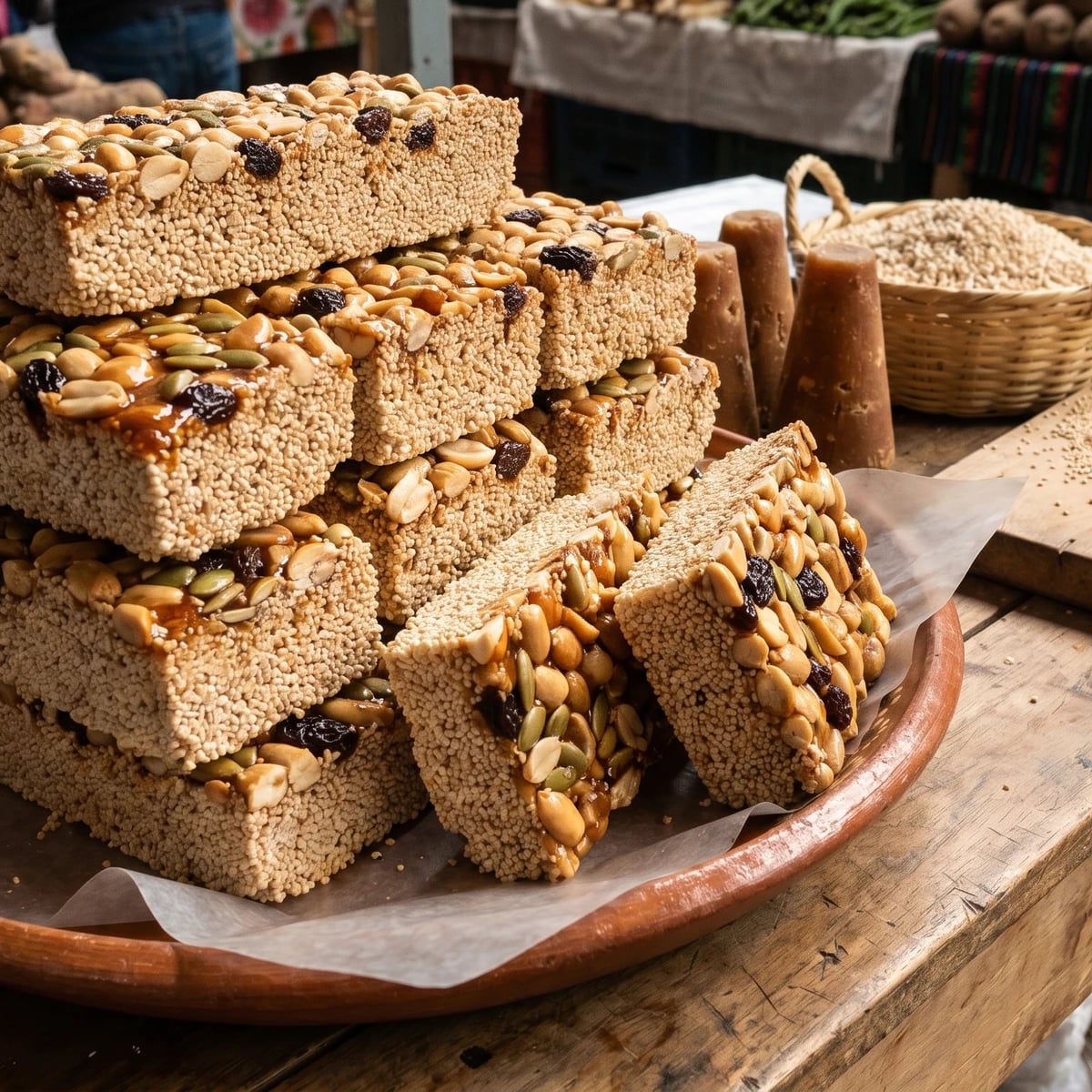
Ciudad de México's Tulyehualco alegría is popped huautli folded into piloncillo honey, pressed with peanuts, pepitas, and raisins, then cut into the rectangular bars that built a pueblo's identity.
Ciudad de México, alcaldía Xochimilco, pueblo de Santiago Tulyehualco. That is where this sweet lives, on the northern slopes of the Teuhtli volcano, where amaranth is not a health-store idea. It is huautli, a seed with memory, work, and a pueblo behind it.
The ingredient that defines the alegría is not sugar. It is amaranto reventado, popped amaranth, light as dry rain in the bowl. The piloncillo honey only binds it. If your syrup is weak, the bars fall apart. If your syrup is overcooked, they turn hard and bitter. The women in Tulyehualco's family workshops know the point by the thread that falls from the spoon. You will learn it the same way, by looking.
My mother kept a note for alegrías in the back of her notebook, three lines only: piloncillo, amaranto, press while hot. She did not write the panic that comes when the syrup is ready and your hands are too slow. That is the lesson. Have the pan prepared before the honey is done. La cocina no es decoración, es trabajo.
No chile here. No cinnamon. No chocolate costume for this version. Not all Mexican food needs heat to prove where it comes from. This is a 32-state cuisine, and this rectangle belongs to Tulyehualco. Cada estado, su propia cocina.
The Nahua word huauhtli referred to amaranth, and 16th-century sources describe tzoalli, a paste of amaranth, maize, and honey used to form edible ritual images in Mexica ceremonies. Santiago Tulyehualco, in Xochimilco on the northern slopes of the Teuhtli volcano, preserved amaranth cultivation and confectionery as family work; the Feria de la Alegría y el Olivo has been held there since 1971. On September 2, 2016, the Government of Mexico City declared the Alegría de Tulyehualco part of the city's intangible cultural heritage.
Quantity
8 cups
picked over for hard unpopped seeds
Quantity
9 ounces
chopped or grated
Quantity
1/3 cup
Quantity
2 tablespoons
Quantity
1 teaspoon
Quantity
1/4 teaspoon
Quantity
1/2 cup
roughly chopped
Quantity
1/3 cup
Quantity
1/3 cup
Quantity
1 teaspoon
for greasing the pan and knife
| Ingredient | Quantity |
|---|---|
| amaranto reventado (popped amaranth)picked over for hard unpopped seeds | 8 cups |
| piloncillochopped or grated | 9 ounces |
| water | 1/3 cup |
| Mexican multifloral honey | 2 tablespoons |
| fresh lime juice | 1 teaspoon |
| fine sea salt | 1/4 teaspoon |
| roasted unsalted peanutsroughly chopped | 1/2 cup |
| toasted pepitas | 1/3 cup |
| raisins | 1/3 cup |
| neutral oilfor greasing the pan and knife | 1 teaspoon |
Lightly oil a 9 by 13 inch metal pan or shallow wooden frame and line it with parchment or waxed paper. Oil the paper lightly too. Mix the peanuts, pepitas, and raisins in a small bowl, then scatter about one-third of them across the bottom of the pan. Have the popped amaranth waiting in a very large bowl. Once the piloncillo syrup is ready, you will not have time to go looking for a pan.
Run your fingers through the amaranto reventado and remove any hard, dark, unpopped seeds. If the amaranth smells stale, warm it in a dry skillet over low heat for two minutes, stirring constantly, just until it smells nutty again. Do not brown it. Popped amaranth burns fast because it is almost weightless.
Put the chopped piloncillo, water, honey, lime juice, and salt in a heavy saucepan. Cook over medium heat, stirring until the piloncillo dissolves. Once it dissolves, stop stirring and let it boil steadily until it reaches 238 to 240F on a candy thermometer. Without a thermometer, drop a little syrup into cold water. It should gather into a soft ball you can pinch between your fingers. That is the point. Not watery. Not burned. Así se hace y punto.
Immediately pour the hot piloncillo honey over the amaranth. Stir with a strong wooden spoon, folding from the bottom up, until every seed has a light amber shine. Work quickly but do not crush the amaranth. Add half of the remaining peanuts, pepitas, and raisins while mixing so the fruit and seeds land throughout the bar, not only on top.
Scrape the mixture into the prepared pan. Cover with a second sheet of lightly oiled parchment and press hard with a flat board, the bottom of another pan, or an oiled rolling pin. Sprinkle the remaining peanuts, pepitas, and raisins over the top, cover again, and press once more. Pressing is not decoration. It is what makes the alegría hold together when you cut it.
Let the slab rest at room temperature for 90 minutes, until firm and dry to the touch. Lift it from the pan and cut into 16 rectangles with a lightly oiled knife. Wipe and oil the knife between cuts if the piloncillo pulls. The bars should be firm enough to hold in your hand, with a clean chew from the honey and a toasted snap from the amaranth.
Wrap the alegrías in waxed paper or cellophane once completely cool. Keep them in an airtight container at room temperature for up to one week. Humidity is the enemy. Tulyehualco producers know this because one damp day can undo a good batch. Recetas probadas y garantizadas, but only if you respect the weather.
1 serving (about 47g)
Culinary guides, cultural storytelling, and the editorial depth that makes cooking meaningful.
Discover Culinary Explorer
Chef Lupita
Ciudad de México's everyday arroz con leche, built with long-grain rice, whole milk, Mexican canela, citrus peel, and patience until the spoon leaves a slow trail through the pot.

Chef Lupita
Puebla's little drunks are tender cornstarch-and-sugar candies perfumed with rompope or fruit liqueur, cut small, rolled in sugar, and served on Talavera when the house is celebrating.

Chef Lupita
Puebla's soft sweet potato candy, cooked down with cane sugar and fruit essence, hand-rolled into logs, and finished with the thin sugar crust of the city's old convent sweets.

Chef Lupita
Jalisco's capirotada de agua layers dry bolillo with piloncillo syrup, cinnamon, clove, raisins, peanuts, and salty aged cheese, the Lenten dessert that belongs to Friday kitchens.