
Chef Lupita
Acitrón de Cidra Conventual
Puebla's convent-style acitrón, made from cidra peel instead of endangered biznaga, built through repeated syrup soakings until the cubes turn firm, translucent, and ready for rosca or chiles en nogada.
A cooking platform built around craft, culture, and the stories behind what we eat.
Created by
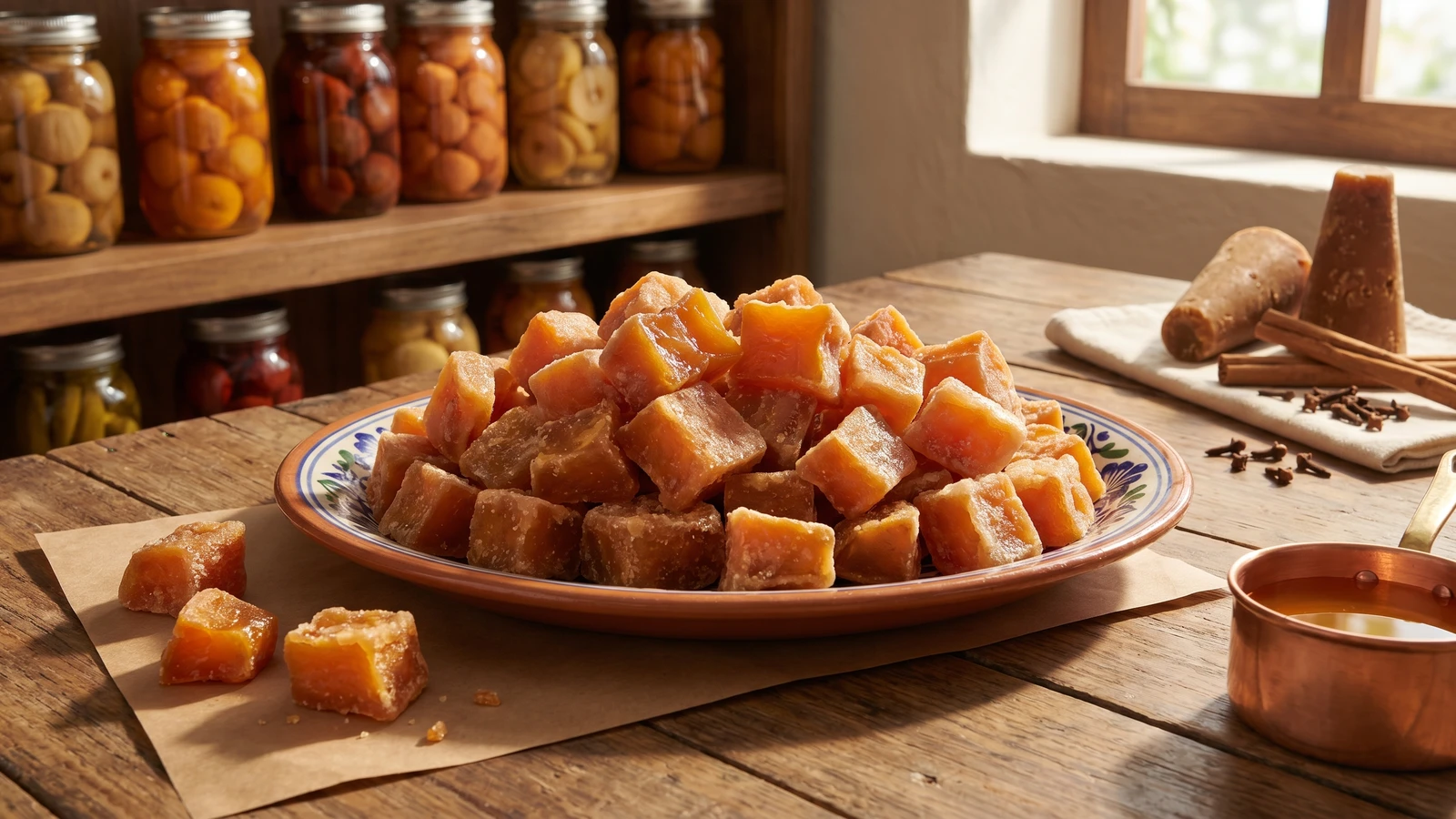
Puebla's convent sweet of camote, cooked by the old cristalizado method: lime-firmed sweet potato, repeated syrup baths, and the patience of a despensa built for winter.
Puebla, the Angelopolis, is where this camote belongs. Not the orange paste wrapped in wax paper, though that also carries Santa Clara's name, but the older huerto logic: take what the convent garden gives you, preserve it in sugar, and make it last beyond the harvest.
At the Convento de Santa Clara de Puebla, the Clarisas worked sugar the way other cooks work chile. They understood stages, density, rest, and repetition. Camote has soft flesh, so you do not throw it into syrup and hope. You firm it first in cal, rinse it clean, simmer it gently, then give it three syrup soakings until the cubes turn amber and translucent at the edges. La paciencia es la regla del huerto.
This sweet sits on Talavera, not in a boutique box. The pieces should be generous, irregular, and lightly crusted with sugar, the inside tender but not collapsing. If you rush the syrup, the outside hardens and the center stays dull. No me vengas con atajos. The fruit was cheap. The technique made it valuable.
Camote sweets are closely tied to Puebla's convent kitchens, especially the Convento de Santa Clara, founded in the early 17th century, where nuns developed and sold preserves, candies, and molded sweets to support their communities. Sugar preservation expanded in colonial Mexico after cane cultivation grew in Puebla, Morelos, and Veracruz, joining Indigenous roots such as camote with Spanish and conventual preserving methods. The famous camote poblano in wax paper became a 19th-century commercial emblem of the city, but cristalizado keeps the older preserved-harvest grammar of repeated syrup soakings and slow drying.
Quantity
2 pounds
peeled and cut into 1-inch cubes
Quantity
2 teaspoons
for firming
Quantity
8 cups
for the cal soak
Quantity
4 cups
divided for three syrup soakings
Quantity
3 cups
for the syrup
Quantity
1 small stick
Quantity
2
Quantity
1 strip
pith removed
Quantity
1 tablespoon
Quantity
1/2 cup
for finishing
| Ingredient | Quantity |
|---|---|
| orange or white-fleshed Mexican sweet potatoespeeled and cut into 1-inch cubes | 2 pounds |
| food-grade calcium hydroxide (cal)for firming | 2 teaspoons |
| cold waterfor the cal soak | 8 cups |
| granulated cane sugardivided for three syrup soakings | 4 cups |
| waterfor the syrup | 3 cups |
| Mexican canela | 1 small stick |
| whole cloves | 2 |
| fresh lime peelpith removed | 1 strip |
| fresh lime juice | 1 tablespoon |
| granulated cane sugarfor finishing | 1/2 cup |
Dissolve the cal in 8 cups cold water in a nonreactive bowl. Add the camote cubes and soak for 2 hours, stirring once halfway through. The cal firms the surface so the pieces can survive long syrup cooking without turning into puree. This is preservation work, not a fruit salad.
Drain the camote and rinse under cold running water until the water runs clear and the pieces no longer feel slippery. Soak them in fresh cold water for 10 minutes, then drain again. Cal did its job. Now it leaves. Así se hace y punto.
Combine 3 cups water, 2 cups sugar, the canela, cloves, lime peel, and lime juice in a wide heavy pot or copper cazo. Bring to a gentle simmer and stir only until the sugar dissolves. The syrup should look clear and smell of canela, not caramel. For cristalizado, refined cane sugar is correct because the goal is translucency. Piloncillo belongs to tacha and almibar oscuro, not this Pueblan candy.
Add the drained camote cubes to the syrup in one layer if possible. Simmer gently for 35 to 45 minutes, turning the pieces with a spoon so every side meets the syrup. Do not boil hard. A hard boil breaks the corners and clouds the syrup. The cubes are ready for their first rest when the edges look slightly glassy but the centers are still matte.
Turn off the heat. Cover the pot and let the camote rest in the syrup at room temperature for 8 to 12 hours. This rest is not empty time. The syrup moves slowly into the flesh while the pieces cool. That is how the convent kitchens got preservation without machinery.
Lift the camote out with a slotted spoon and set it on a tray. Add 1 cup sugar to the syrup and bring it back to a gentle simmer. When the sugar dissolves, return the camote to the pot and simmer 25 to 30 minutes. The syrup will cling more heavily now, and the cubes will turn deeper amber at the corners.
Turn off the heat, cover, and rest the camote in the syrup for another 6 to 8 hours. Do not refrigerate it unless your kitchen is very hot. Cold slows the absorption and makes the sugar seize on the surface before the center has taken enough syrup.
Lift the camote out again. Add the final 1 cup sugar to the syrup and simmer until dissolved. Return the camote and cook 20 to 30 minutes more, until the pieces look translucent at the edges and glossy all over. If you cut one open, the center should be tender and stained with syrup, not pale and dry.
Set a wire rack over a tray. Lift the camote from the syrup and let the pieces drain for 1 hour. Roll them lightly in the remaining 1/2 cup sugar, then return them to the rack for 3 to 4 hours, until the surface feels dry and lightly crusted. Save the syrup. It is good over arroz con leche or to brush a pan de yema.
1 serving (about 75g)
Culinary guides, cultural storytelling, and the editorial depth that makes cooking meaningful.
Discover Culinary ExplorerChef Lupita
Puebla's convent-style acitrón, made from cidra peel instead of endangered biznaga, built through repeated syrup soakings until the cubes turn firm, translucent, and ready for rosca or chiles en nogada.

Chef Lupita
Ciudad de México's Tulyehualco alegría is popped huautli folded into piloncillo honey, pressed with peanuts, pepitas, and raisins, then cut into the rectangular bars that built a pueblo's identity.

Chef Lupita
Oaxaca's pre-Columbian amaranth bar, popped on a hot comal and bound with piloncillo, honey, and the sacred Zapotec grain that the Spanish tried, and failed, to outlaw.

Chef Lupita
Querétaro's mercado candy of popped amaranto pressed with dark piloncillo syrup, pepitas, pecans, and cacahuate, a Bajío sweet that respects the seed before it decorates the table.