
Chef Lupita
Acitrón de Cidra Conventual
Puebla's convent-style acitrón, made from cidra peel instead of endangered biznaga, built through repeated syrup soakings until the cubes turn firm, translucent, and ready for rosca or chiles en nogada.
A cooking platform built around craft, culture, and the stories behind what we eat.
Created by
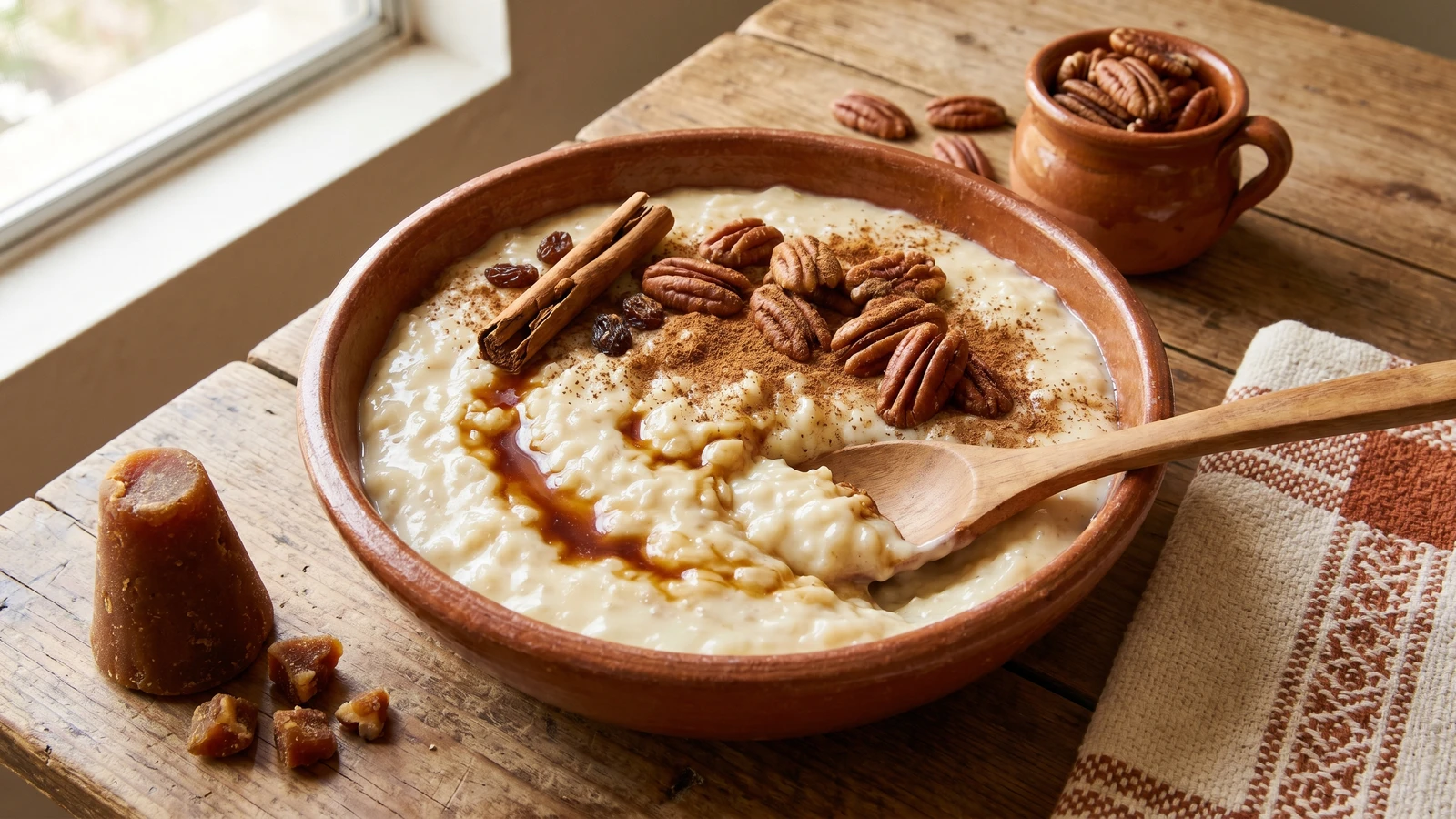
Northern Mexico's rice pudding, slow-simmered with piloncillo and canela then crowned with butter-toasted Sonoran pecans. Richer than the central version and built for ranch tables and long cold mornings.
This is arroz con leche from the north. From Sonora, Chihuahua, Coahuila, the ranch country where dairy is plentiful and pecans grow in long rows beside the irrigation canals. The central Mexican version is lighter, thinner, often made with water and a touch of milk. The norteño version is something else. It uses whole milk, evaporated milk, and a finish of egg yolks and condensed milk that gives it the body of a custard. It is a dessert that came up in a region where cattle and dairy shaped the kitchen, and you can taste that history in every spoonful.
The pecans are the signature. Sonora and Chihuahua produce most of Mexico's pecans, and the nogales grow along the rivers in long disciplined groves. A norteña abuela does not finish her arroz con leche with almonds or with nothing. She finishes it with the nuez from her own state, toasted in butter with a pinch of canela, piled generously on top. Cada estado, su propia cocina, and the north claims this dish with the pecan.
My mother was from Jalisco and her arroz con leche was the central style: thinner, perfumed with lime peel, finished with raisins. I learned the norteño version in Hermosillo from a woman named Doña Esperanza who ran a fonda across from the cathedral. She made it in a stockpot the size of a washbasin every morning and sold it in clay cups by the cathedral steps. She told me the secret was the yolks and the patience. No me vengas con atajos. Saber cocinar es saber vivir, and a pot of arroz con leche made right will teach you both.
Arroz con leche traveled to Mexico with the Spanish, who themselves inherited it from the Moorish kitchens of Al-Andalus, where the original arroz con leche, arroz con leche moruno, was perfumed with rose water and cinnamon as early as the 13th century. The dish was naturalized across all of Latin America but took distinct regional forms within Mexico: the central version stays lighter and is often eaten as a street-vendor cup with cinnamon and raisins, while the northern version absorbed the dairy abundance and pecan production of states like Chihuahua and Sonora, becoming richer and nuttier. Mexico is the world's second-largest pecan producer after the United States, with Chihuahua alone accounting for over 70 percent of national output, a fact that shaped norteño dessert culture far more than most national-cookbook treatments acknowledge.
Quantity
1 cup
Quantity
3 cups
Quantity
2 sticks, about 4 inches each
Quantity
1 strip
no white pith
Quantity
1 pinch
Quantity
4 cups
Quantity
1 can (12 ounces)
Quantity
1 cone (about 8 ounces)
chopped, or 1 cup dark brown sugar as compromise
Quantity
1
split and scraped, or 1 tablespoon Mexican vanilla extract
Quantity
3
Quantity
1/2 cup
Quantity
1 cup
halves or large pieces
Quantity
1 tablespoon
Quantity
1 pinch
Quantity
for dusting
Quantity
for serving
| Ingredient | Quantity |
|---|---|
| long-grain white rice | 1 cup |
| water | 3 cups |
| Mexican canela (true cinnamon, Ceylon) | 2 sticks, about 4 inches each |
| lime peelno white pith | 1 strip |
| kosher salt | 1 pinch |
| whole milk | 4 cups |
| evaporated milk | 1 can (12 ounces) |
| piloncillochopped, or 1 cup dark brown sugar as compromise | 1 cone (about 8 ounces) |
| vanilla beansplit and scraped, or 1 tablespoon Mexican vanilla extract | 1 |
| large egg yolks | 3 |
| sweetened condensed milk | 1/2 cup |
| pecans from Sonora or Chihuahuahalves or large pieces | 1 cup |
| unsalted butter | 1 tablespoon |
| ground canela (for the pecans) | 1 pinch |
| ground canela (optional) | for dusting |
| raisins (optional) | for serving |
Rinse the rice under cold water until the water runs almost clear. Drain. In a heavy 4-quart pot, combine the rice, the 3 cups of water, the canela sticks, the strip of lime peel, and the pinch of salt. Bring to a boil over medium-high heat, then drop to a low simmer. Cook uncovered for about 18 minutes, until the rice is tender and almost all the water is gone. You are not making rice. You are softening the grain so it surrenders when the milk goes in.
Pour in the whole milk, the evaporated milk, the chopped piloncillo, and the scraped vanilla bean with its seeds. If you are using extract, hold it back for now. Stir gently with a wooden spoon to dissolve the piloncillo. Bring the pot to a bare simmer over medium heat. Never let it boil. Boiled milk scorches at the bottom and the whole pot tastes burned.
Cook at the lowest simmer that still moves the milk, partially covered, for 35 to 45 minutes. Stir every three or four minutes with a wooden spoon, scraping the bottom each time. The mixture will thicken slowly as the rice releases its starch and the milk reduces. You want a loose, creamy consistency, not a stiff porridge. It tightens as it cools, so pull it off the heat while it still moves easily off the spoon.
While the arroz simmers, melt the butter in a small skillet over medium-low heat. Add the pecans and a pinch of ground canela. Toast for 4 to 6 minutes, stirring constantly, until the pecans smell sweet and nutty and turn a shade darker. Sonora and Chihuahua are pecan country. The nuts from there are sweet and oily, and toasting them in butter pulls that oil to the surface. Pull them off the heat the moment they smell done. Burned pecans turn bitter and there is no recovering them.
In a small bowl, whisk the egg yolks with the sweetened condensed milk until smooth. When the rice mixture is thick and creamy, ladle about one cup of the hot milk into the yolks in a slow stream, whisking constantly. This warms the yolks without scrambling them. Pour the tempered mixture back into the pot, stirring as you go. Cook for two more minutes over very low heat, stirring without stopping. The yolks give this northern version the body and color that sets it apart from the lighter central Mexican arroz con leche. Asi se hace y punto.
Remove from the heat. Fish out the canela sticks, the lime peel, and the spent vanilla pod. If you used vanilla extract instead of a bean, stir it in now. Taste for sweetness. Piloncillo varies cone to cone, so add a little more chopped piloncillo melted into a splash of hot water if it needs lift. Let the arroz rest for 10 minutes off the heat. It will thicken as it sits.
Ladle into clay bowls or wide ceramic cups. Crown each serving with the toasted pecans and a heavy dusting of ground canela. Raisins on the side for those who want them, not stirred in. Northern households serve this warm in winter and cold in summer, both from the same pot. The cold version sets a little, the warm version is looser. Both are correct.
1 serving (about 200g)
Culinary guides, cultural storytelling, and the editorial depth that makes cooking meaningful.
Discover Culinary ExplorerChef Lupita
Puebla's convent-style acitrón, made from cidra peel instead of endangered biznaga, built through repeated syrup soakings until the cubes turn firm, translucent, and ready for rosca or chiles en nogada.

Chef Lupita
Ciudad de México's Tulyehualco alegría is popped huautli folded into piloncillo honey, pressed with peanuts, pepitas, and raisins, then cut into the rectangular bars that built a pueblo's identity.

Chef Lupita
Oaxaca's pre-Columbian amaranth bar, popped on a hot comal and bound with piloncillo, honey, and the sacred Zapotec grain that the Spanish tried, and failed, to outlaw.

Chef Lupita
Querétaro's mercado candy of popped amaranto pressed with dark piloncillo syrup, pepitas, pecans, and cacahuate, a Bajío sweet that respects the seed before it decorates the table.