
Chef Juliette
Smelt (Éperlans)
Tiny éperlans, lightly floured and fried until their tails stand crisp, arrive in a generous heap on a napkin with fried parsley and grooved lemon, a weeknight lesson in heat and restraint.
A cooking platform built around craft, culture, and the stories behind what we eat.
Created by Chef Juliette
Based on No. 999, Caisses de Laitances à la Nantua, from Le Guide Culinaire (1907) by Auguste Escoffier
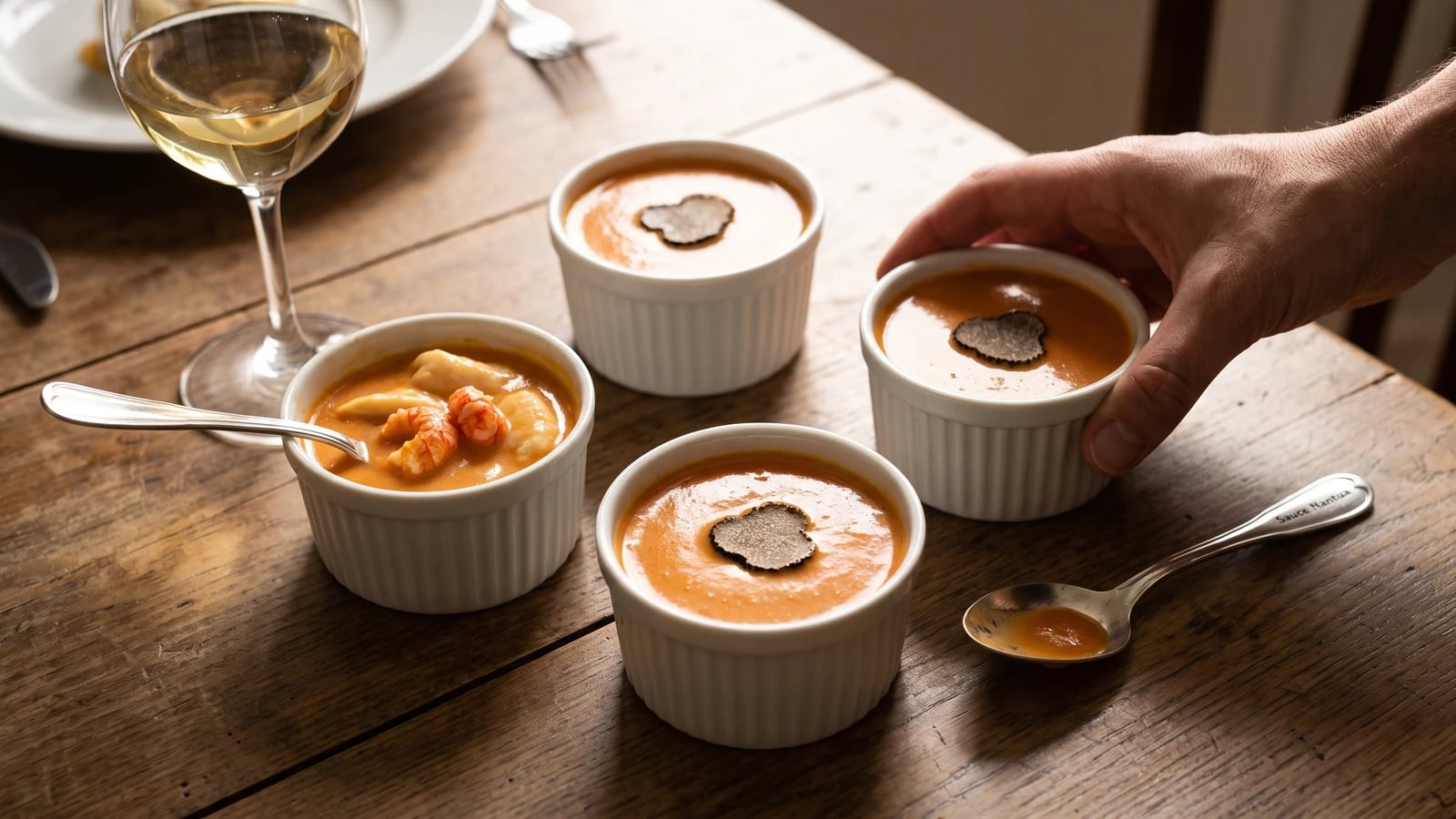
A lesson in classical assembly: tender poached carp milt and crayfish tails held in little porcelain cases, blanketed with glossy Sauce Nantua, then finished with one translucent slice of black truffle.
Caisses de Laitances à la Nantua (pleated cases of poached fish milt with crayfish sauce) teaches a severe little lesson: when a dish bears a sauce's name, that sauce carries the whole argument. The one true thing to know before touching a pan is that Sauce Nantua must taste unmistakably of crayfish butter. If it tastes merely of cream, the dish has lost its name.
The original entry assumed a saucier with the finished sauce ready, the house's sauce foundations always within reach, cooked crayfish waiting, and a cupboard of tiny pleated porcelain cases. Your home equivalent is four fluted ramekins, a separately prepared Sauce Nantua warmed gently, and exactly eight tails. A salamander has no work here because the cases are filled, not gratinéed. The brigade's separate station work is scaffolding and may happen ahead; the careful poach, two tails in every case, the sauce, and the fine truffle crown are the dish and must stay. Only the vessel and scale change. Four guests need four cases, not a service tray. One cook, one stove, one evening.
Finished correctly, each caisse is generous rather than fussy: tender ivory slices beneath a gleaming coral-ivory sauce, with sweet crayfish and the dark perfume of truffle at the center. Before you begin, remember the step that decides it: warm the Sauce Nantua gently enough that its crayfish butter stays in the sauce, not as orange beads on top.
The name à la Nantua belongs to Nantua in the Ain department, where the lakes and rivers of the Bugey supplied crayfish that local cooks worked into intensely flavored butter. In the classical vocabulary, Sauce Nantua means a sauce finished decisively with that crayfish butter, often accompanied by crayfish tails, rather than any pale cream sauce served with seafood. Caisses de laitances carried the regional signature into grand dining rooms by enclosing delicate poached milt and tails in individual porcelain cases, then crowning each with truffle.
Quantity
6 cups (1.4 L / 1.4 kg)
Quantity
1 tablespoon (15 ml / 18 g)
Quantity
8 oz / 225 g
membranes clean and unbroken
Quantity
8 medium tails (about 2 oz / 60 g)
peeled and unseasoned
Quantity
1½ cups (360 ml / about 370 g)
Quantity
1 (about 6 g)
cut into 4 very fine slices
| Ingredient | Quantity |
|---|---|
| water | 6 cups (1.4 L / 1.4 kg) |
| fine sea salt | 1 tablespoon (15 ml / 18 g) |
| intact carp milt (soft roe)membranes clean and unbroken | 8 oz / 225 g |
| cooked crayfish tailspeeled and unseasoned | 8 medium tails (about 2 oz / 60 g) |
| prepared Sauce Nantua made with real crayfish butter | 1½ cups (360 ml / about 370 g) |
| small black trufflecut into 4 very fine slices | 1 (about 6 g) |
Set four small fluted porcelain cases or ramekins on a tray. Fill them with hot tap water so the porcelain loses its chill, then leave them to stand while you poach the milt. Lay out the crayfish tails and truffle slices now. Once the sauce is warm, assembly must be immediate.
Combine the water and salt in a wide saucepan and bring it to a boil, then lower the heat until the surface barely trembles. Ease in the intact milt and poach for 6 to 8 minutes, turning it once with a spoon, until uniformly opaque and firm but still yielding; the thickest piece should reach 145°F (63°C). Never let the pieces tumble in a hard boil, which tears their membranes and turns the texture grainy. If the water begins boiling hard, pull the pan from the heat immediately and add a small splash of cool water before returning it to the gentlest flame.
Lift the milt out with a slotted spoon and drain it on a clean folded towel for 5 minutes. Cut it crosswise into compact, stout slices about ½ inch (1.25 cm) thick. The source asks for substantial little pieces rather than thin wafers, because the milt must remain recognizable beneath the sauce. Use a very sharp knife and a single drawing stroke so the fragile slices keep their shape.
Put the prepared Sauce Nantua in a small heavy saucepan and warm it over the lowest heat, stirring slowly around the bottom and corners. It is ready when glossy, fragrant with crayfish butter, and fluid enough to nappe, or coat, the back of a spoon. Do not boil it. If orange butter begins gathering in beads, remove the pan from the heat and whisk in 1 teaspoon of cold water until the sauce becomes smooth again. Ça se rattrape. If it is simply too thick, loosen it with hot poaching water, 1 teaspoon at a time.
Empty and dry the warmed porcelain cases. Divide the sliced milt among them without pressing it down, then place exactly two cooked crayfish tails in each case, preserving the source's proportion. Spoon in the warm Sauce Nantua until the contents are covered and the sauce reaches just below each rim. Work gently so the slices remain whole and the sauce stays glossy.
Lay one very fine truffle slice over the center of each caisse. Give the warmth of the sauce half a minute to release the truffle's perfume, then carry the cases directly to the table. Do not broil them and do not add another garnish. The truffle is the crown, the Sauce Nantua is the point. À table!
1 serving (about 165g)
Culinary guides, cultural storytelling, and the editorial depth that makes cooking meaningful.
Discover Culinary ExplorerChef Juliette
Tiny éperlans, lightly floured and fried until their tails stand crisp, arrive in a generous heap on a napkin with fried parsley and grooved lemon, a weeknight lesson in heat and restraint.

Chef Juliette
Brandade de Morue turns salt cod, warm olive oil, and milk into a pale, silky emulsion: keep everything warm and add the oil slowly, then crown the generous dome with butter-fried bread.

Chef Juliette
Salt cod worked warm with cream, one patient spoonful at a time, until the rough flakes become a glossy Nîmes paste, domed generously and ringed with butter-fried croutons for the table.

Chef Juliette
Wine-poached char packed in its earthenware crock beneath butter gold: a make-ahead first course that turns careful cooling, thorough boning, and one unbroken seal into quiet abundance.