
Chef Juliette
John Dory (St. Pierre)
John Dory has the delicacy of sole and the firmness of turbot. A light flouring, a quick butter sauté, and nut-brown beurre noisette show exactly why looks never mattered.
A cooking platform built around craft, culture, and the stories behind what we eat.
Created by Chef Juliette
Based on No. 992, Cabillaud Frit, from Le Guide Culinaire (1907) by Auguste Escoffier
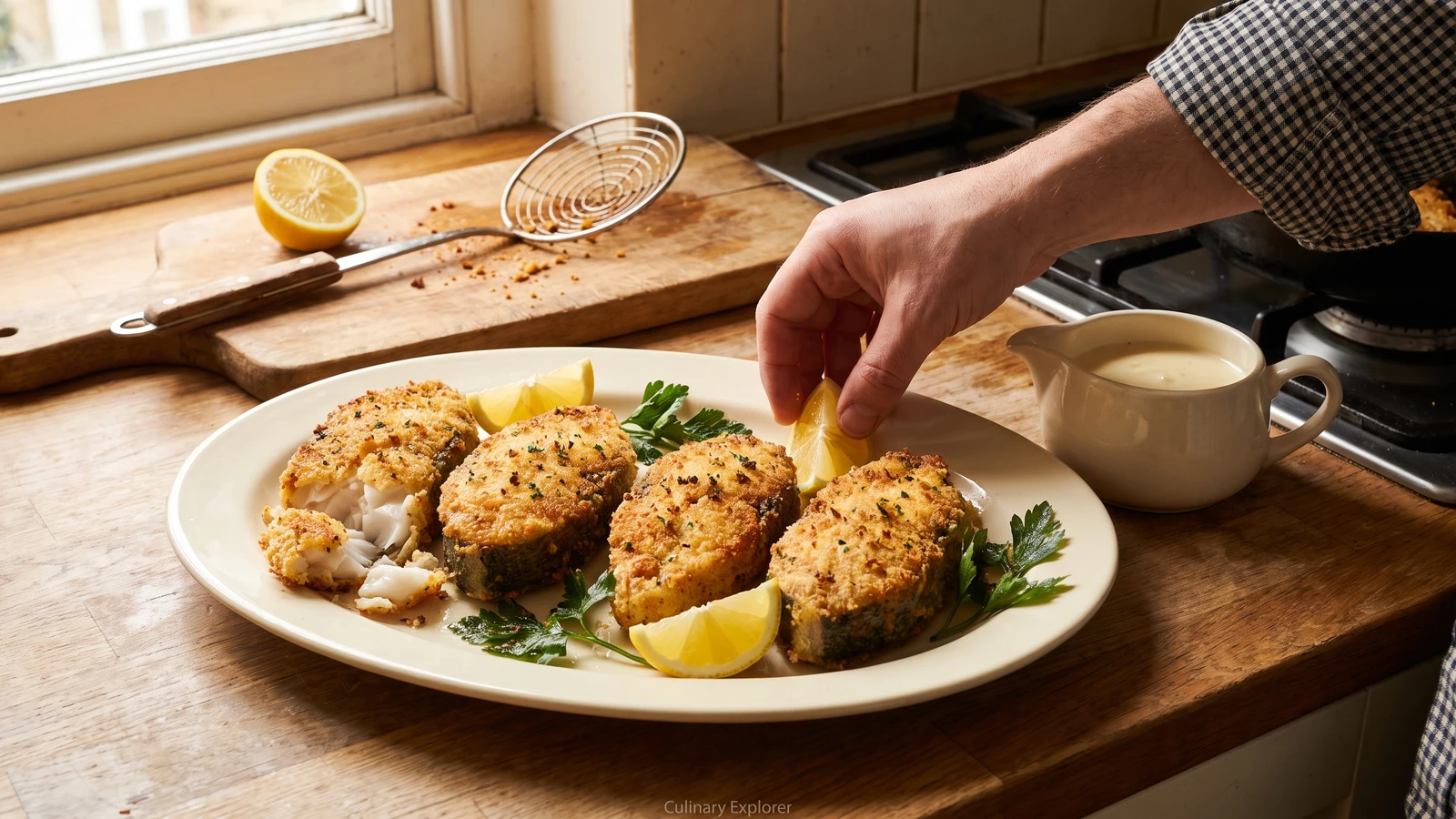
Cabillaud frit teaches the discipline of properly hot fat: thick cod steaks sealed in a close, crisp à l’anglaise crust, with pearly fish beneath and lemon at the table.
Cabillaud frit (fried cod) teaches the discipline of paner à l’anglaise, coating with flour, seasoned egg, and fine breadcrumbs before frying. The crust is not decoration. It must set the instant it enters properly hot fat, sealing the thick cod while the centre cooks pearly and moist. Start cool and the crumbs drink fat before they harden; the dish is decided before the fish has fried for a minute.
The classical entry assumed a fryer held at service temperature, Anglaise (for Egg-and-bread-crumbing) (No. 174) already prepared, and a saucier keeping Butter Sauce (No. 66) ready to send. At home, use a heavy pot and thermometer, prepare both referenced components before heating the fat, drain the fish on a wire rack, and fry two steaks at a time. The cloth-lined service dish and brigade portions are scaffolding; flour, Anglaise, fine crumbs, and truly hot fat are the dish and must stay. The quantities are reduced to four one-inch steaks and two manageable batches so the fat can recover between them. One cook, one stove, one evening.
The finished fish should wear a close golden crust that sounds crisp beneath the knife, with moist white flakes held inside. Before you touch the pan, settle a thermometer in the fat and wait until it reaches 180°C. That temperature, and the patience to restore it between batches, is the step that matters most.
Cabillaud frit belongs to the Parisian classical repertoire, built from cod carried inland from the Channel and Atlantic ports and from the professional kitchen’s exact vocabulary of coatings. In that vocabulary, pané à l’anglaise does not mean fish in a British-style batter; it means flour, seasoned egg, and breadcrumbs forming a sealed crust in hot fat. The dish passed easily from grand dining rooms to bourgeois tables because its principle needs no brigade, only thick fish, properly heated fat, lemon, fried parsley, and a sauce passed separately.
Quantity
4 steaks, 1½ pounds (680 g) total
each about 1 inch (2.5 cm) thick
Quantity
1½ teaspoons (7.5 ml / 9 g)
divided
Quantity
½ teaspoon (2.5 ml / 1 g)
Quantity
½ cup (120 ml / 60 g)
Quantity
½ cup (120 ml / 120 g) Anglaise (for Egg-and-bread-crumbing) (No. 174)
Quantity
1½ cups (360 ml / 150 g)
Quantity
1½ quarts (1.4 L / 1.3 kg)
for frying
Quantity
1 packed cup (240 ml / 30 g)
washed and dried bone dry
Quantity
1
cut into 8 wedges
Quantity
1 cup (240 ml / 240 g) Butter Sauce (No. 66)
| Ingredient | Quantity |
|---|---|
| centre-cut cod steakseach about 1 inch (2.5 cm) thick | 4 steaks, 1½ pounds (680 g) total |
| fine sea saltdivided | 1½ teaspoons (7.5 ml / 9 g) |
| freshly ground white or black pepper | ½ teaspoon (2.5 ml / 1 g) |
| plain flour | ½ cup (120 ml / 60 g) |
| Anglaise (for Egg-and-bread-crumbing) | ½ cup (120 ml / 120 g) Anglaise (for Egg-and-bread-crumbing) (No. 174) |
| fine dry breadcrumbs | 1½ cups (360 ml / 150 g) |
| refined peanut oil or clarified beef drippingfor frying | 1½ quarts (1.4 L / 1.3 kg) |
| flat-leaf parsley sprigswashed and dried bone dry | 1 packed cup (240 ml / 30 g) |
| large lemoncut into 8 wedges | 1 |
| Butter Sauce | 1 cup (240 ml / 240 g) Butter Sauce (No. 66) |
Run your fingertips over the cod and remove any loose pin bones. Blot every surface thoroughly, then season with 1 teaspoon of the salt and all the pepper. Leave the steaks for five minutes and blot them once more if the salt draws moisture to the surface. Wet fish loosens its coating and cools the fat, so dryness begins the crust before frying does.
Put the flour in the first shallow dish, the prepared Anglaise (for Egg-and-bread-crumbing) (No. 174) in the second, and the fine breadcrumbs in the third. Set a clean wire rack beside them. Keep one hand for flour and crumbs and the other for Anglaise; this small discipline prevents your fingers acquiring more breading than the fish.
Roll each steak lightly in flour and shake away the excess. Dip it completely into the Anglaise (for Egg-and-bread-crumbing) (No. 174), let the surplus drip away, then cover it with breadcrumbs, pressing gently around the edges and central bone so no wet patches remain. Set the coated fish on the rack. If you find a bald spot, touch it with a little Anglaise and patch it with crumbs now; once the fish reaches the fat, leave the crust alone.
Pour the frying fat into a heavy pot, filling it no more than one-third full, and attach the thermometer without letting its tip touch the bottom. Heat steadily to 180°C (355°F). Keep the pot handle turned inward, a fitted lid nearby, and water away from the frying station. Butter belongs in the sauce, not this pot; ordinary butter burns before the fat reaches the temperature the crust requires.
Lower two cod steaks into the fat, one at a time and away from you. Fry for 5 to 7 minutes, turning once if they are not fully submerged, while keeping the fat between 170°C and 180°C (340°F and 355°F). The crust should turn an even deep gold, and the fish should reach 63°C (145°F) at its thickest flesh, clear of the bone. If the fat falls below 170°C and the crust begins to look pale and oily, wait until the coating is firm, lift the fish to the rack, restore the fat to 180°C, and return it briefly to finish. Ça se rattrape. Drain the first batch on the rack while you bring the fat back to temperature and fry the second.
Let the fat settle at about 175°C (350°F). Lower the bone-dry parsley in two small batches with a long-handled spider and cover the pot with a splatter screen. Fry for 10 to 15 seconds, just until the leaves darken slightly and become crisp, then drain them on the rack and season with the remaining salt. If the fat snaps violently, step back and wait; the parsley still carried water, and adding another handful only makes matters worse.
Warm the Butter Sauce (No. 66) over the gentlest heat, whisking until smooth, but never let it boil. If an oily rim appears, remove it from the heat and whisk in 1 teaspoon of cold water until the sauce closes again. Arrange the cod on a warm oval platter with the fried parsley and lemon wedges, then pass the sauce separately while every crust is still crisp. À table!
1 serving (about 340g)
Culinary guides, cultural storytelling, and the editorial depth that makes cooking meaningful.
Discover Culinary ExplorerChef Juliette
John Dory has the delicacy of sole and the firmness of turbot. A light flouring, a quick butter sauté, and nut-brown beurre noisette show exactly why looks never mattered.

Chef Juliette
Fresh haddock proves its delicacy in the meunière pan: a fine flour crust, moist pearly flakes, and beurre noisette sharpened with lemon and parsley, ready from one skillet in half an hour.

Chef Juliette
Éperlans à l’Anglaise turns small fish into a lesson in disciplined coating: boned smelts under a close, crisp crumb, pan-fried in clarified butter and finished with bright, half-melted maître d’hôtel butter.

Chef Juliette
Tiny smelts, shallot, mushrooms, white wine, gratin sauce, and fine bread raspings meet a fierce oven, where the fish must turn tender in the same breath the buttered crust bronzes.